A freezer door is a rather undistinguished piece of laboratory equipment. It has no opinion about the tissue samples behind it, no appreciation of the years spent collecting them, and no interest in whether somebody has quite managed to shut it. Yet the door can tell a useful story before the thermometer does. That small interval is where Rees Scientific earns its place in a laboratory.
- What it sells: environmental sensors, monitoring software, and the services that keep both credible.
- Who buys: laboratories, hospitals, blood banks, biotech companies, and sample repositories.
- Why it matters: an early alarm can prompt action; a reliable record can explain what happened afterward.
The door, then the temperature
At Astoriom’s Research Triangle Park site, the difficulty was an aging monitoring system. Records lived on paper. Staff lacked remote access. The arrangement was poorly suited to expansion. In a company-published case study from October 2025, those limitations explain the decision to change. This was a failure of visibility and workflow, rather than a documented catastrophe involving ruined samples.
Rees installed monitoring for freezers and room conditions, but also for door activity, generator automatic transfer switches, and oxygen levels in liquid-nitrogen rooms. A failover node provided backup monitoring. The reported result was electronic recordkeeping and real-time visibility, with staff able to respond to events such as open doors and power interruptions.
The intriguing detail is the order of events. Sample Management Supervisor Katie Barnard describes a door alarm giving staff a chance to intervene before a storage unit warms up. A temperature threshold identifies an excursion. A door signal may help identify its cause earlier. For a repository entrusted with other people’s samples, that distinction has practical value.
“The system is there to let me know something is up.”
Katie Barnard / Sample Management Supervisor, Astoriom
From a Rees-published customer case study
- 01Door activityA sensor detects a condition.
- 02Alert deliveredThe assigned team is notified.
- 03Staff investigateA person checks the equipment.
- 04Response recordedThe event becomes evidence.
A thermometer with a memory
Rees Scientific sits in the instrumentation layer of healthcare and life sciences. Its customers need to know whether refrigerators, ultra-low freezers, incubators, cleanrooms, and other controlled spaces are behaving as required. Temperature is one measurement among several: humidity, differential pressure, gases, airflow, water leaks, and particles can also be relevant, depending on the installation.
The company began in 1982. Its automated monitoring originated with wired systems, and it still sells them alongside Zigbee wireless, Wi-Fi, and hybrid configurations. This persistence is sensible. A facility’s network, walls, equipment, and existing installation shape the choice of connection. The newest delivery method need not be the answer to every room.
Centron Presidio is the hardware and software family behind much of this work. Enterprise Centron handles centralized monitoring; ReesCloud offers hosted access; an All-in-One workstation provides a compact local option. Presidio software maintains reading and event histories, encrypted records, audit trails, and controls for electronic signatures. The product has to preserve the account of an incident as well as notice the incident itself.
monitoring inputs, at maximum expansion
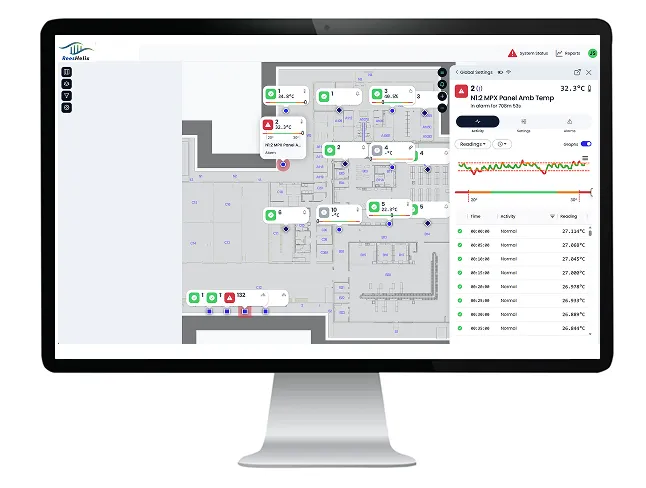
A hardware capacity specification, not a count of customers or installed sensors.Helix gives that work a newer interface: sensor readings on facility maps, comparisons with alarm limits, scheduled reports, and single sign-on through Microsoft Entra ID. Its cloud-native architecture includes email, text, and interactive phone alerts, with configurable escalation and optional redundant backup nodes. A map is useful here because a warning must be located before it can be investigated.
The van belongs in the product diagram
Software is the visible part when somebody opens a dashboard. Calibration is the reason to take the readings seriously. Rees also designs installations, validates systems, maps temperature-controlled spaces, trains users, performs preventative maintenance, and provides technical support. The service visit belongs in any honest account of what the customer purchases.
Rees reports more than 100 dedicated, factory-employed and factory-trained field technicians, with stocked service vehicles and regional support. That is a company-reported figure. Its relevance is straightforward: sensors exist in physical places, and physical equipment eventually needs attention. A laboratory’s relationship with its monitoring supplier can extend well beyond the installation date.
Calibration checks measurement accuracy against traceable standards. Validation has a broader assignment: documenting that the configured system performs as intended. Rees offers installation and operational qualification protocols, software validation, and calibration certificates. These services support a customer’s quality system; buying a dashboard does not, by itself, settle every question about a facility’s compliance.

The customer engineering can be specific. Rees’s September 2025 Duke University case study describes a 270-input hybrid installation, monitoring temperature, humidity, carbon dioxide, power, water detection, and differential pressure. It also describes custom controls and utility integration. The point is the variety: research facilities have operating requirements that resist a single shopping-cart configuration.
The full fridge has other ideas
A refrigerator displaying an acceptable temperature can still contain warmer and colder locations. Rees’s September 2026 guidance on chamber mapping explains another complication: the same chamber behaves differently empty and loaded. Product adds thermal mass and can obstruct airflow. An empty study establishes an equipment baseline; a loaded study tests a defined configuration closer to actual use.
This is the expertise behind the readings. Mapping helps identify where variation occurs and where routine monitoring probes should sit. Changes to shelving, loading, equipment location, or operating conditions may justify another look. The number on the display is an observation at one location. A mapping study asks what the rest of the space is doing.
EMPTYHow does the equipment behave?Establish a baseline and locate variation.
LOADEDWhat changes in actual use?Examine the effects of product and airflow.
Canyon Labs wanted easier access to its monitoring data and more internal mapping capability. Rees’s April 2026 case study describes continuous temperature and humidity monitoring, cleanroom differential pressure measurements, and cloud access. Engineers also helped develop a custom kit consolidating mapping hardware into one integrated system. The reported benefit included less reliance on outsourced mapping, although the account provides no quantified savings.
What the customer is actually buying
The commercial model combines configured hardware and proprietary software with ongoing services. Customers can use on-premises or SaaS deployment. When AEA Investors announced its acquisition of Rees in November 2022, alongside employee rollover investment, it emphasized the service network, long customer relationships, and highly recurring revenue. Keeping an installed system accurate and supported creates continuing work.
A public Canadian contract offers a concrete financial reference. The temperature-monitoring contract awarded to Rees on January 31, 2022, and ending March 31, 2026, had a total value of CAD 138,879.50 including amendments. That is the value of a particular government purchase across its contract period. It is not a price for one sensor or a standard quotation for an entire laboratory.
A useful comparison is Vaisala’s viewLinc, another continuous monitoring system for regulated environments. It too combines sensors, configurable alarms, reporting, calibration, and validation support. Those features therefore do not establish uniqueness on their own. Rees’s pitch centers on its regional service organization, customized installations, multiple delivery methods, and the continuity between equipment, software, and quality documentation.
The alarm still needs a person
The lessons travel beyond laboratories. Monitor likely causes as well as eventual consequences. Decide who receives an alarm and how it escalates. Keep records of the response. Test equipment under conditions representative of its use. Budget for maintenance and calibration alongside the purchase. These are practical inferences from the installations and services Rees describes.
The fit is strongest where sensitive assets and documented operating conditions justify a supported monitoring program. Success still depends on suitable sensor placement, working communications, validated configuration, and staff who can act. An alert cannot close a door. It can make the open door somebody’s immediate business, which is a useful achievement for an otherwise rather ordinary piece of hardware.