Three days is an awkward amount of time between switching on a quality management system and facing an auditor. Long enough to discover a problem. Short enough to wish you had discovered it earlier. In Dot Compliance’s account of its work with medical imaging company Nanox, that was the interval. The audit was passed. The more revealing detail is that Nanox had used Dot Compliance before, left, and then returned.
- The work: connecting life sciences documents, training, quality events and audit evidence.
- The wager: prebuilt processes can shorten the distance between buying software and using it.
- The next act: Dottie AI researches and reviews quality information, with people retaining critical approvals.
Six weeks to earn a second chance
Under QA director Dorit Nahari, Nanox chose to reimplement the system. Dot Compliance’s case study describes six weeks of work, 700 migrated documents and a deliberately narrow first phase: document management, training and migration. Workshops, demonstrations and an audit binder helped the team prepare. There was resistance to overcome; support and visible usefulness helped secure adoption.
The story is worth keeping beside any enterprise software proposal. A return customer has already encountered the product outside a demonstration. Winning that customer back requires a case for what will work this time. Here, the case was made through a bounded project and considerable human effort. An audit pass is the reported outcome of that particular deployment, rather than a promise attached to every subscription.
The signature is only half the story
Dot Compliance makes an electronic quality management system, or eQMS, for organizations whose products require dependable, traceable processes. Its customers include pharmaceutical developers, biotechnology businesses, medical device makers and clinical research organizations. The software is part of the machinery behind their work: the controlled procedure, the training record, the investigation that must be completed and the evidence someone will eventually ask to see.
Consider a standard operating procedure, usually shortened to SOP. A revised document needs review and approval. The correct version must reach the correct people. Those people may need new training. Later, a quality team must be able to establish what happened and when. A shared folder can hold the file; coordinating the surrounding obligations is the larger job.
Dot Compliance’s document controls include version histories, approval workflows, electronic signatures and access permissions. Its document and training functions connect, so an approved revision can generate training tasks for the relevant employees. The training tools also support assessments and expiring qualifications. The useful unit is the relationship between a procedure and the evidence that someone learned it.
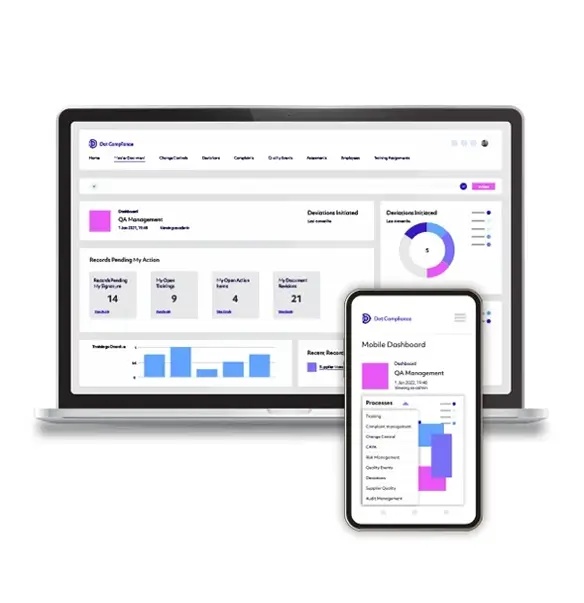
Another connection runs through CAPA: corrective and preventive action. Dot Compliance links these records to deviations, complaints and audit findings, assigns tasks and tracks deadlines. That gives a team a way to follow an issue through investigation and corrective work. A tidy dashboard has value only if the underlying actions are owned, completed and checked.
The wider portfolio includes supplier quality, risk, equipment and electronic batch record processes. Regulatory management covers registrations, dossiers and correspondence; clinical management addresses study planning, documentation and reporting. These are tools for administering regulated work. Their appeal is the possibility of fewer gaps between departments that otherwise maintain their own records.
Software with the furniture already in it
Dot Compliance’s positioning rests on the starting point. Its eQMS arrives with preconfigured processes and validation documentation. The buyer can begin with an existing arrangement of workflows rather than commission every piece of furniture. That matters most when a quality team needs usable controls soon and lacks the appetite for a long design exercise.
Satsuma Pharmaceuticals offers a good example. Its existing eQMS was insufficient for the move toward commercial operations. In the published customer account, users tried Dot Compliance’s modules and discussed questions with the vendor weekly. Supplier qualifications and immediate usability mattered. QA and compliance leader Janera Harris said, “We did not need to customize the product.” The buying decision followed a practical test.
“We did not need to customize the product”
Janera Harris / Satsuma Pharmaceuticals
The platform underneath is Salesforce. Dot Compliance says buyers need neither existing Salesforce licenses nor prior Salesforce experience. For an organization already familiar with that ecosystem, the native foundation can be attractive. For another, the question is whether the platform fits its integration and administration needs. Familiar plumbing is useful when it serves the house.
This is a competitive market. Veeva Vault QMS offers life sciences quality processes on the Vault platform. MasterControl also offers preconfigured or configurable workflows and validation support. Qualio and Intellect are further alternatives. Documents, CAPA and audits are shared territory. Dot Compliance’s particular combination is packaged life sciences processes, a Salesforce foundation and its own AI offering. A serious comparison should examine the buyer’s actual workflow, migration needs and total operating cost.
First the records. Then the reader.
In April 2023, Dot Compliance announced generative and predictive AI within its eQMS. In April 2024, founder and CEO Doron Sitbon described the strategic ambition succinctly: “Dot Compliance is transforming into a data company.” The funding announcement also outlined a hybrid, vendor-agnostic direction for working across quality systems. That was a stated product strategy, not evidence that every integration was already available.

Portrait: Natalia Gorji Photography / Dot Compliance.
Its April 21, 2026 news entry announced Dottie AI 5.0 and agentic personas. The current Dottie page describes research and review agents, plus a document-to-protocol function. Organizations can define an agent’s domain, duties, training materials and boundaries. The system is designed to ground output in source material and pause for expert approval before critical steps.
The interesting design question is authority. A useful assistant might assemble evidence or identify a gap, while a quality professional decides what it means. Buyers should examine that handoff during a demonstration: can the reviewer inspect the supporting record, challenge the output and see which actions require approval? Those are more informative tests than how confidently an assistant writes.
The money buys time. So does the software.
Dot Compliance announced a $23 million Series B in July 2022, led by Israel Growth Partners with Vertex Ventures and TPY Capital participating. A $17.5 million extension followed in April 2024, co-led by IGP and Vertex with TPY participating. The later announcement put total funding at approximately $50 million and earmarked proceeds for AI development, product work and customer acquisition.
Funding amounts, not revenue or customer subscription prices.
The operating model is B2B software subscriptions supported by consulting, implementation and technical assistance. The company says its validation documentation package is included in the subscription. A buyer should request a quote covering the intended modules, user population, migration, integrations and services. The cost question is larger than the license: whose time will the project consume, and which work will become easier afterward?

The company reports more than 500 customers across 30 countries. Its stated values include customer success, urgency and employee empowerment. Those are intentions; the deployment stories provide more tangible clues about how the work gets done. Consulting, training and support sit alongside the software because installing a system and persuading an organization to use it are different tasks.
Borrow the sequence, not the deadline
VLE Therapeutics’ published account describes a two-phase approach: documents and training first, CAPA and deviations later. Scientia Clinical Research moved paper-based training and deviation processes into the cloud within a few weeks. Milouda Laboratories centralized document, change and training management across three sites. Different organizations, related sequencing problems.
The transferable lesson is to choose a first phase that people can finish and use. Give someone responsibility for the migration. Test representative records and approvals. Rehearse how evidence will be retrieved. Satsuma’s hands-on evaluation offers another useful habit: let the people who will operate the system try their real tasks before the buying decision.
These lessons depend on conditions. Preconfigured processes must fit the organization closely enough to be adopted. The team needs time for data cleanup, training and validation. An organization requiring extensive bespoke workflows or full control of its own infrastructure has a different purchasing problem. The six-week example should prompt questions about scope, rather than become an imposed deadline.
Dot Compliance’s own guidance says compliance remains a shared responsibility: customers must document system use, train users and maintain validation. That is a fitting end to the comeback story. Ready-to-use software offers a head start. The customer still has to run the organization that uses it.