The life-science industry has a peculiar relationship with paperwork. A medical device can contain elegant engineering, a therapy can rest on years of careful science, and then the proof that everything was done correctly winds up scattered across a spreadsheet, an inbox and a folder named FINAL_v7. For an auditor, the product is only as trustworthy as that trail. For the team building it, the trail can become the work.
Qualio sells a way out of that mess. Its cloud platform brings controlled documents, employee training, suppliers, audits, corrective and preventive actions, design requirements, product risks and test evidence into one connected system. More recently it has added regulatory frameworks and AI-assisted gap analysis. The buyer is not the ordinary office manager. It is the quality leader who knows that one missing approval can delay a launch, trigger an audit finding or send half the company searching for evidence.
The pharmacist who disliked the filing cabinet
Robert Fenton did not come to quality software from generic enterprise IT. He studied pharmacy at University College Cork, practiced as a community pharmacist, then worked in quality and research roles at Pfizer and LEO Pharma. The recurring contradiction was hard to miss: companies promised that products going into or onto a human body were safe and effective, yet the machinery for demonstrating that promise was slow, fragmented and often manual.
He founded Qualio in Ireland in 2012 and bootstrapped it for several years. In 2016, after an Enterprise Ireland program brought him to Silicon Valley to meet customers and investors, he moved to San Francisco. The company retained the habits of a distributed operation. Long before remote work became a corporate emergency, Qualio was hiring across locations and replacing office overhead with periodic team gatherings.

That history mattered in 2020. Qualio closed an $11 million Series A led by Storm Ventures without a single in-person investor meeting. Less than a year later, Tiger Global led a $50 million Series B, joined by Menlo Ventures and existing backers. Qualio had reached 250 customers and 100 employees. The money was earmarked for global customer expansion and a larger product and engineering organization. Public funding records put total capital at roughly $64 million; no current valuation has been announced.
First, control the documents. Then connect the work.
The early product digitized the familiar bones of a quality system: documents, approvals, training and audit trails. Qualio then moved into events such as complaints, nonconformances and CAPAs; supplier oversight; analytics; and change control. The important shift came when it pushed upstream into design controls. Medical-device and software-as-a-medical-device teams could link user needs to product requirements, risks, tests and results, then generate the traceability records regulators expect.
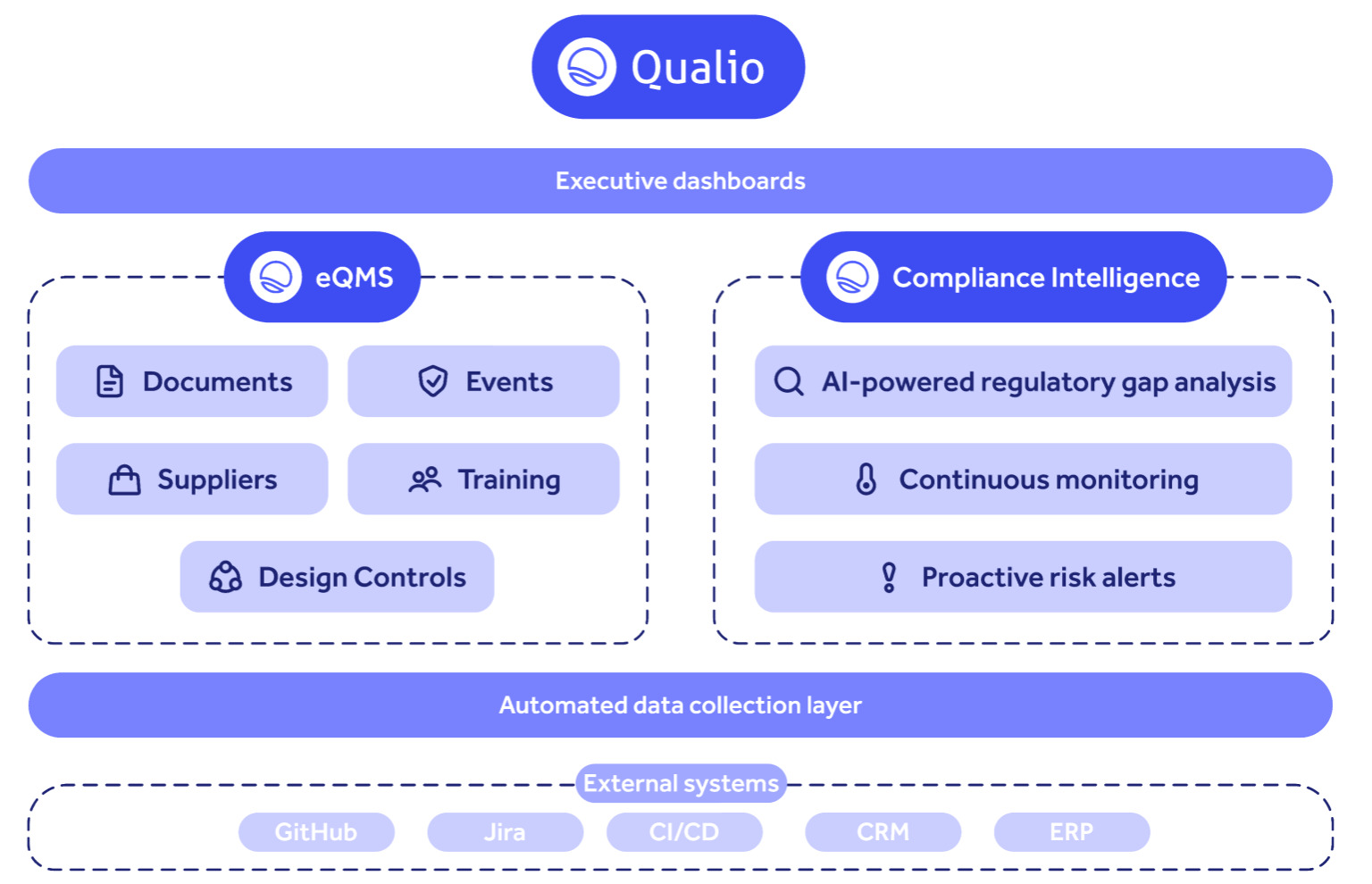
By June 2025, Design Controls had an interactive traceability view, visual flags for missing or stale connections, more flexible product structures and one-click review-file generation. Integrations pulled work from Jira, GitHub, GitLab, Azure DevOps and test platforms; customer complaints could flow from Salesforce, HubSpot, Intercom or Zendesk into a quality event. Qualio says it now offers more than 20 self-serve integrations.
The evidence loop
Requirements, tests, releases, complaints
Risks, controls, owners, approvals
Traceability, gaps, audit records
This is where Qualio differs from a generic document manager. The point is not merely to put PDFs in the cloud. It is to preserve the relationship between a product decision and the evidence that justifies it. Compared with broad governance tools such as Vanta, Drata, SAP or ServiceNow, Qualio arrives with life-science workflows and frameworks. Compared with direct QMS rivals such as MasterControl, Greenlight Guru, Veeva Vault Quality, ETQ Reliance and Arena, it leans on usability, startup-to-scale adoption and connected product development.
What broke first was the scavenger hunt
Customer stories make the pain more concrete than a feature list. At eClinical Solutions, growth, international operations and remote work exposed the ceiling of a paper-based system and a later content platform. Staff could take 15 steps to connect an SOP with the relevant work instruction, form and template. Audit tracking remained manual. The company faced more than 50 customer audits each year with a small quality team.
“Our audit tracking and trending was all manual.”Evan Grunbaum, eClinical Solutions
The team’s mind changed when scale turned inconvenience into headcount. After adopting Qualio, eClinical gave auditors rapid access to a library of 325 controlled documents, onboarded 100 more users in a year and estimated that the system avoided work equivalent to three or four full-time salaries. At global CRO Linical, the platform grew beyond 950 users. Warehouse Anywhere made its move after a large contract imposed quality demands its Word-based system could not support; the company later attributed millions of dollars in new life-science revenue to removing that bottleneck.
Those percentages are Qualio’s aggregation of customer results, not a promise that every deployment will reproduce them. Still, they reveal what buyers are paying for: fewer document chases, less consultant time, faster audit preparation and a shorter road to market. Qualio sells B2B subscriptions through Foundation, Growth and Scale plans. Prices are quote-based, an implementation fee applies, and users, regulatory frameworks and add-ons vary by plan. In other words, the cost arrives through a sales conversation, not a checkout button.
That makes the purchase less like choosing a note-taking app and more like replacing a piece of operating infrastructure. Validation, migration, permissions, templates and staff training all belong in the budget. Qualio tries to reduce that burden with prebuilt content and a vendor-led assurance package; it says only 1 percent of customers choose to validate the software themselves. Review-site data places typical implementation around three months, although simple customer deployments can move faster. One medical-device customer reported contacting Qualio in November, going live in December and obtaining ISO 13485 certification the following July.
Market position depends on company stage. A startup wants a credible quality system without hiring an army of administrators. A scaling device maker needs design traceability and stronger supplier control. A global CRO needs hundreds of users to find the same approved record quickly. Enterprise pharma may compare Qualio with broader suites that offer deeper customization but demand longer implementation. Qualio’s sweet spot is the team that has outgrown shared drives yet still values software people outside the quality department will willingly open.
The AI can inspect the map. A human signs it.
In September 2025, Qualio launched Compliance Intelligence. It maps a company’s evidence against expert-built regulatory frameworks, runs gap analysis, reuses evidence across overlapping standards and monitors for emerging risks. Qualio says a scan takes 30 to 40 minutes and that early users cut audit preparation from more than 20 weeks to fewer than four. Reported early outcomes also include annual consultant savings of $150,000 to $300,000.
The guardrails matter more than the adjectives. Qualio says the model runs in its private cloud, customer data is available only for the prompt and is not used for training, and assessments preserve audit trails. Frameworks are created by its quality experts and reviewed externally. The company tests for reliability, confidence and hallucinations. Most important, it says a process owner must review and validate the output. This is not an autonomous regulator in a box.
Where the pitch meets reality
Qualio’s AI can point to a missing control or weak evidence. It cannot own the risk, understand every undocumented practice or approve a regulated decision. The customer remains accountable for the quality system.
The company’s 2026 direction pushes further, from software that stores records toward agents that take governed actions. Even its release process shows the tension. Ordinary SaaS teams ship whenever code is ready; regulated customers need time to assess and validate change. Qualio now bundles major updates into quarterly “launch trains,” with notice and documentation before production. Speed, in this market, needs a timetable.
The playbook worth copying
A buyer does not need to imitate Qualio’s entire stack. The useful method is to begin with the evidence trail. List where requirements, tests, risks, complaints, training records and approvals actually live. Mark every manual handoff. Then price the current system honestly: audit-prep weeks, consultant bills, duplicated review, delayed launches and the quality headcount required to keep everything current.
Draw the path from product decision to regulatory proof.
Count the hours spent finding, reconciling and reformatting evidence.
Automate the expensive breakpoints, not every possible workflow.
Assign human owners to review gaps, exceptions and AI output.
The approach fails under predictable conditions. A lightly regulated team may be buying a cockpit for a bicycle. A company that refuses to move work out of private spreadsheets will create an expensive second archive. Teams needing a self-hosted Jira connector should note that Qualio’s current integration supports Jira Cloud only and reads from Jira without writing back. And anyone expecting AI to replace accountable quality professionals has misunderstood both the product and the regulations.
Qualio’s strongest idea is less glamorous than “agentic compliance.” Quality evidence should emerge from ordinary work, remain connected to the decision that created it and stay ready before the auditor sends a calendar invite. The company began by taking paper out of the cabinet. Its larger bet is that compliance can stop being a season.