Regulatory affairs is where a product meets the burden of proof. A medicine or device may be ingenious, but ingenuity does not organize a dossier, reconcile years of evidence or keep a submission current across markets. The work is procedural, dense and consequential. Sonia A. Veluchamy has made a career inside that machinery. First she learned how a global life-sciences software business operated. Then she and her sister built Celegence around the stubborn gap between knowing a rule and doing all the work the rule requires.
Veluchamy is the CEO; her sister and co-founder, Punya Abbhi, is the COO. They launched the company at the end of 2017 after careers that approached the same industry from different doors. Veluchamy had spent close to a decade as managing director of ArisGlobal, the life-sciences technology company she has described as their family business. Abbhi came from management consulting, technology implementations and product launches. One knew the operating engine. The other knew how to translate a complicated process into a buildable system.
Their timing was useful. Pharmaceutical and medical-device companies faced expanding documentation demands, fragmented data and teams stretched across specialized work. The founders did not begin with a sweeping promise to replace those specialists. Celegence began as a tech-enabled regulatory service. Its people helped companies with strategy, intelligence, submissions, publishing, data and medical writing. Software entered where the work exposed repetition worth removing.
The apprenticeship before the pitch
Veluchamy's education looks almost suspiciously well fitted to the job she eventually chose: a BA in economics from the University of Chicago, followed by an MBA in finance and entrepreneurship from Columbia Business School. Yet the sharper education came through operations. At ArisGlobal, she led a company serving life-sciences organizations with software for drug development and compliance. During her tenure, she helped expand its customer base to 30 of the world's top 50 pharmaceutical companies.
In 2016, discussing an update to ArisGlobal's safety platform, Veluchamy framed the product around a familiar operational advantage: keeping clients prepared for changing industry requirements. The language was not about novelty for its own sake. It was about readiness. That instinct traveled with her to Celegence.
The original opportunity was a seam in the market. Companies could possess regulatory intelligence and still struggle to turn it into compliant, repeatable operations. A rule may be known, yet the data remains scattered. A team may understand the submission, yet lack the bandwidth to assemble it. Veluchamy and Abbhi built at that seam, pairing onshore and offshore expertise with technology that could make the process more efficient.
“We saw an opportunity to bridge the gap between process and technology by offering this industry tech-enabled services.”Sonia A. Veluchamy
The phrase “tech-enabled services” is easy to glide past. It contains the whole operating philosophy. Service work places the company beside the customer's mess. The team sees the odd exception, the inconsistent source, the deadline that collides with another deadline. Those encounters supply better product questions than a generic brainstorming session ever could.
Let the customer open the next door
One early customer did exactly that. Celegence was helping pharmaceutical clients navigate requirements including IDMP, a framework for standardizing medicinal-product information, and the European Union's Medical Device Regulation. A pharma customer asked whether the same team writing its drug documents could also prepare clinical evaluation reports for its devices. The request moved Celegence deeper into medtech.
It was an expansion plan disguised as paid work. The adjacent need matched capabilities the firm already had: scientific writing, regulatory interpretation, project management and document control. Celegence followed the demand and widened its range, eventually supporting companies from regulatory strategy through publishing, submissions, data services and lifecycle maintenance.
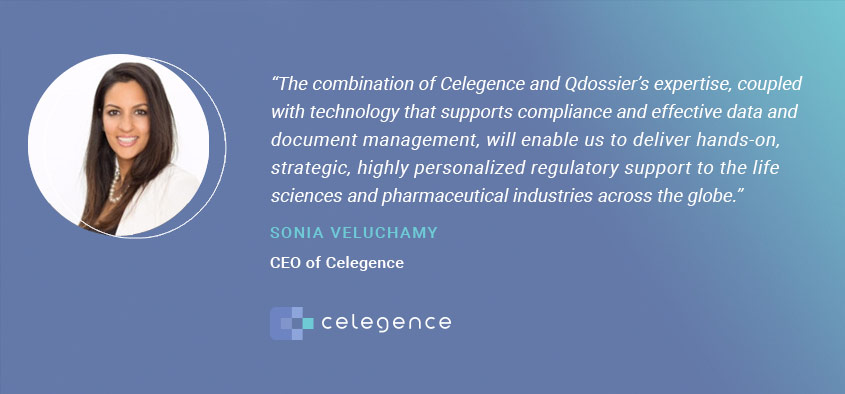
In 2022, the company made the logic geographic as well as operational by acquiring Qdossier, a Netherlands-based provider of regulatory services and technology for pharmaceutical document and dossier management. Veluchamy said the aim was to build a stronger global footprint capable of supporting companies of different sizes. The transaction added people, expertise and mature tools rather than merely another logo for the slide deck.
Automation starts with the boring bit
CAPTIS, Celegence's AI-enabled platform for regulatory literature and document work, began with a wonderfully plain question. Which parts of recurring clinical and performance evaluation reports did the company's own writers find monotonous and time-consuming? Literature review rose to the top. Writers had to search, screen and appraise papers, extract data, manage references and then update long documents on a schedule.
The task had features automation likes: identifiable inputs, structured stages and outputs that humans could inspect. It also had something generic AI demos often avoid: accountability. An elegant paragraph is of little value if the supporting evidence cannot be traced. Celegence put engineers and medical writers in workshops together, then expanded CAPTIS from literature review into data extraction, reference management, templates, document authoring and dashboards.
The Celegence build loop
Veluchamy's public argument for adoption begins one step earlier than the software. Companies should establish sound processes and data governance before they automate. Otherwise technology simply helps disorder travel faster. In her 2024 conversation with the Empowered Patient Podcast, she urged medical-device companies to invest in the frameworks that make compliance manageable and reduce expensive remediation later.
“Winning this award is a testament to the hard work and vision of the CAPTIS team.”Sonia A. Veluchamy, after TOPRA's 2024 recognition
The award mattered because it recognized a team, not a mythology. CAPTIS won TOPRA's 2024 Innovation Award; Celegence's cloud-based dossier tool, Dossplorer, was also a finalist. Veluchamy pointed to the team's effort. Abbhi emphasized years of work with clients and internal writers. Their accounts make innovation sound like what it usually is: people with different vocabularies agreeing on a better sequence of steps.
The people work runs in parallel
There is another line through Veluchamy's record, far from dossiers but close to her operating instincts. For 15 years, from 2005 through 2020, she served as a board member and founding mentor at LAUNCH U, a Chicago college-and-career preparation program for high-achieving students with limited resources. The program helped guide more than 1,400 students toward postsecondary goals. In 2024, she joined the board of Commit2Change, an organization focused on education for girls.
Mentoring and regulatory consulting sound unrelated until one notices their shared verb: navigate. Both begin with a complex institution, unequal access to its unwritten rules and a person trying to move through it. Veluchamy's roles at YPO's Chicago chapter and The Economic Club of Chicago add a third element, the networks through which operators trade hard-won context.
By late 2025, Celegence said it had grown to more than 175 employees worldwide and worked with more than 100 pharmaceutical and medical-device organizations. That year the company joined the Inc. 5000 with reported three-year growth of 117 percent, while Crain's Chicago Business named Veluchamy among its Notable Leaders in Health Care Technology.
Her response to the Crain's recognition was characteristic. She wrote about the company's commitment to automation and AI, then shifted the spotlight to her colleagues: “I am proud of the entire Celegence team whose everyday dedication make our accomplishments possible.” The grammar is less important than the habit. In work built across disciplines and continents, the plural pronoun is an operating fact.
A useful limit on the machine
The more interesting part of Veluchamy's AI thesis is its limit. Celegence presents technology as support for expert judgment, not a substitute for it. In regulatory work, output must be scientifically grounded, traceable and defensible. Fluency is the beginning of review, not the end. At RAPS Convergence in 2026, the company planned to discuss this division of labor directly: where AI-assisted drafting belongs, where human expertise belongs and how to judge whether the result can survive scrutiny.
That position is commercially shrewd because it respects the customer's actual fear. A regulatory leader is not worried that software will fail to produce enough words. The worry is that it will produce plausible words with weak provenance, and that the weakness will surface when the stakes are highest. A tool earns its place by making evidence easier to inspect, not by making uncertainty prettier.
Veluchamy's career offers a modest playbook for other founders. Learn the backstage before selling transformation. Use service delivery as a listening device. Follow adjacent demand when it matches an existing strength. Automate a bounded pain before promising an autonomous future. Preserve the human who must answer for the result.
This is not the loudest version of an AI company. It may be the more durable one. Celegence grew from a field where the paperwork is part of the product and the fine print can determine whether years of work move forward. Veluchamy chose to make that fine print legible, structured and a little less punishing. There are grander pitches. Few are as satisfyingly specific.
Continue reading
- Sonia Veluchamy at Celegence
- Sonia Veluchamy on LinkedIn
- The Celegence founders on the company's journey
- Gens & Associates interview with Sonia Veluchamy and Punya Abbhi
- Empowered Patient Podcast interview and transcript
- pharmaphorum podcast with Sonia Veluchamy
- CAPTIS and the 2024 TOPRA Innovation Award