At Wellington Foods, making the product was only part of getting it out the door. The contract manufacturer’s post-production review once took 10–15 days. A batch could be finished while its record continued its own leisurely journey. Paper, it turns out, has an excellent talent for making everyone else wait.
The company’s MasterControl case study reports that digital records shortened that review to 72 hours. The mechanism was practical: templates checked entries, flagged mistakes, and linked access to current training. Quality staff could review exceptions instead of hunting through every page. The queue had become a design problem.
- MasterControl connects quality rules with production records and equipment management.
- It reached more than $100 million in ARR before its first announced outside funding.
- The lesson for operators: measure the waiting around finished work.
The temporary boss and the permanent problem
MasterControl began in 1993 as Document Control Systems. Its later CEO, Jon Beckstrand, did not arrive bearing a garage invention. In his account of taking charge, his father Richard bought the company outright in 2002. Jon expected a temporary assignment. When an employee asked who was in charge, he replied, “I guess I am.”
The interesting decision came afterward. General document management gave way to a focus on life sciences, where quality problems were more urgent and complicated. A pharmaceutical procedure is consequential reading. The company’s mission became helping customers bring life-changing products to more people sooner. There was a larger purpose for the electronic filing cabinet.

By December 2022, MasterControl had grown to more than $100 million in annual recurring revenue. It then announced a $150 million Series A from Sixth Street Growth at a $1.3 billion valuation. The rationale was faster QMS and manufacturing product development, plus investment in AI. Customer-funded growth had established demand; capital would fund the next expansion.
Three systems, one awkward handoff
Consider three questions on a production floor. Is this the approved procedure? Is the operator trained to perform it? Is the equipment fit for use? Separate records can answer each. The awkwardness begins when somebody must assemble the answers while production is moving. MasterControl sells software for those handoffs.
Quality Excellence manages documents, training, changes, audits, risk, and quality events. A revised instruction can move through approval and training workflows. Teams can track deviations and corrective actions. The expertise here is in controlled work: who did what, using which version, with what evidence. A shared folder leaves rather more to memory.
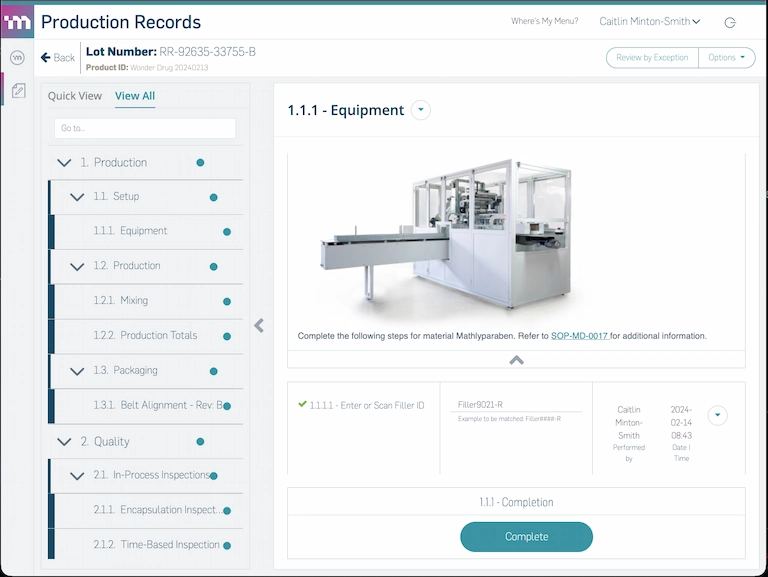
Manufacturing Excellence, launched in 2019, takes that logic into production through electronic batch records, device history records, and logbooks. It captures the work while it happens. A record becomes an active participant, able to check an entry, rather than a passive witness consulted after the mistake has acquired a signature.
In March 2025, MasterControl acquired Qualer, adding cloud asset management, calibration, and maintenance capabilities. The connection makes sense: a production record needs context about the instrument that supplied its measurement. Asset Excellence extends the portfolio to equipment condition and upkeep, alongside quality and manufacturing.
procedure
operator
record
equipment
MasterControl’s proposition: connect the records that establish whether the work was done correctly.
Customers include Pfizer, Cochlear, Thermo Fisher Scientific, and WD-40. The market spans pharmaceuticals, devices, supplements, and other regulated manufacturing. Alternatives include Qualio, TrackWise, and Veeva. Qualio pitches a leaner quality system to growing life-sciences firms. MasterControl’s case rests on the breadth of its connected portfolio, especially when production itself needs digitizing.
The bill includes the change
The commercial model uses named-user licenses for Quality Excellence and Manufacturing Excellence, with different rights and modular packages. Buyers obtain tailored quotes. Validation tools are included; additional validation training and support can be purchased. The buying decision therefore involves both software scope and the work of introducing it.
A useful implementation has to identify approved procedures, decide who owns each record, train users, and connect the necessary data. These are operating decisions. Digitizing a muddled handoff can leave a very legible muddle. The attractive number is time recovered; the less photogenic expense is getting people and processes ready to recover it.
The same attention to learning appears in MasterControl’s own published workplace programs: mentoring, leadership training, and internal promotion. Those programs describe its intentions rather than prove every employee’s experience. Still, they suit a company whose product asks customers to change familiar habits. Teaching someone a new screen is a small part of teaching an organization a new way to work.
An Aspire Pharma integration example offers a manageable starting point. MasterControl and Elemental Machines describe sending balance readings directly into batch records, removing manual transcription. The accompanying advice is to begin with a tangible use case. Follow one measurement, establish where errors enter, and measure the improvement before attempting the entire factory.
“What makes a quality product better is being able to focus on the work, not the paper.”
Robin Joyner · Wellington Foods
An AI that can show its working
MasterControl’s assistive AI tools generate training questions, summarize documents, and help teams query regulations. Humans remain in the loop. Its September 2026 research commentary makes a more particular argument: analytical answers should follow governed, repeatable procedures. If a count is 17, a convincing paragraph is insufficient. The reader needs the route to 17.
The deterministic-analytics approach uses a small set of defined operations rather than allowing a model to invent its analytical method. This is research, with explicit limits: missing records or a wrongly interpreted question can still spoil an answer. Stable definitions, data, and procedure versions matter. That is a useful discipline for any team buying AI.
In September 2025, MasterControl reported more than $200 million in ARR and over 1,250 customers across nearly 40 countries. David Edwards became CEO in April 2026; Beckstrand moved to board chair. The company’s next chapter has plenty of fashionable technology. Its practical test remains pleasantly unfashionable: can a finished batch spend less time waiting for its paperwork?