The first reliable trace of Menley Stewart's technical life arrives not in a software repository, but in a theater at the Hill Aerospace Museum. It is May 2014. A Brigham Young University team is presenting a NASA-supported experiment about measuring launch-vehicle sound. Rockets are impolite subjects: their noise is broad, forceful and difficult to capture cleanly. The group's method promised accurate intensity measurements across a wider frequency range. Stewart was one of five presenters named on the program.
That early credit supplies a fitting overture. Stewart would later work as a software engineer at MasterControl, where the objects being organized are documents, manufacturing records and quality workflows rather than pressure waves. Her current professional profile also places her with Hello World Co-Op DAO, a small cooperative technology venture. The settings could hardly look more different. Yet the same practical question keeps turning up: how do you extract something dependable from a complicated system?
Her public biography is concise. The experiments are not. They involve loudspeaker arrays, military-jet recordings, controlled blasts, microphones, an aerospace museum and a box built to keep airborne sound out. It is a career best understood through apparatus.
A career begins in the pressure field
Acoustic intensity is not merely a synonym for loudness. It describes the flow of sound energy, including direction. Measuring it around a launch vehicle means dealing with a wide band of frequencies and enough unruly physics to make ordinary methods feel underdressed. The 2014 project tested a phase and amplitude gradient estimation method, known as PAGE, against loudspeaker arrays. The formal description is dense. The underlying impulse is plain: build a better way to see where sound is going.
By 2018, Stewart's name appears in a second corner of acoustics, this time in the preparation and completion of a formal listening study. Researchers wanted to understand the “crackle” in high-powered jet noise, the abrupt quality produced by acoustic shocks. Thirty-one people listened to fifteen short recordings from a tied-down F-35A and sorted or rated them by perceived crackle. The work found a strong relationship between those judgments and a statistical measure called derivative skewness.
There is something wonderfully human about the experiment. Advanced acoustics still had to pass through ordinary ears. A graphical interface presented the samples. Participants could replay them as often as needed. Behind the scenes, researchers normalized loudness, chose representative three-second snippets and made the test comparable. Stewart and Sarah Shaw were thanked for helping prepare and complete the study. Scientific findings often arrive under a few names; functioning experiments rely on more hands.
Crackle, sketched
A smooth waveform rises politely. Acoustic shocks announce themselves with abrupt pressure changes.
The useful signal is rarely the loudest thing in the room.A through-line from Stewart's acoustics work to software engineering
Eight forty-eight on a Saturday morning
On October 13, 2018, at the American Physical Society's Four Corners Section meeting in Salt Lake City, the general-physics session began at eight. Carbon fullerenes came first. Two talks on noisy vacuum-assisted toilets followed. At 8:48 a.m., Stewart, Julio Escobedo and Grace McKay were scheduled to present “Measuring directionality of small-scale explosions.” They had twelve minutes.
A conference timetable can make inquiry look comically orderly. Explosions from 8:48 to 9:00; materials discovery immediately after. But the title points toward fieldwork that was anything but abstract. In the summer of 2018, the BYU group joined scale-model explosion experiments designed to study acoustic and seismic signals. One setup used oxy-acetylene-filled balloons on the ground. Another used buried charges. The larger aim was to understand how explosive events send energy through earth and air, knowledge relevant to interpreting volcanic activity.
A paper from the project thanked Stewart among the undergraduate students who helped with the experiments. Its signature object was a portable soundproof box. A microphone placed inside was meant to ignore sound arriving through the air and detect vibration traveling through the ground before coupling back into air. The box used mass-loaded vinyl, composite board, adhesive, foam and, during calibration, a concrete block. It resembles engineering in its most persuasive form: a difficult question reduced to a thing that can be built, carried and tested.
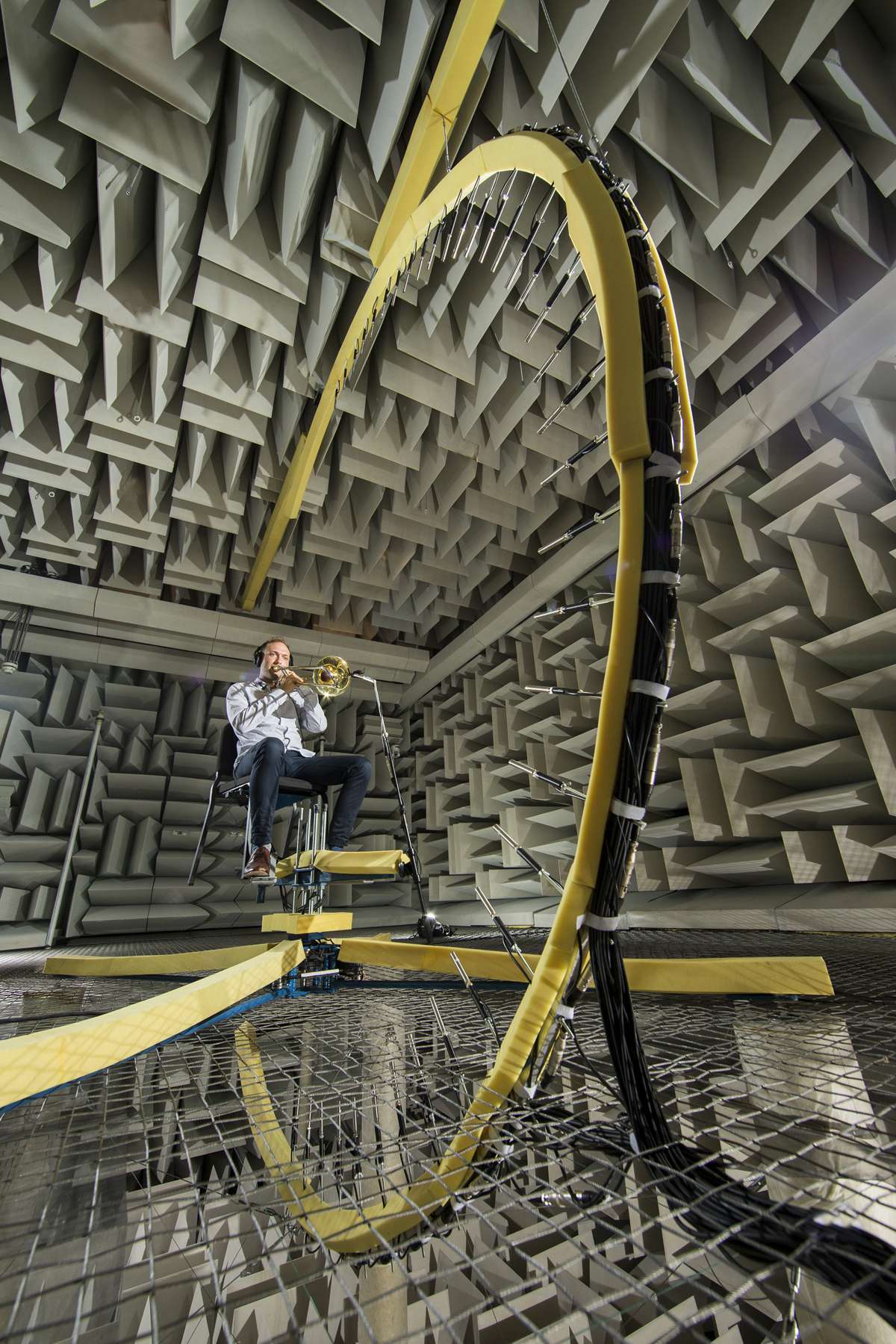
Stewart's work around the department was not limited to research tests. She is listed among the volunteers who supported Sounds to Astound, BYU's acoustics outreach show. The program used demonstrations to make sound physical and visible for audiences. Acoustics has a theatrical advantage over many technical disciplines: flames can dance, tubes can resonate and a room can make echoes disappear. The subject invites wonder before it asks for equations.
The outreach credit also reveals the social side of technical work. A demonstration has to survive outside the laboratory. It must be safe, repeatable and clear enough that a child at the back of a room can understand what changed. A research instrument may be designed for precision; an outreach instrument needs precision plus timing, explanation and a little showmanship. The published account of Sounds to Astound names a long roster of student volunteers, Stewart among them, because the performance depended on preparation that an audience would never see.
Her education likewise crossed institutional lines. Her professional profile lists Brigham Young University for the period that contains the acoustics work and Utah Valley University from 2018 to 2022. UVU's 2022 commencement program records her as Menley Stewart-Hawkes. It is a small documentary detail, but a useful one: while one strand of the public record still carried the name Stewart and another used Hawkes, the commencement listing joins the names that appear across the research and professional chapters. It also marks the hinge between a long season around university work and the software career that followed.
When the medium became software
Stewart's later route runs through Utah Valley University, whose 2022 commencement program includes her full name, Menley Stewart-Hawkes, and into software engineering. Professional data places her at MasterControl, the Salt Lake City enterprise-software company. MasterControl builds systems for companies that operate under exacting quality and manufacturing rules: document control, training records, production data, audits and change processes.
The comparison to laboratory work should not be pushed too far. A quality-management platform is not an acoustic sensor, and a regulated workflow is not a pressure field. Still, both demand disciplined boundaries. Inputs need definitions. Measurements need context. Interfaces must help people distinguish an exception from ordinary variation. A record is useful only if someone can trust how it was produced.
There is also the matter of translation. The jet-crackle study converted subjective listening into comparable ratings. Outreach demonstrations turned invisible waves into things an audience could grasp. Enterprise software translates a maze of procedures into screens, states and permissions. In each case, the craft lives between a complicated system and the person expected to understand it.
Named on a BYU presentation testing a wider-band method for acoustic-intensity measurement.
Helped prepare and complete a formal listening study using F-35A recordings.
Presented small-explosion research and participated in seismo-acoustic tests.
Listed in Utah Valley University's commencement program.
Works across MasterControl's enterprise-software world and Hello World Co-Op DAO.
The co-op at the other end of the line
Stewart's current LinkedIn profile leads with Hello World Co-Op DAO. The organization describes itself as a community-owned cooperative building tools for governance, crowdfunding, a marketplace and learning credentials. Its stated design centers on equal member voting rather than influence weighted by wallet size. Publicly, it is a very small operation, listing two employees. That scale makes the “co-founder” label less a ceremonial title than a notice that somebody is probably close to both the idea and the implementation.
The project adds a fresh kind of signal problem. Cooperative governance produces votes, proposals, transactions and claims of trust. Software has to make those visible without quietly restoring the middlemen the project intends to avoid. Hello World says its stack is open source and names Rust, React and self-hosted Kubernetes. The ambition is institutional, but the raw materials are familiar to an engineer: states, interfaces, permissions and evidence.
There is no need to turn Stewart's path into a fable about destiny. Careers are usually assembled under ordinary pressures: available work, new skills, family economics, curiosity and timing. Her record does offer one clean observation. Across a decade, she has repeatedly appeared near systems that are difficult to read. A rocket's acoustic field. The crackle inside jet noise. Vibrations passing from earth into air. Regulated production records. Cooperative decisions written on-chain.
The instruments change. The appetite for legibility remains.
A straight résumé would be less interesting. Stewart's has rockets at one end and a cooperative software stack at the other.With a soundproof box somewhere in the middle
That soundproof box is worth remembering. It did not amplify the event. It tried to remove the obvious path so a quieter transfer could be detected. Much of engineering has the same modest purpose. It does not invent the signal. It builds the conditions under which the signal can be recognized.