Lumileds makes lighting products. Yet one of the more illuminating numbers in its ETQ customer story concerns the software behind the lights: more than $700,000 a year in reported quality-system operating savings. The company also cut its QMS technology footprint by 35%. There is an appealing business proposition hidden in those figures. Sometimes the next improvement comes from having fewer places to look.
- ETQ connects quality records, responsibilities and follow-up in Reliance, its configurable cloud platform.
- Customers include electronics manufacturers and businesses where defects carry regulatory consequences.
- The buying decision involves users, applications and implementation, with pricing supplied by quote.
- Reliance now carries the Octave name following the 2026 separation from Hexagon.
For anyone who has chased an approval through email, the appeal is recognizable. A procedure lives in one place. The evidence that somebody learned it lives in another. A complaint arrives somewhere else. Each record may be perfectly respectable. Together, they make an awkward conversation.
ETQ sells software for that conversation. Its market is enterprise quality management: the work of keeping procedures controlled, investigating deviations, managing suppliers and showing what happened when something went wrong. The machinery gets the attention. The record of who did what makes the machinery governable.
The problem starts between the systems
In Lumileds’ 2020 case study, roughly 900 local solutions formed a patchwork of commercial software, documents and home-built applications. It expanded from core Reliance tools to 20 applications, about half standard and half developed on the platform. A supplier module connected shipment records, inspections and follow-up. Technical project manager Sadiq Eshaq described demand spreading through colleagues asking for applications of their own.
“So, it’s a proactive approach now rather than reactive.”Sadiq Eshaq · Lumileds · 2020 customer case study
The useful lesson is to inspect the handoff. A system can store an inspection result while leaving someone to hunt down the supplier or retype the record. Consolidation earns its keep when that next action becomes easier. The published savings belong to one customer’s deployment; they are a reason to investigate the mechanics, rather than a budget every buyer can adopt.
Give the defect somewhere to go
Reliance offers more than 40 ready-to-use applications. Document control, training, audit management and corrective and preventive action, usually shortened to CAPA, form the familiar foundation. The wider portfolio covers suppliers, nonconformance, laboratory investigations, environmental management and health and safety. A company can extend the platform as its quality work becomes more connected.
Consider a hypothetical shipment with a suspect component. The practical questions arrive quickly. Which supplier sent it? Which materials are affected? Who can decide whether to accept, reject or investigate? Has the supplier already caused a similar problem? A quality platform needs to preserve those relationships as the record moves between people.
- 01CaptureRecord the defect
- 02ConnectLink parts and supplier
- 03ActAssign the correction
- 04CheckVerify the result
Reliance’s codeless designer lets teams alter forms, rules and workflows. Its cloud architecture supports access across locations, while integrations connect quality data with systems such as ERP, PLM, CRM and MES. That matters because a quality record rarely contains every detail needed to make a decision.
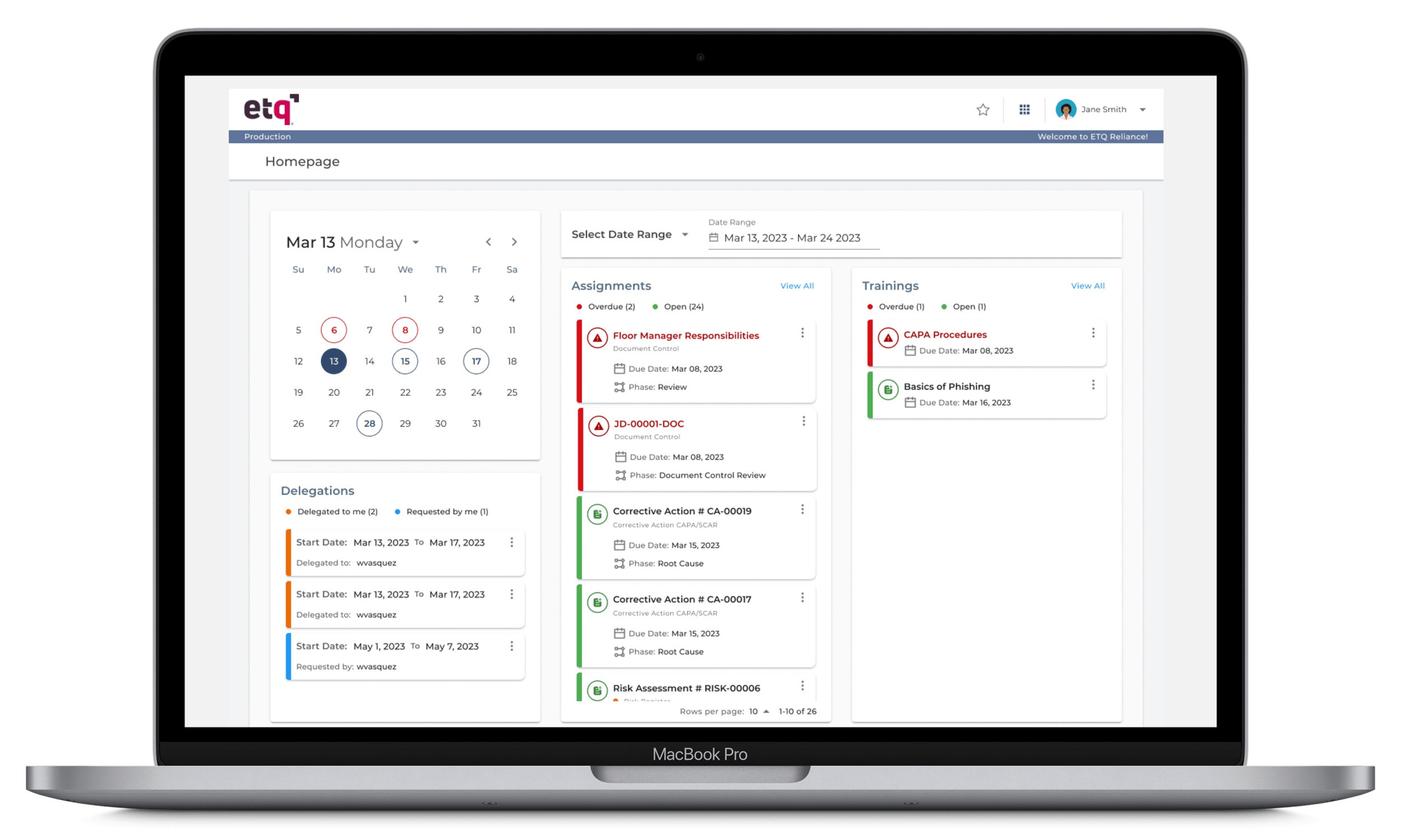
The attraction of configuration is that an organization can retain meaningful differences in its work. The responsibility is deciding which differences deserve to survive. As a purchasing principle, it is sensible to separate a regulatory requirement from a habit that simply acquired seniority. Otherwise, a flexible platform can become a handsome new address for an old mess.
AMD began with a smaller question
AMD’s published case study provides a useful counterweight to the temptation to implement everything. Its ETQ journey began in 2018 with automation for ISO 9001 certification. In 2019, its team added ten modules, separating governance work from product and material processes. A supplier portal followed in 2020.
The 2024 account describes ten global locations and 2,000 users, alongside seven customized dashboards and a quality data lake. Integration was central to reducing data-entry work and opportunities for human error. The sequence is instructive: establish a purpose, build a working foundation, then widen the scope.
Celestica faced a related problem at a different organizational scale. Its customer account describes independent site processes and manual re-entry between business systems. Reliance provided a shared environment with locations and groups configured for individual sites. The resulting model combined global visibility with local operation across 20 sites in 14 countries.
These cases suggest a practical starting point for a buyer. Choose one process whose pain is visible. Define the owner and the expected result. Ask the vendor to demonstrate the entire path, including the awkward exceptions. A polished dashboard is much easier to demonstrate than a working relationship between systems.

A platform has an implementation bill
ETQ’s public pricing framework identifies three cost drivers: concurrent users, selected application sets and implementation scope. A deployment can use standard applications, configured ones or a mixture. The offer also describes a dedicated customer success manager and online Academy training. A proposal therefore needs to account for both access to software and the work required to make it useful.
A serious comparison should price the same process in each candidate system. Include the migration, integrations, administrator time and training your organization will require. These are buying considerations, rather than a claim about a particular ETQ contract. The subscription quote cannot tell you how much discipline your team must supply.
MasterControl and Honeywell’s TrackWise products occupy the same broad market. They also advertise connected workflows, quality-event management and enterprise integration. ETQ’s case rests on the fit of its configurable platform and its range of applications. A feature checklist alone will not establish that fit.
For a small team with a narrow document problem, breadth can add work before it adds value. For a manufacturer with several sites, suppliers and systems, the same breadth may remove repeated work. That is an editorial judgment about suitability: evaluate the complexity you actually have, then test how much the platform reduces it.
The $1.2 billion chapter, and the new name
Founded in 1992, ETQ took its first institutional investment when TCV acquired it in 2017. The announcement described plans to accelerate product development and international expansion. Twenty-five years is a long time to wait before inviting an institutional investor to dinner; it also gives a software business time to learn its customers’ peculiarities.
Hexagon completed its purchase on April 1, 2022, for $1.2 billion on a cash and debt free basis. Its acquisition announcement forecast about $75 million in ETQ revenue for that year and described rapidly growing SaaS bookings. The purchase joined enterprise quality software with a group already deeply involved in industrial measurement.
The effort to connect quality with execution continued. In October 2023, ETQ and Augmentir launched a Connected Worker solution, integrating Reliance’s Quality Events application with Augmentir’s frontline platform. The idea was to let observations on the factory floor enter the enterprise quality process more directly.
In 2026, ETQ entered Octave’s portfolio as Hexagon separated the software business. The spin-off completed on May 22. Reliance is now marketed as Octave Reliance; the product page describes the change as a rebrand with consistent core functionality.
Earlier that month, Octave launched an Advanced Manufacturing Package for industries including automotive, aerospace and heavy equipment. It connects advanced product planning, failure mode analysis, control plans and corrective action. Its emphasis is on feeding evidence from field problems back into prevention, so the next design or process can benefit.
That brings ETQ’s story back to the original buying question. When someone spots a problem, how far does the information travel? A company can keep a beautiful archive of yesterday’s mistakes. The more interesting achievement is giving today’s mistake a route to the person who can prevent tomorrow’s.
Take Reliance for a closer look
Explore the product, watch it at work, or follow the quality conversation.