Scottsdale, Arizona · The middle of the testing stack
A chicken carcass rinse is not an object that invites poetry. It is cold, cloudy and, to a poultry processor, expensive when it sits around waiting for an answer. The answer might be whether Salmonella is present, how much is there, which serotype it is, and whether a vaccine strain is confusing the picture. Conventionally, those can become separate tests, separate handoffs and several calendar days of product held in storage.
PathogenDx wants to compress that untidy chain into a working shift. The Arizona biotechnology company sells molecular-testing kits, sample-preparation automation and analysis software built around a patented microarray called D3, short for Dynamic Dimensional Detection. Instead of asking one or two questions of a sample, the platform is designed to ask dozens at once.
That is the clean version. The more revealing version starts somewhere less obvious: legal cannabis. A technology with roots in clinical diagnostics found its first dependable customers among compliance laboratories testing flower, gummies and concentrates for mold and bacteria. The route from there to poultry safety explains what PathogenDx actually built, why buyers may care, and where the pitch stops working.
The technology came first. A market had to be found.
PathogenDx was formed in 2014 by Milan Patel, molecular biophysicist Michael Hogan and operations executive Eric Lachance. Hogan's work supplied deep experience in genetic testing and a substantial patent portfolio. Patel brought an engineer's training and a finance operator's instinct. Lachance brought program management, contracts and supply-chain experience. The mix matters because diagnostics companies rarely fail for want of an interesting molecule alone.
The platform amplifies DNA from a sample, then exposes the labeled material to target-specific probes held in a porous, three-dimensional structure. The company argues that suspending probes away from a flat surface gives targets more binding area and easier access. An imager reads the pattern. Its Augury software interprets the spots, and a cloud portal handles results and reports. Replicate probes can check the same analyte within a well.
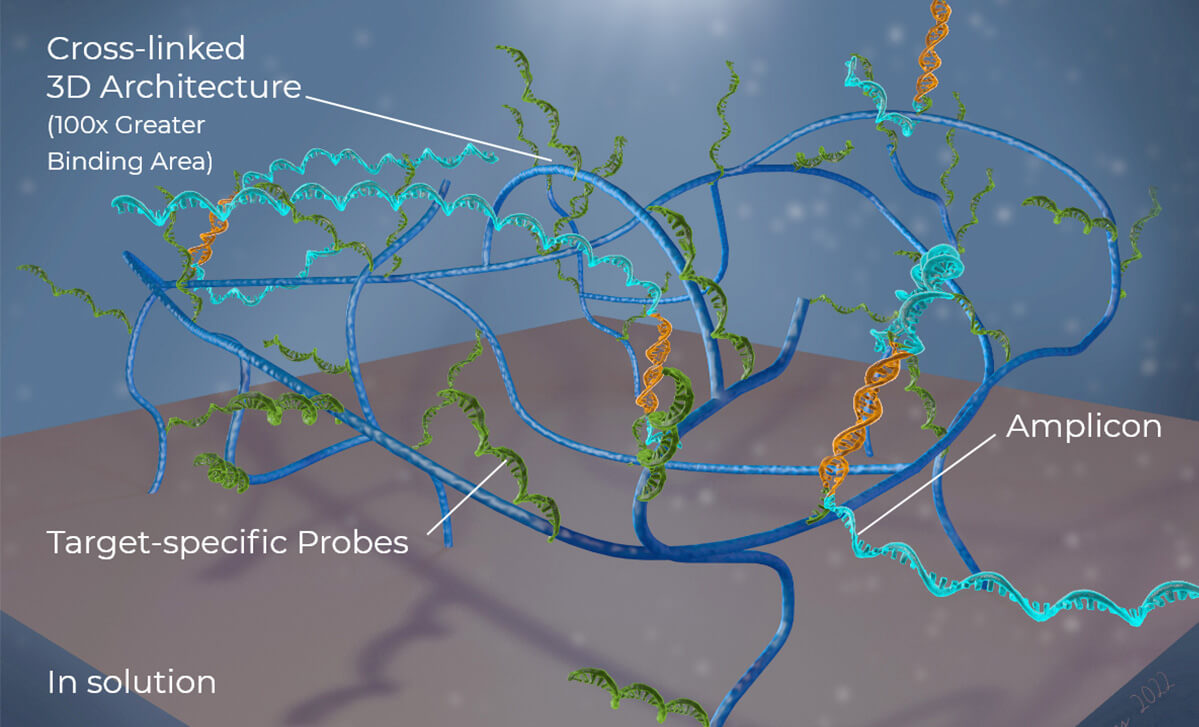
In plain English, the product is an attempt to occupy the space between qPCR and next-generation sequencing. qPCR is established, fast and sensible for a short list of targets. But each additional reaction adds reagents, labor and complexity. Sequencing sees broadly and can discover what was not anticipated, but it brings more time, expense and bioinformatics. PathogenDx is for the middle case: the lab knows the suspects, there are many of them, and an answer is needed soon.
“The first three years were a hard grind getting the platform commercially running.”Milan Patel, co-founder and CEO
That admission is more useful than the usual biotech adjectives. A clever array still needed consistent manufacturing, sample preparation, controls, imaging, software and validation. The first thing to fail was not necessarily the science; it was the fantasy that science alone constituted a product. Older microarrays had already struggled with manufacturing cost. Cannabis samples added inhibitors and messy matrices. PathogenDx eventually added a spin-column step to improve robustness and reduce dim signals and reruns, then moved from 12-well slides to a familiar 96-well format.
Why cannabis was a rational first customer
Every legal cannabis state assembled its own microbial rulebook. Some required a few organisms; New York required a much longer panel. A laboratory running hundreds of samples could either repeat narrow tests or look for a platform that combined them. PathogenDx could put Aspergillus species, Salmonella and Shiga toxin-producing E. coli into one workflow, without a culture-enrichment step for its validated DetectX Combined use.
It was a peculiar but well-shaped opening. The customers were commercial compliance labs, with cultivators and processors downstream. The pain was measurable: technician hours, per-reaction consumables, sample queues and the risk of releasing contaminated product. Early validation work involved Steep Hill, Brightside Scientific and Caliva. The company says it later worked with more than 120 laboratories in 36 states.
Third-party validation made the sales story harder to dismiss. AOAC studies reported that DetectX Combined met relevant performance requirements for specified targets in dried hemp and cannabis flower. In 2021, QuantX Total Yeast and Mold received an AOAC Performance Tested Method certificate. Validation does not make every assay suitable for every matrix, but in regulated testing it converts a vendor claim into something a lab can put into its quality system.
The business is consumables wrapped in workflow
PathogenDx sells business-to-business. Labs and processors buy assay kits and recurring consumables; automation and software make those assays easier to run and results easier to manage. The Octa AutoPrep Station, introduced for cannabis and hemp workflows, attacks a persistent bottleneck: skilled humans performing repetitive preparation. The portal tracks jobs and automates reporting. The assay is the recurring sale, but the defensibility lives across the kit, instrument compatibility, software, validation and customer procedure.
Current pricing is not public. A 2016 interview estimated about $4 per pathogen per test, an old figure that should not be mistaken for today's quote. The better way to understand cost is to look beyond the reagent. A test that replaces several reactions can save technician time and plastic. A faster result can reduce product-hold days, cold-storage expense and lost shelf life. Those savings appear elsewhere in a customer's accounts, which means PathogenDx must sell to operations as well as the laboratory.
The company raised $7.5 million in a 2019 Series B led by Cresco Capital Partners, bringing reported equity funding to roughly $11.6 million. The money was intended to extend the platform from cannabis into food and agriculture. Then the pandemic presented an abrupt test of that ambition.
COVID changed the tempo, not the basic bet
With support from NIAID and the NIH RADx program, PathogenDx developed respiratory detection and clade-variant work and pushed its platform toward higher-throughput 96-well processing. The company describes its contribution to the federal response as a major achievement. Just as important, federal funding paid for capabilities that could transfer back to food, agriculture and environmental monitoring.
The episode clarified the company's horizontal ambition, but it also showed the hazard. Each market brings a different specimen, regulator, workflow and sales channel. A respiratory assay, a cannabis mold assay and a poultry serotyping assay may share an array architecture, yet they are not one product. Platform companies can drown in their own possibility.
| Method | Best fit | Trade-off |
|---|---|---|
| Culture | Live isolate recovery and established reference methods | Often slow; growth can bias what appears |
| qPCR | Fast, familiar tests for a small target panel | Repeated reactions become costly as targets multiply |
| D3 Array | Many known targets, speciation or semi-quantitation | Cannot discover an organism that lacks a probe |
| NGS | Discovery and deep genomic characterization | More time, cost and analytical complexity |
Poultry is the sharper test of scale
In January 2026, PathogenDx brought four poultry products to the International Production & Processing Expo: SalSure Detect, SalSure Quant, SeroX for serotyping and SalVac for vaccine identification. Together they form a unified Salmonella system. The company said deployments with poultry processors were underway and AOAC certification was in progress at launch.
The market logic is clearer than the product names. Presence alone is a blunt answer. Quantity can indicate process control; serotype helps distinguish higher-risk strains; vaccine identification may prevent a vaccinated flock from muddying a processor's category rating. Conventional serotyping can take five to seven days. PathogenDx says its microarray can return serotyping results in roughly four hours after enrichment. The useful comparison is not “faster science.” It is a plant manager learning something while there is still time to act on the shift.
Its alternatives are formidable. Plate culture is cheap, understood and embedded in reference methods. Bio-Rad, Thermo Fisher, Qiagen and other molecular suppliers sit inside existing lab workflows. Sequencing costs continue to fall. PathogenDx therefore wins only when multiplexing removes enough repeated work to justify a new procedure - and when validation satisfies the buyer's regulator and quality team.
What another founder can steal
The copyable move is not “invent a microarray.” It is to find a market where a technical property alters the customer's daily arithmetic. Cannabis gave PathogenDx many regulated targets, overloaded labs and expensive delay. That made multiplexing visible. The company then accumulated the less glamorous assets - validation data, sample protocols, lab relationships, reporting software and automation - required to enter adjacent markets.
There is also a useful sequencing rule. Start narrow enough to prove the workflow, but collect capabilities that travel. PathogenDx's 96-well processing and automated analysis could migrate from respiratory testing to cannabis and food. Its regulatory experience could travel, even when the specific certification could not. Its customer lesson - sell the cost of waiting, not merely the cost of the test - applies well beyond diagnostics.
The unanswered question is execution. A company of roughly a few dozen people is addressing cannabis, food, agriculture and clinical research against much larger incumbents. Poultry could concentrate the story around a large, urgent use case. Or it could become another branch on a very broad product tree. For now, PathogenDx is at its most convincing when the target list is long, the clock is expensive and a lab needs an answer before everyone goes home.