A small team in Sorrento Mesa decided the problem with genetic testing wasn't biology. It was bandwidth. So they hired telecom engineers.
Walk into Pleno's space in San Diego's Sorrento Mesa and the org chart reads wrong. There are biologists, sure. There are also signal-processing engineers - the kind who spent careers figuring out how thousands of phones share one cell tower without shouting over each other. They are not in the building by accident. They are the whole idea.
Pleno builds an instrument called RAPTOR. It detects biological targets - the molecular signatures of disease, drug response, ancestry, crop traits - and it claims to read up to 10,000 of them from a single sample, in roughly the two hours a routine PCR test takes. The pitch is almost rude in its simplicity: genetic testing has been expensive and slow because the industry kept solving it as a chemistry problem. Pleno solves it as a communications problem.
That is the company as it stands in 2026: roughly forty people, about $80 million raised, a brand-new CEO poached from Illumina, and a first paying customer. Out of stealth, out of the lab, and out to prove the bet.
Here is the inconvenient truth the genomics revolution doesn't put on its posters. Sequencing got astonishingly cheap. But most clinical and research questions don't need the whole genome read end to end - they need a known set of targets checked, fast and affordably. And that middle ground stayed clumsy, costly, and slow.
The standard tools each have a catch. PCR is fast and simple but reads only a handful of targets at a time, because it leans on a small palette of fluorescent colors. Sequencing reads everything but is overkill - a discovery machine pointed at a question you already know the answer's shape of. Multiplex panels exist, but scaling them is its own headache.
So the gap is this: detect many specific targets at once, cheaply, with a workflow a normal lab can actually run. The whole company exists in that gap. Everything that follows is a bet on how to fill it.
Pleno is the fourth act of Pieter van Rooyen, a founder with the unusual habit of building something, selling it, and doing it again. Zyray Wireless went to Broadcom. ecoATM - those mall kiosks that buy your old phone - sold for around $350 million. Edico Genome, which built genomic-data-crunching chips, was acquired by Illumina; its DRAGEN technology now ships inside Illumina's sequencers. He holds a portfolio of more than 150 patents across semiconductors, wireless, and life sciences.
The through-line is not biology. It is signal processing - the math of pulling a clean message out of noise. Van Rooyen's wager with Pleno was that the same toolkit that lets a phone network multiplex thousands of conversations could let a single tube multiplex thousands of molecular targets. Assign every target its own code. Mix them together. Read the codes back out with error-correction algorithms. They called it Hypercoding.
It is a contrarian bet, and contrarian bets are charming right up until they have to work. In late 2024 the company brought in Dr. Vik Vaz - a physician trained at Harvard Medical School who ran strategy at Illumina and consulted at BCG and McKinsey - to turn the science into a business. Founders dream; someone has to ship.
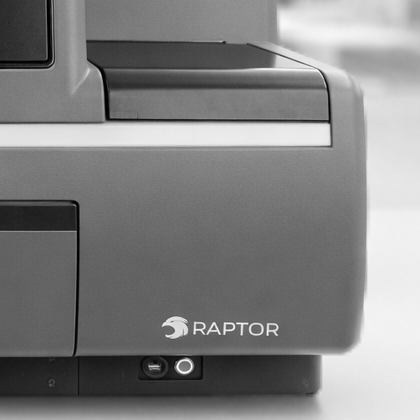
The instrument is deliberately unintimidating. The workflow is meant to look and feel like the PCR runs labs already do - load a sample, wait roughly two hours, get an answer. Underneath, Hypercoding is doing the heavy lifting, decoding the multiplexed soup of coded targets and using error correction to keep the readout honest.
Up to ten thousand biological targets detected from a single sample - DNA, RNA, methylation, and protein.
A workflow timed to roughly match a standard PCR run, not a multi-day sequencing pipeline.
Built for high-throughput labs that need volume, not just a clever one-off readout.
Genomics, transcriptomics, epigenetics, proteomics - the "multi" in multi-omic, on one platform.
The application list is broad on purpose: oncology, infectious disease, pharmacogenomics, genotyping, proteomics, even agrigenomics. A platform that detects coded targets doesn't much care whether the target lives in a tumor or a tomato.
Deerfield and Foresite seed the telecom-meets-biology idea.
Led by Deerfield Management with Foresite Capital. Leadership and board expand soon after.
The platform is deployed with BioLegend antibodies, stretching Hypercoding into protein detection.
Dr. Vik Vaz arrives from Illumina to lead commercialization. Medical Excellence Capital joins the cap table.
A deal with Slopes Bio marks RAPTOR's official commercial launch.
Skeptics are right to ask: where's the evidence? Three things keep the story honest. First, the money - roughly $80 million across three rounds from investors who specialize in life sciences and don't tend to fund vibes. Second, the talent signal - you don't leave Illumina's strategy seat for a forty-person startup unless the technology survives a close look. Third, and most concretely, a paying customer: the 2025 Slopes Bio agreement turned RAPTOR from a demo into a product.
None of this guarantees the thing scales. A single commercial deal is a beginning, not a verdict. But the partnerships - BioLegend on the chemistry side, Slopes Bio on the commercial side - suggest a company stitching together the unglamorous supply chain that real products need.
Pleno's stated goal is to democratize biological target detection. Strip the jargon and it means this: make checking thousands of molecular markers cheap and simple enough that a normal lab can do it without a fortune or a PhD-heavy workflow. The interesting technologies don't stay exciting. They become plumbing. That's the ambition - to turn multi-omics into something nobody thinks twice about ordering.
If it works, the winners aren't the company - they're the patients who get a faster oncology answer, the researchers who run an experiment they couldn't afford before, the labs that stop choosing between depth and cost. That's the version of the future Pleno is selling. Whether the market buys it is the open question.
Return to Sorrento Mesa, to the org chart that read wrong. The biologists and the wireless engineers, working the same problem from opposite ends of the science library. It looked like a mistake. It was the thesis.
If Pleno is right, the lasting idea is bigger than one instrument: that the hardest problems in biology might yield faster to the people who solved them somewhere else first. A genome is, after all, just a very old message that's been hard to read. Pleno's bet is that the engineers who spent decades cleaning up noisy signals were holding the decoder ring the whole time.
The RAPTOR still looks like a lab instrument. The question is whether, a few years from now, anyone remembers it was supposed to be impossible.
Compiled from public filings, press releases, and trade coverage. Figures approximate where noted.