A browser can summon a taxi, move money and rent a computer on another continent. Ask it to hold a pipette, however, and the arrangement becomes rather less elegant. The liquid still needs a vessel. The sample still needs a temperature. Somewhere, something has to open a lid. Strateos built a business around that awkward distance between an instruction and a physical act.
- Scientists design experiments remotely; connected instruments perform the supported workflows.
- LodeStar coordinates the equipment, requests, samples and resulting data.
- A Wisconsin protein-engineering project shows what joining several protocols can accomplish.
- In 2023, customer demand pushed Strateos toward building private cloud labs on site.
A browser cannot hold a pipette
Strateos operates in the space between laboratory equipment and scientific software. Its proposition is straightforward: let researchers specify what should happen, let automation handle the repeatable execution, and return experimental data through a common interface. The company advertises workflows for drug discovery, synthetic biology and related life-science research. A researcher can work at a distance while the experiment remains stubbornly physical.
The useful distinction is between owning a robot and running a connected laboratory. A single automated instrument can relieve a tedious task. A collection of instruments introduces another problem: which sample goes where, which device is available, and which result belongs to which request? Strateos’s software addresses those handoffs. In this business, a calendar can be as consequential as a robotic arm.
The incubators were a clue
The company traces its origins to Transcriptic, founded in 2012 by Max Hodak. Strateos became the name of the combined business when Transcriptic and automated tissue-imaging company 3Scan joined in 2019. The merger brought two approaches to making biology computational: remotely executed experiments and detailed digital representations of tissue. Mark Fischer-Colbrie, previously chief executive of Labcyte, was appointed to lead the combination.
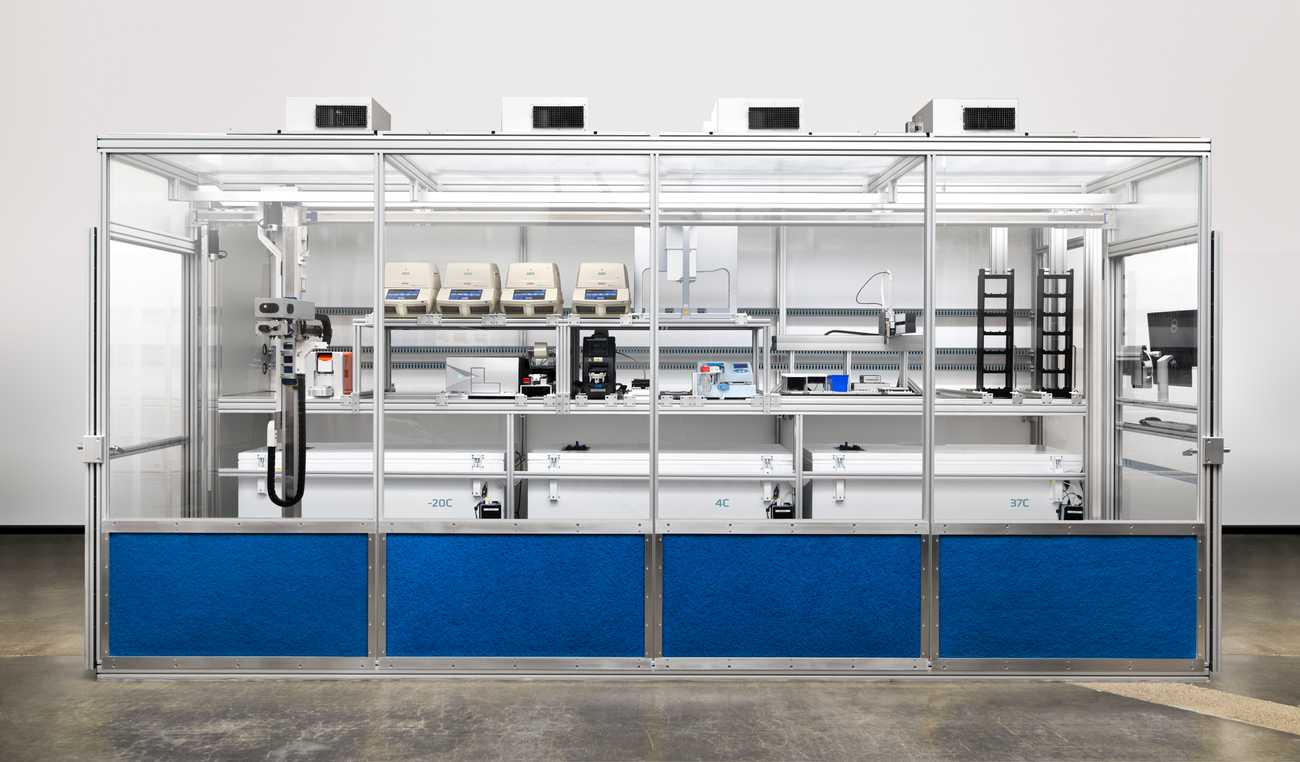
Jimmy Sastra, an early Transcriptic engineer, offers a less polished and more revealing origin story. In a retrospective interview, he describes joining as the fourth employee and helping build a remotely accessible lab for simple biology experiments in roughly six months. The team’s ambition was to let someone write Python from a dorm room and execute an experiment elsewhere. They even built their own robotic incubators.
“We built a lot from scratch, probably more than we needed.”
Jimmy Sastra, recalling the early Transcriptic team
That admission matters. Automation companies can spend a great deal of ingenuity recreating things that already exist. The early team demonstrated an idea quickly, but Sastra’s recollection also exposes the temptation to solve every engineering problem personally. A useful lesson for another founder sits inside that small confession: speed of invention and economy of invention are different accomplishments.
The later Strateos offering rests on several kinds of expertise working together. Scientists understand the experimental constraints. Hardware engineers connect instruments and movement. Software engineers represent requests and execution in a form the machinery can use. The company’s stated culture emphasizes sharing knowledge and continuous improvement. In a lab spanning these disciplines, those are practical operating requirements.
Five protocols beat one clever algorithm
Consider the Romero Lab at the University of Wisconsin-Madison. Its work concerns engineering proteins with useful functions. Computational design can generate candidates, but a proposed protein still has to be assembled, expressed and tested. The number of possible sequences makes that physical work a serious bottleneck. An algorithm with a long waiting list is an unusually expensive way to practice patience.
A Strateos case study published in 2021 describes integrating the lab’s AI-driven design system with robotic experimentation. Five protocols were automated and connected. The reported results included a 32-fold increase in output scale, seven hours of hands-on work freed per sequence, and a design-to-data cycle of six hours compared with eight days. These are vendor-reported results from that project, rather than promises for every laboratory.
Reported design-to-data cycle after integrating five protocols.
Hours converted from the published eight-day comparison. Workflow-specific, company-reported results.The transferable idea is the connection between stages. Making one operation fast is helpful; joining the operations changes how often a team can learn. That also explains Strateos’s fit with AI research. A computational model needs measurements from the world. An automated experimental loop can provide them, provided the chosen assays answer the scientific question and the data retain their context.
Results feed the next design. Each handoff needs a sample identity, an executable instruction and usable data.
The customer wanted the keys
Remote access was one route into the market. Another emerged from customers who wanted the automation in their own buildings. In April 2023, Strateos announced a strategic shift toward designing and deploying on-site cloud labs. It reported completed multimillion-dollar design programs with two unnamed top-20 biopharmaceutical companies, alongside a staffing reorganization. Fischer-Colbrie described the need to “pivot toward demand.”
The commercial lesson is more interesting than the word cloud suggests. Remote control does not require the customer to rent someone else’s facility. The same idea can operate inside a privately owned laboratory. Strateos’s product pages consequently present three routes: use its lab, control your existing lab, or have it design and build a lab. The location changes; the need to coordinate work survives.
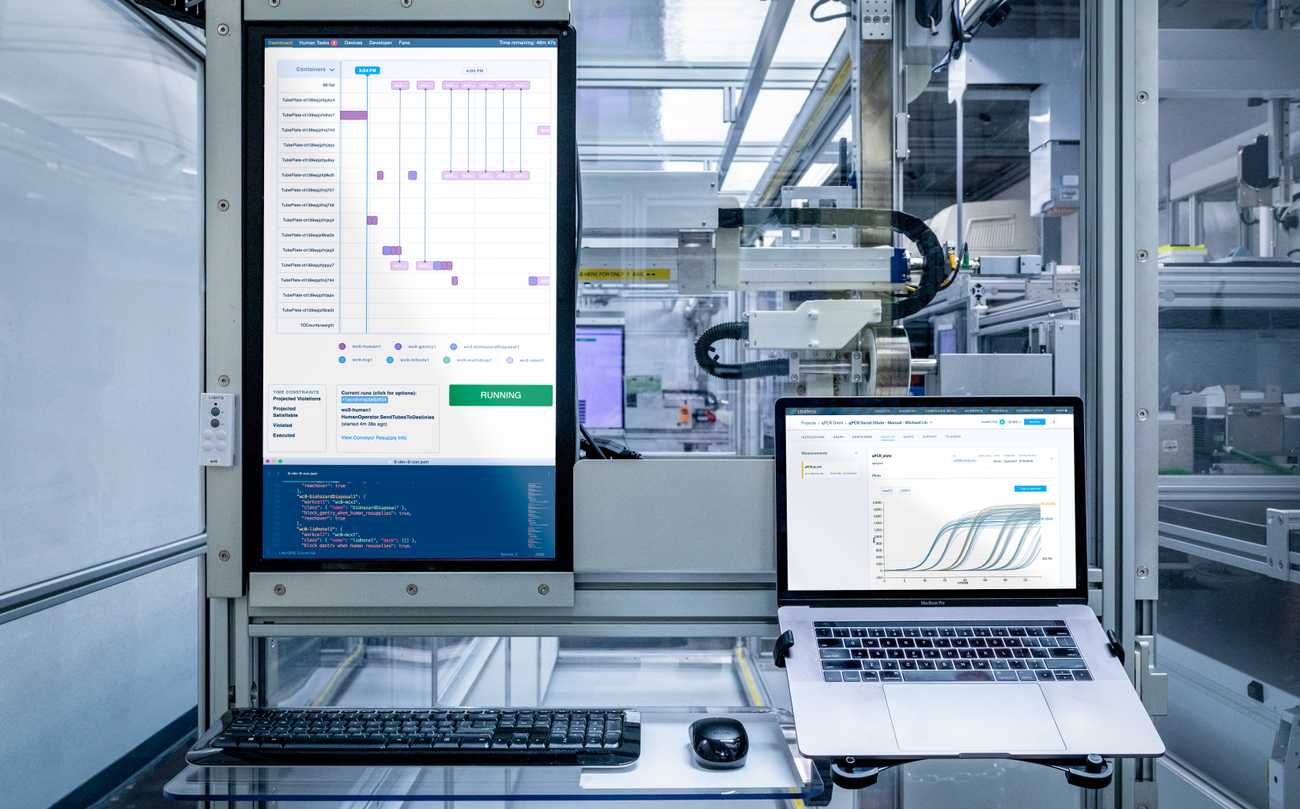
LodeStar is the coordinating software. Public product descriptions cover protocol requests, approval and assignment, experimental queues, sample tracking and near-real-time data acquisition. Sample volume, storage and other properties can be associated with an experiment and its results. These details explain what a customer buys more clearly than a photograph of expensive equipment ever could.
The market offers several alternatives. Emerald Cloud Lab provides remotely operated wet-lab infrastructure. Synthace concentrates on digital experiment design and automation software. A company can also employ its own integration team or contract out research. Strateos’s distinctive pitch combines software, operating experience and the design of private facilities. These choices involve different responsibilities for equipment, experiments and day-to-day operations.
Three bills, three different stories
In January 2020, Lilly and Strateos unveiled the Lilly Life Sciences Studio in San Diego. Lilly had conceptualized and designed it; Strateos supplied the operating platform and was named as operator. At launch, Lilly described an 11,500-square-foot laboratory with more than 100 instruments and storage for over five million compounds. The facility connected chemistry and biology across an integrated experimental cycle.
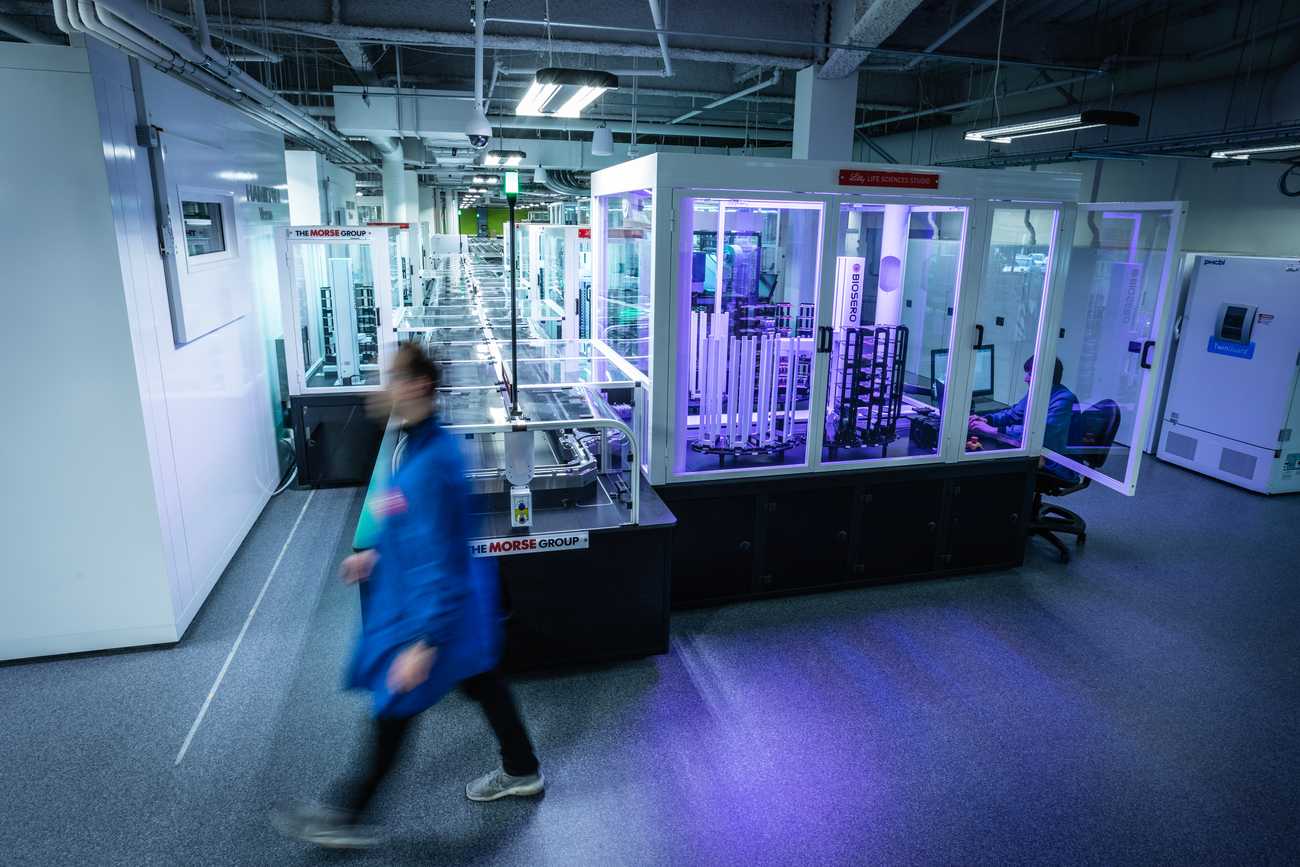
Lilly’s announcement placed the studio within a broader $90 million investment announced in 2017 to expand its San Diego research footprint. That number is often more portable than its meaning. It was a wider expansion budget, not a published price for buying one Strateos lab. Separately, Strateos announced a $56.1 million Series B in June 2021, led by DCVC and Lux Capital. Financing a supplier, constructing research facilities and paying for experiments are three different transactions.
The business model follows the work: enterprise software, laboratory services and contracted design and deployment. A prospective customer needs a scope and a quote. For a private facility, the sensible comparison includes integration, validation, maintenance and people, alongside instruments and software. A fast experimental cycle becomes valuable when the organization has enough relevant work to use it.
Start with the handoff
Someone copying the approach should begin with a recurring workflow and trace every transfer: instruction to instrument, sample to assay, result to analysis. Specify the conditions that a colleague might otherwise infer. Then choose one useful loop to connect. The Wisconsin example is persuasive because it identifies the protocols and the resulting change in work, rather than treating automation as a decorative purchase.
There are limits. An experiment requiring frequent improvisation may resist a fixed automated protocol. Unsupported instruments, unstable assays or poorly recorded samples can make integration costly. These are consequences of the operating model, rather than documented Strateos failures. Robots execute the instructions they receive; repeatability can preserve a mistake as faithfully as it preserves a good method.
Strateos’s story therefore turns on a surprisingly ordinary question: where does the customer want the work to happen? The original ambition made a laboratory accessible through software. The later shift made that software and engineering experience portable. The bench acquired an interface, and then the customer asked for the bench back.
Visit the lab, virtually
Strateos website · LodeStar · Lab design services · Company blog
LinkedIn · X · Facebook · Python client on GitHub
Watch Seeker’s visit inside the robotic lab
Strateos videos and demonstrations
Jimmy Sastra on building Transcriptic
Lilly’s studio launch · The 2023 strategic shift · Wisconsin protein-engineering case study