In a photoreceptor, rhodopsin has a destination. It must reach the right part of the cell to help turn faint light into a signal the brain can use. Some inherited mutations spoil the trip. The protein folds badly, stalls in the cell’s production machinery, and the cell pays for the congestion. For people with rhodopsin-associated autosomal dominant retinitis pigmentosa, the consequence can begin with poor night vision and continue toward severe sight loss. Octant, a biotech company in Emeryville, California, decided to study the traffic before designing the road repair.
The short version
- What it makes: investigational small molecule drugs, led by oral retinal candidate OCT-980.
- How it works: barcoded human cells reveal which mutations and cellular behaviors a compound changes.
- What has happened: the first patient entered the OCT-980 Phase 1b/2 study in September 2026.
- What remains open: whether the drug proves safe and preserves vision in people.
The familiar drug discovery picture is a molecule fitted to a purified protein, like a key cut for a lock. Octant’s preferred picture is busier: living human cells, each engineered to report what happens to a protein’s folding, location, signaling or stability. That shift matters when the illness is a failure of cellular behavior. A key can fit its lock and still fail to clear the traffic outside the door.
A cell that can send a postcard
Co-founders Sri Kosuri, a synthetic biologist, and Ramsey Homsany, a former Google and Dropbox executive, started Octant in 2017. Its early public ambition ranged across complex diseases and the many targets a useful drug might influence. The practical question was how to observe all that biology at enough scale to make design decisions. Their answer was a genetic barcode: a short sequence built into a cell so the cell’s response can be read later by sequencing.
Make many cell lines, give each a distinguishable barcode, pool them, apply compounds, and count the resulting signals. In a 2020 example, Octant compared a conventional experiment testing 100 receptors against 100 drug conditions in triplicate - about 80 plates of 384 wells - with a multiplexed version on one plate. It was an illustration of assay capacity, not a claim that every experiment shrinks by the same ratio. Still, the idea is wonderfully concrete: put more questions into each well without losing track of which cell answered.
The company calls the combined system the Navigator. It links this synthetic biology to nanoscale chemical synthesis, automation and computation. Its direct customers are pharmaceutical research partners buying discovery work or licensing resulting candidates; Bristol Myers Squibb is the named example. Octant is also building its own medicines. That makes it a drug developer with a platform, rather than a lab selling an assay by the plate.
The first promising molecules had a problem
The retinal program is where the machinery faced a difficult question. There are many disease-linked changes to the RHO gene. A medicine tailored to one may reach too few patients; a molecule that helps several variants could cover more of them. Octant used deep mutational scanning to make barcoded cell models for possible amino acid substitutions and see which variants disrupted rhodopsin trafficking. In July 2026, Octant and academic collaborators reported measurements across all 6,612 possible RHO missense variants.
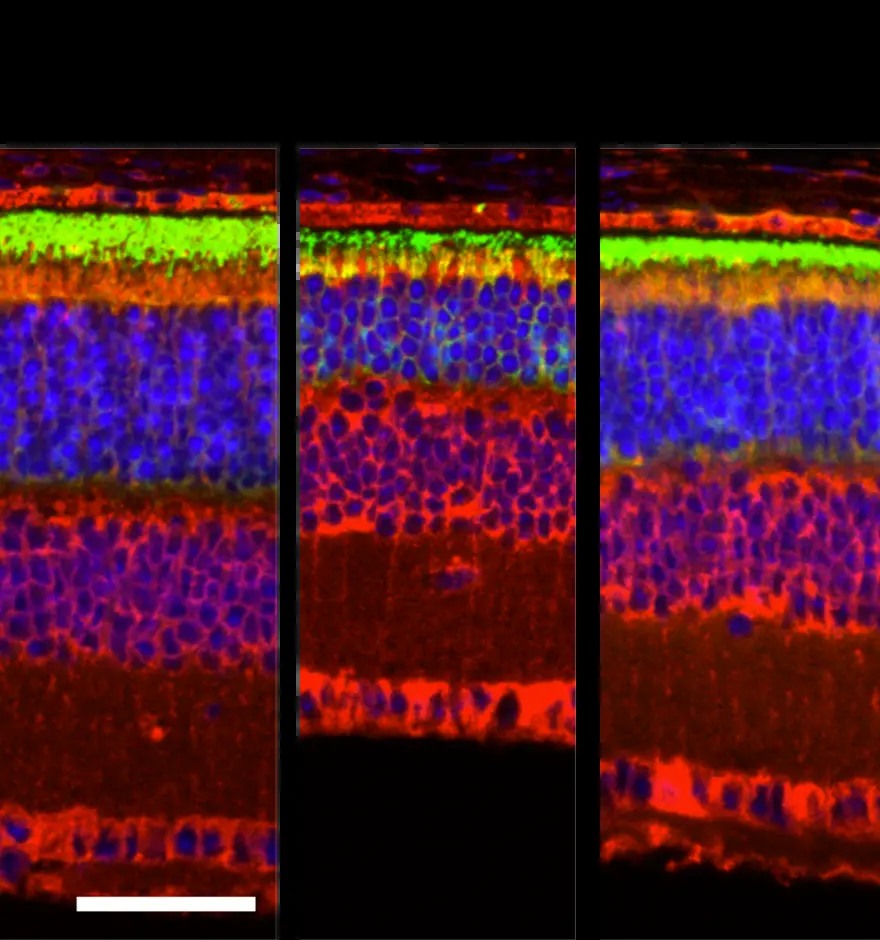
The scanning map helped define the target population. Then chemistry supplied a less obliging verdict. Octant says its first hits helped rhodopsin move, but were very hydrophobic and had poor drug-like properties. A promising response in a dish is no use if a molecule cannot be made into a suitable medicine or reach the retina. The team broke molecules into cores and fragments, recombined them, and tested the new analogs in its cell systems. It reports screening about 250,000 analogs, at roughly 5,000 a week, to improve the candidate’s properties.
“We found initial hits that helped traffic rhodopsin, but those molecules were very hydrophobic and had poor drug-like qualities.”Octant, on its RHO program
This is the useful part of the story for anyone building a research tool: the tool was not vindicated by finding a hit. It earned its keep when the hit failed a practical test and the team could iterate. The company says some of the biggest improvements were non-additive - the best molecular core and the best fragment did not necessarily make the best pair. That is precisely the kind of mess an empirical loop can reveal.
From a map to a patient
OCT-980 is the result: an investigational oral small molecule designed to stabilize misfolded rhodopsin and restore its proper cellular route. It is meant for genetically diagnosed RHO-associated retinitis pigmentosa, not every form of retinal degeneration. After dosing the first healthy volunteer in March 2026, Octant announced the first patient had been dosed in its Phase 1b/2 study on 24 September. The patient portion is designed to examine safety, how the body handles the drug, biological activity, retinal structure and visual function. It is the first direct test of whether an elegant cell story can become a useful human one.
The company’s 2024 account estimated that its lead corrector might cover roughly half of RHO-adRP patients by mutation profile. That is a research estimate, not a clinical response rate. The conditions for success are exacting: a person must have a relevant mutation, the compound must reach photoreceptors at a useful exposure, the cellular correction must persist safely, and the change must matter to sight. If a disease variant does not share the misfolding and trafficking mechanism, the same corrector logic may not apply.
A platform with more than one route to market
Octant has raised substantial capital for this work. Its $80 million Series B in 2022, led by Catalio Capital Management, took disclosed cumulative funding to $115 million at the time. Bristol Myers Squibb joined that round and started a separate deep mutational scanning collaboration on inflammation-related targets. In 2025 the two companies signed another agreement, this time to discover molecules for neurodegenerative disease. Octant received $15 million up front and may receive milestone payments and royalties; Bristol Myers Squibb gained exclusive worldwide development and commercial rights to candidates from that deal.
The broader pipeline includes Fabry disease and early oncology and metabolism programs. A $4.9 million Gates Foundation grant announced in 2025 supports work on HPV-related cancers. Octant also joined the ARPA-H-backed OpenADMET effort to build open models for drug safety. These activities show why a flexible discovery engine attracts partners, but the economics vary by program. Grants support research; licenses can pay before approval; Octant’s own drugs could create much larger value only if they survive development.
There is a small lesson in the company’s name. An octant was a navigation instrument, useful when the sea did not hand you a straight line. The analogy is almost too neat, but Octant has made it literal: barcode the biology, chart which mutations share a failure, correct the chemistry when it misbehaves, and then ask patients whether the route was worth taking. The patient trial, appropriately, has the final vote.