A scientist can describe an experiment perfectly well to another scientist and still leave a machine bewildered. “Mix thoroughly” sounds helpful until someone asks how fast, for how long, in which vessel. Emerald Cloud Lab makes that awkward conversation part of the job. Researchers send samples to a physical laboratory, then direct the work through software. The person with the hypothesis can stay elsewhere. The hypothesis, however, must arrive with unusually good instructions.
- Real biology and chemistry experiments, controlled remotely.
- Shared instruments, with software connecting methods and results.
- A subscription buys capacity; training and usage shape the final economics.
The side project ate the laboratory
Brian Frezza and D.J. Kleinbaum began with a different ambition. Their predecessor company, Emerald Therapeutics, was founded in 2010 to pursue antivirals. Along the way, they encountered the familiar laboratory jumble: equipment from different manufacturers, separate software, incompatible outputs. They built a common system to control instruments and keep experimental records together. By 2014, the laboratory itself had become an offering, as its public history records.
The interesting business decision was to sell access to the machinery behind the research. Other scientists had the same plumbing problem. A production facility opened in South San Francisco in 2015, with more than $3 million of instrumentation installed, according to Bio-IT World’s opening report. The founders had acquired a second product while building the first.


A pipette with an address
Today, the workflow has four stages: command, run, explore, analyze. Scientists ship samples and define procedures in ECL Command Center. The laboratory executes them. Constellation, its database, connects the resulting data in a knowledge graph. Researchers return to the same software to inspect and interpret results.
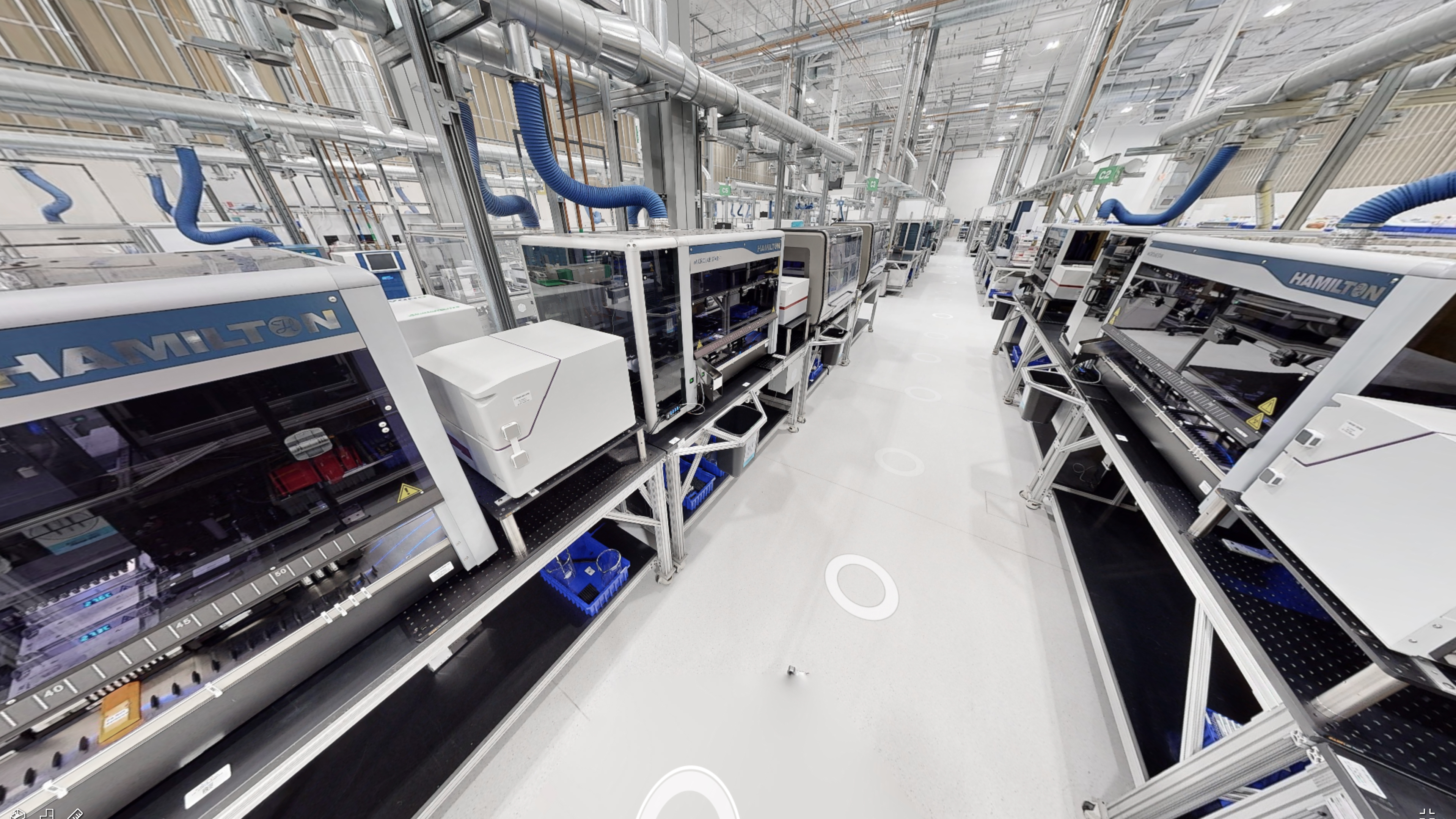
Its expertise lies in making instruments, sample handling and experimental records work as one system. The current site lists chromatography, mass spectrometry, PCR and flow cytometry among its capabilities. A biotech team might characterize proteins; a formulation group might compare conditions; an academic researcher might run a series that would otherwise monopolize a bench.
The physical work includes robots and trained operations personnel. Manual techniques can also receive scripted instructions. This matters because a collection of automated instruments does not, by itself, constitute an automated workflow. Someone must account for the unglamorous intervals between machines. ECL sells that coordination alongside access.
Consider what happens after a measurement. A graph detached from its method can be difficult to interpret, especially when another researcher inherits the project. Keeping instructions and results together changes the handover: the next person has a record to examine, rather than a colleague’s recollection to reconstruct. That is the quieter attraction of a cloud lab. Its software can make the procedure travel with the answer. The benefit still depends on sound experimental design; a beautifully organized record can faithfully document a poor experiment.
- 01ShipPhysical samples
- 02SpecifyExecutable method
- 03RunInstruments + staff
- 04InspectConnected results
The price of getting your hands back
Subscriptions charge for concurrent experimental capacity. Sequential experiments can run back-to-back; parallel work depends on the account. The public startup configurator displays a Basic comprehensive plan at $30,020 a month, with two software licenses, one terabyte of database storage and annual renewal. That is a particular configuration, rather than a universal bill.
The terms add applicable utilization costs, including materials, shipping and waste disposal. The sensible comparison includes equipment purchases, maintenance and staff time, but also training and method conversion. A monthly subscription becomes attractive when a team can turn its capacity into useful results. Idle access is still idle access.
ECL sits between laboratory ownership and outsourced research. Traditional contract research can delegate execution to another team; ECL emphasizes researchers specifying the work themselves. Strateos has pursued a related cloud-lab model. ECL’s distinctive proposition is the combination of laboratory access, its experimental language and connected records.
Basic capacity · 2 licenses · 1 TB · annual renewal
Applicable utilization charges are additional.
A university asks for proof
Carnegie Mellon supplied an institutional test. When the founders proposed an academic cloud lab in 2018, dean Rebecca Doerge asked for a test case. The university’s account describes research on virus-like particles and the labor involved in improving their proteins through directed evolution. “You’re limited by the manpower,” researcher Yu Hong (James) Wang observed.
In 2021, CMU and ECL announced a $40 million project. Remote experiments had also supported teaching during pandemic closures. The academic laboratory opened in spring 2024. That sequence offers something other institutions can copy: test a recognizable research problem before buying an unfamiliar way of working.
AI research has followed the same physical bridge. A 2023 Nature paper, co-authored by ECL’s Ben Kline, demonstrated Coscientist’s ability to use laboratory documentation and generate commands, including ECL’s Symbolic Lab Language. The language gives a model somewhere concrete to send its instructions.
“You’re limited by the manpower”Yu Hong (James) Wang · Carnegie Mellon researcher
The trouble starts before the robots
Access was easier to grant than proficiency. Align to Innovate’s account of its Bioautomation Challenge reported that new cloud-lab users struggled with scant example code and insufficient training material. The organization assembled an experienced internal team to help academic users and develop shareable DNA-manipulation methods.
This is a useful corrective to the idea that automation removes effort. Some effort moves into specifying, debugging and validating a method. ECL’s public language repository and shared protocol libraries offer material to inspect before committing. A prospective user should try one representative workflow, record the learning time and check that every required operation is supported. More instrument access cannot compensate for a method the facility cannot execute.
The cloud still has plumbing
Even a well-specified experiment can go wrong. In October 2025, ECL and Carnegie Mellon collaborators published a study of air-bubble contamination in automated HPLC runs. Using roughly 25,000 traces, they developed a classifier that achieved 0.96 accuracy and a 0.92 F1 score in prospective validation. Those results concern this detection task, rather than laboratory reliability overall.
The lesson is pleasingly mundane. Machines need checks; connected records make problems easier to investigate. For a small research team, ECL’s appeal is a wider experimental repertoire without buying every instrument. The bargain works when supported methods, training and enough useful work line up. The reader can borrow its underlying discipline immediately: write down what execution requires, retain the data’s context, and check the result before trusting it.