In 2018, Nils Ove Gustafsson arrived at the Swedish biopharmaceutical company Camurus and encountered a thoroughly ordinary difficulty: locating the details of work already done in the laboratory. The company had paper records, Word documents and Excel spreadsheets. Experiments happened. Finding their traces demanded copying, scanning, archiving and patience. Anyone who has searched a shared drive for a file called “final” will recognize the species.
This is a useful place to meet Revvity Signals. The company sells scientific software, including ChemDraw, electronic laboratory notebooks and research analytics. Its larger proposition is that an experiment should retain its identity as it moves between people, instruments and applications. The result ought to be knowledge another scientist can find and use, rather than another document someone must remember exists.
- The starting point: ChemDraw, first demonstrated in 1985, made chemical drawing a computer task.
- The current bet: Signals One connects design, experiment capture, processing and analysis.
- The customers: drug developers, academic researchers and industrial R&D teams working on materials, chemicals and food.
- The buying lesson: in one biotech’s selection, compatibility with everyday Office applications helped carry the day.
01 / A drawing tool with a long memory
In 1985, David and Sally Evans and Harvard graduate student Stewart Rubenstein were tackling chemical structures. Preparing them by hand was laborious. The Macintosh offered a graphical interface; the group saw the possibility of a drawing program that understood chemistry. On July 17, they demonstrated ChemDraw at the Gordon Research Conference on Reactions and Processes. Cambridge Scientific Computing, later CambridgeSoft, formed in 1986.
A molecule drawing looks like a collection of lines to a general graphics program. To a chemist, those lines carry meaning. That distinction explains much of this business: scientific software must preserve the scientific meaning inside the record. A prettier filing cabinet would be a modest achievement.
“ChemDraw infected a lot of people; it spread like a virus”
David Evans / ChemDraw anniversary recollection
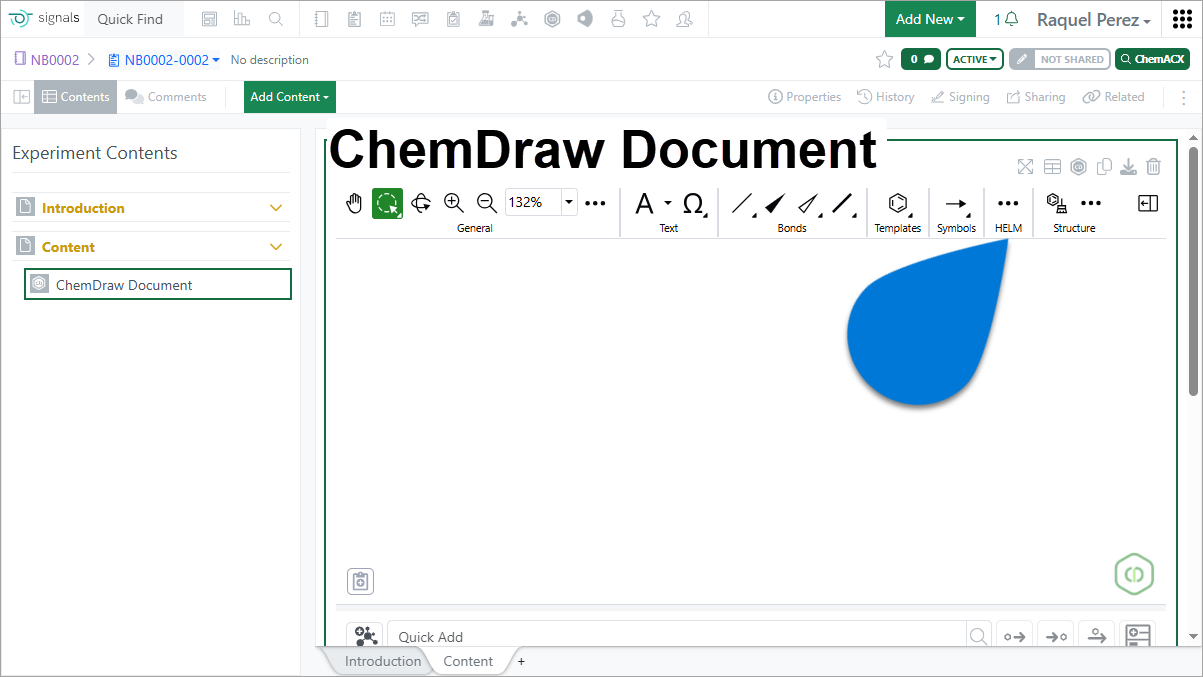
The Revvity Signals name arrived in 2023 when PerkinElmer Informatics rebranded. Its history is longer than the lettering on the door. Signals ChemDraw, launched in 2024, combines desktop drawing with cloud applications for finding, organizing and reusing structures. It can find drawings inside Office files and search structures within notebook experiments. The drawing is becoming a searchable piece of a larger scientific record.
02 / Four verbs, many handoffs
Signals One, announced in April 2025, organizes its pitch around four verbs: Design, Make, Test, Decide. It evolved from the company’s existing research portfolio. The sequence matters because different people may own each step. A proposed structure, an experimental record, an assay result and a decision can become four disconnected objects unless software keeps their relationships intact.
The platform connects data capture, processing and analytics across those activities. Its audience includes chemistry and biology teams working on drug discovery, alongside scientists developing materials and formulations. Native ChemDraw integration gives it a recognizable entry point. The commercial argument is continuity: less reconstruction when a result crosses a departmental boundary.
Several products address particular seams. Signals Notebook records and links experimental work. Signals Synergy adds external collaboration with contract research organizations, contract manufacturers and academic laboratories. Sponsors can select the fields a partner needs and mask others. It is a sensible recognition that sharing a task should not require sharing every secret.
Signals Clinical handles another kind of handoff: the passage from trial data to review. It combines prebuilt visualizations with Spotfire customization and supports medical monitoring, data review and query workflows. The March 2026 release added natural-language generation of listings. These are tools for inspecting and acting on study information; a dashboard still needs a qualified person to interpret what it shows.
03 / The familiar software won
The Camurus story makes those seams visible. Gustafsson’s team approached 19 suppliers, received interest from 17 and shortlisted six. Signals Notebook won. The published case attributes particular weight to integration with Excel, Word and PowerPoint. There is something refreshing about an enterprise software purchase decided partly by the tools everyone already has open.
One selected notebook. Procurement counts from the published Camurus case study.
Camurus went live on January 2, 2020. The case describes 40 licenses at the time of its account. Finding experiments became easier, but the consequential change extended beyond search. Formulation scientists could begin work, link it to analytical experiments and receive results back through connected records. The old circulation of plans, approvals and reports became less necessary.
Gustafsson described those gains as subjective observations. The account does not put a controlled productivity measurement behind them. What it does provide is a concrete change in the work: teams could follow linked experiments rather than chase the documents around them. A buyer can copy the method by testing a troublesome handoff with actual laboratory files.
04 / The price of keeping the thread
Revvity Signals operates as a B2B software business within Revvity. Its revenue comes from software subscriptions and licenses, with enterprise scope and services shaping the purchase. Signals One pricing depends on factors including team size, modules and deployment requirements. A platform that supports one small team and one that connects several disciplines need different buying conversations.
Signals Notebook access to one multi-tenant environment, as listed on AWS Marketplace. A specific listing, not a total deployment budget.
That AWS listing gives a useful reference point, provided its scope stays attached. Infrastructure charges may apply. Training, configuration, migration and instrument connections also belong in a buyer’s budget assessment. It would be a mistake to treat the price of a notebook seat as the price of transforming a laboratory.
The company’s newer startup program acknowledges the setup problem. Signals for Startups supplies a preconfigured environment, templates and guided onboarding, including structured support over the first three months. Standardizing the starting point may suit a lean biotech. Whether those defaults fit a particular laboratory is something to demonstrate with its work.
05 / Now the notebook can talk back
The 2026 additions make the company’s ambition clearer. In January, Revvity announced a Lilly collaboration bringing TuneLab predictive models into Signals Xynthetica, its Models-as-a-Service offering. Selected participants receive jointly funded access to Signals One, Xynthetica and modeling credits. The arrangement connects model access with experimental data already being captured in research workflows.
Lilly’s TuneLab exchange uses federated learning: participating organizations contribute to model improvement while keeping proprietary data private under the described framework. The attraction is access to models trained on accumulated pharmaceutical research. The condition is participation in the exchange. Co-funded access for selected biotechs should not be read as unrestricted free software for everyone.
Signals BioDesign, announced in April, adds cloning and high-throughput plasmid modeling. In June came Signals AI, a native agentic framework for asking questions of connected R&D knowledge in natural language. July brought a connector allowing Claude to reach Signals’ intelligence layer. Together, these developments extend the company’s role from recording scientific work toward helping people interrogate it.
The chemistry underneath also broadened. Revvity announced its agreement to acquire ACD/Labs in November 2025; the current Signals company page confirms it is now part of the business. Its tools add spectral interpretation, molecular-property prediction and analytical data management. Connecting a proposed structure to evidence about what was actually made is a meaningful extension of the original drawing problem.
06 / Buy the handoff you need
Revvity Signals inhabits a crowded market for scientific informatics. Benchling combines notebooks, molecular design and laboratory data workflows. Dotmatics also connects research records, chemistry and biology tools. Integration is a competitive argument across the category. Signals’ distinctive combination includes ChemDraw’s established chemistry role, its broader workflow portfolio and its Spotfire relationship for scientific and clinical analytics.
Its expertise reaches beyond code. Strategy chief David Gosalvez describes moving from a chemistry Ph.D. into CambridgeSoft and spending more than 25 years in scientific software. His account credits the shift to cloud and SaaS with enabling a ground-up rewrite and faster deployment. NEXUS meetings and Connect webinars make customer discussion part of the public operating rhythm.
For a prospective customer, the useful test is specific. Can an old experiment be found? Can an analytical result stay connected to the material tested? Can an outside partner see enough to work without seeing everything? A team that needs chemical drawings may choose a narrower tool. A connected platform earns its place when its connections improve real work.
Camurus’ original problem was almost embarrassingly mundane. Someone needed the details of an experiment. Revvity Signals has added cloud workflows, biological design and AI around that need, but retrieval remains a sharp test of the whole proposition. The laboratory can be full of knowledge. The value arrives when the next person can use it.