The most useful thing Schrödinger sells is a well-informed “no.” No, do not spend a week making that molecule. No, do not send this candidate into the next assay yet. No, the attractive shape on a chemist’s screen probably will not bind the way everyone hopes. In laboratories where each yes consumes money, materials and months, a faster no has real value.
The New York company builds software that models matter at the atomic level. Drug researchers use it to dock compounds against proteins, estimate binding affinity, predict molecular properties and keep a team’s ideas and experimental results in one place. Materials scientists use related physics to investigate batteries, polymers, catalysts, semiconductors and formulations. The goal is not a virtual lab that makes glassware obsolete. It is a sharper queue for the real lab.
That distinction has kept Schrödinger relevant through several cycles of computational enthusiasm. Founded in 1990 by computational chemists Richard Friesner and William Goddard III, it made its first software sale to Brookhaven National Laboratory in 1992. Three decades later, its platform combines physics-based simulation, machine learning and enterprise informatics. In 2025, every member of the company’s revenue-ranked top-20 pharmaceutical cohort licensed its products.
The 11,000-to-208 funnel
The cleanest explanation is a published D-amino acid oxidase inhibitor project. The team scored approximately 11,000 compounds with FEP+, Schrödinger’s free-energy calculation software, then synthesized 208. The point is not that 10,792 molecules vanished. Most had never existed outside a computer. The team could inspect far more possibilities than a practical synthesis campaign would allow, then reserve chemists and assays for a smaller set of informed bets.
This is a case study, not a universal conversion rate. Target quality, structural data and model fit change the result.
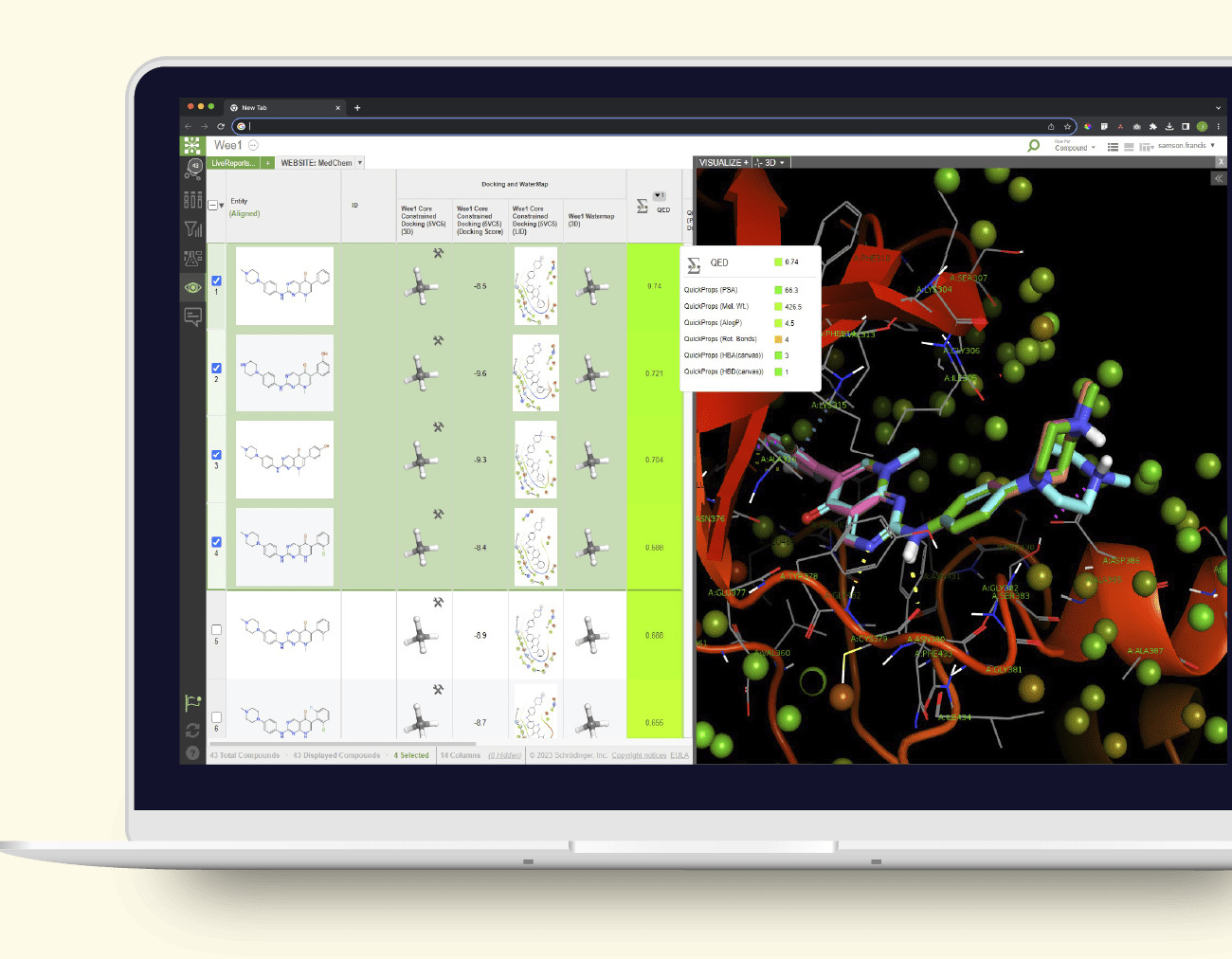
FEP+ is only one station on the workbench. Glide screens how ligands may fit receptors. Prime works on protein structures. WaterMap models the energetics of water in binding sites. BioLuminate supports biologics design. Maestro is the graphical cockpit, while LiveDesign is the shared room where computational chemists, medicinal chemists and outside research partners compare designs, calculations and lab data. For less specialized users, that connective tissue may matter more than any individual algorithm.
One engine, four cash registers
Schrödinger is commonly filed under “AI drug discovery,” but that label hides the more interesting machinery. It is a scientific-software company, a hosted enterprise vendor, a contract discovery partner and an owner of drug-program economics. Customers pay for licenses, cloud usage, support, deployment and research services. Pharmaceutical partners can also pay upfront fees and milestones, while Schrödinger may retain royalties or equity in companies it helped create.
Rent the workbench
On-premise and increasingly hosted access to modeling, informatics and machine-learning tools.
Bring in the scientists
Target enablement, hit discovery, protein design and materials research for teams that need expertise as well as code.
Share the program
Upfront research payments, potential milestones and royalties tied to molecules advanced with drugmakers.
Keep a sliver
Equity and program rights in co-founded biotechs turn platform use into long-dated, uneven upside.
The Novartis agreement announced in 2024 shows the bundle at full size: $150 million upfront for a multi-target research and license collaboration, as much as roughly $2.3 billion in potential milestones, tiered royalties, and a three-year expansion of software access across Novartis research. The milestone ceiling is possibility, not booked revenue. But the pairing is strategic. A customer does not merely test a tool; it embeds the platform while both companies work on molecules.
Sell the software. Use the software. Let the hard projects expose its weaknesses. Put the learning back into the software.Schrödinger's operating flywheel, in plain English
The bill for better guesses
What does this cost? Schrödinger does not post one universal price card, and enterprise deployments vary. A company white paper described one free-energy calculation campaign costing approximately $20,000. Treat that as a project example, not a quote. The real comparison is against chemist time, compound synthesis, cloud compute, assays and the delay caused by following a poor series.
At company scale, the expense is easier to see. Schrödinger reported $255.9 million in 2025 revenue, up 23.3 percent. Software contributed $199.5 million; drug discovery added $56.4 million. It also posted $309.5 million in operating expenses and a $103.3 million net loss. The physics engine may help customers spend more selectively, but maintaining the platform, research staff and therapeutic portfolio is not light work.
Then biology voted no
The first thing to fail was not the software franchise. It was the assumption that Schrödinger should carry an expanding set of its own discoveries deep into clinical development. In August 2025, the company discontinued SGR-2921, a CDC7 inhibitor then in a Phase 1 trial for acute myeloid leukemia and high-risk myelodysplastic syndromes. Later that year it said it would complete dose-escalation work for two other Phase 1 programs but did not intend to push new discovery programs into the clinic independently.
The plan changed. Schrödinger shifted toward discovery-stage work, licensing, new ventures and collaborations, paired with measures expected to save about $70 million. Partners with larger development organizations would be asked to carry more of the clinical burden.
That retreat is not proof that molecular modeling failed. It is proof that a well-designed molecule is not yet a medicine. Human biology, safety, dosing, patient selection and trial execution live downstream from the problems Schrödinger models best. The adjustment also clarifies where the company fits: upstream of the clinic, where many molecular options exist and the cost of choosing badly compounds.
Schrödinger still gets paid for downstream success. By the end of 2025, it described a portfolio of more than 25 collaborative and proprietary programs, more than 10 in the clinic, with 16 eligible for royalties. It said drug-discovery initiatives had generated over $650 million in cash since 2020. Co-founded companies produced notable outcomes: Lilly bought Morphic for about $3.2 billion, Takeda paid $4 billion upfront for Nimbus’s TYK2 program, and Lilly completed an acquisition of Ajax valued at up to $2.3 billion in 2026. Those transaction values are not Schrödinger revenue, but they validate why the company keeps a toe in ownership.
The flywheel worth stealing
Few readers can copy three decades of force-field research. The organizational pattern is more portable. Schrödinger sells to demanding practitioners, uses the same product on internal projects, records where predictions and workflows disappoint, then routes those lessons back to the platform. Its discovery group is both a customer and a stress test. The software team gets feedback from people with real deadlines and expensive consequences.
Own a narrow decision
“Which molecule should we make next?” is more actionable than “reinvent drug discovery.” Start with one repeated, costly choice.
Pair prediction with a system of record
A score becomes useful when teams can compare it with experimental evidence, discuss it and recover the decision later.
Dogfood where failure is expensive
Internal use should expose the product to the same ambiguity, scale and accountability customers face.
Keep outcome economics selective
Services, milestones, royalties and equity can capture upside, but they also make revenue lumpy and capital demands harder to control.
Bunsen arrives, carrying the old physics
In summer 2026, Schrödinger put an agentic layer over the workbench. Bunsen is an AI co-scientist intended to plan and execute chemistry-native workflows, use the company’s computational tools and work alongside its RetroSynth synthesis-planning system. Bristol Myers Squibb agreed to deploy it and collaborate on new functionality. The name is playful; the positioning is careful. Bunsen is not a language model asked to hallucinate its way through chemical space. It is an interface and orchestrator for established calculations, data and operating procedures.
The same logic sits behind the Lilly TuneLab partnership. Participating biotechs can reach Lilly’s federated-learning workflows through LiveDesign while keeping proprietary data separated. Schrödinger supplies the shared environment and physics-based calculations. This matters because molecular AI often confronts sparse, biased experimental data. Simulation can generate another form of signal, provided the physical model is appropriate.
- When the biological target is wrong, a beautifully optimized binder can still be useless.
- When protein structures, assay data or chemical starting points are weak, the ranking inherits that uncertainty.
- When a project sits outside a model’s validated domain, confident numbers can outrun evidence.
- When compute and specialist labor cost more than the experiments being avoided, simulation becomes theater.
- When teams cannot integrate predictions into daily decisions, even accurate output becomes another forgotten file.
The competitive field is broad: BIOVIA, Chemical Computing Group, Cadence’s OpenEye tools, Certara, Dotmatics, Chemaxon, Cresset and newer AI discovery companies all attack pieces of the workflow. Academics can reach for AMBER, CHARMM, GROMACS or OpenMM. Large drugmakers build internal systems. Schrödinger’s defense is integration plus accumulated trust: many methods, one collaborative environment, scientific support and evidence from programs where its own money was exposed.
Its best pitch, then, is not that the computer knows the answer. It is that a disciplined combination of physics, learned models and experimental feedback can make the next question cheaper. That sounds modest beside promises to automate invention. In a laboratory, modest can be valuable - especially when it keeps 10,792 bad ideas out of a flask.
Take a look at the workbench
Explore the platform, watch the short company film or inspect the open-source projects maintained by Schrödinger’s developers.