A protein does not pose for its portrait. It bends, shifts and settles into different shapes. For a drug designer, that is troublesome: the shape a molecule binds to can influence what happens next. Superluminal Medicines has built its business around that complication. The Boston biotech wants to design small molecules for particular states of cell-surface receptors, then check whether the cell receives the intended message.
- The method: model receptor motion, design compounds, test the biology.
- The business: an internal drug pipeline plus pharmaceutical collaborations.
- The next test: an obesity candidate expected to enter Phase 1 by the end of 2026.
It is an appealing proposition with an unforgiving finish line. A convincing model has to become a useful medicine. Between those two things sit chemistry, safety studies, human trials and enough inconvenient results to ruin a beautiful slide deck. Superluminal’s interest lies in how it connects those jobs.
01 / The trouble with a portrait
The company began in 2022 and emerged publicly with a $33 million seed round in August 2023. Co-founders Cony D’Cruz, its CEO, and Ajay Yekkirala, now chief scientific officer, brought together commercial and biological experience. D’Cruz had worked at Schrödinger; Yekkirala had worked at RA Capital and co-founded Blue Therapeutics. The problem they chose was highly specific.
G protein-coupled receptors, or GPCRs, help cells respond to signals. Superluminal focuses on these membrane proteins, initially for endocrine and cardiometabolic diseases. Many lack detailed structural information. Even when a structure exists, a single image cannot describe every state a receptor can adopt.
The company’s Target GPS methods predict collections of conformations. Hyperloop, its broader discovery platform, combines those models with virtual screening, generative chemistry, structural biology and laboratory readouts. Its website describes the ambition as “Movies rather than static pictures.” The practical question is which shape offers a useful opportunity for a drug.
- 01PredictExplore receptor shapes
- 02DesignPropose small molecules
- 03TestMeasure biological response
That last step gives the proposal its discipline. A compound must engage its target and produce the desired response. Predictive ADMET tools examine absorption, distribution, metabolism, excretion and toxicity; experimental profiling checks drug properties. A plausible docking pose is an invitation to investigate.
02 / Nine molecules, eight signals
There is a useful piece of public evidence beyond the financing announcements. In August 2025, researchers including Superluminal scientists coauthored a Communications Chemistry paper combining generative AI with a physics-based active-learning framework. The system proposed molecules, evaluated them and used selected results to refine subsequent generation.
For CDK2, the researchers synthesized nine molecules, including analogues. Eight showed activity in laboratory assays; one reached nanomolar potency. For KRAS, they identified four molecules with potential activity computationally. The distinction matters. The CDK2 result included experimental testing. The KRAS result remained a prediction.
Molecules showed in vitro activity.
A selected experimental set, not a platform-wide success rate.
Neither result proves that Superluminal’s obesity drug will work. Neither target is MC4R. What the paper offers is a concrete example of generated chemistry meeting an assay, with the boundary between measured and predicted results still visible. Readers can inspect the work instead of taking the word “AI” on credit.
03 / A button worth pressing
The less glamorous machinery is revealing, too. A Globus case study describes Superluminal’s structural-model workflow: edit locally, transfer files to a high-performance computing cluster, run refinement, retrieve results, repeat. Scientists previously navigated manual transfers and remote logins through several iterations. Globus automated that sequence into a button-driven process.
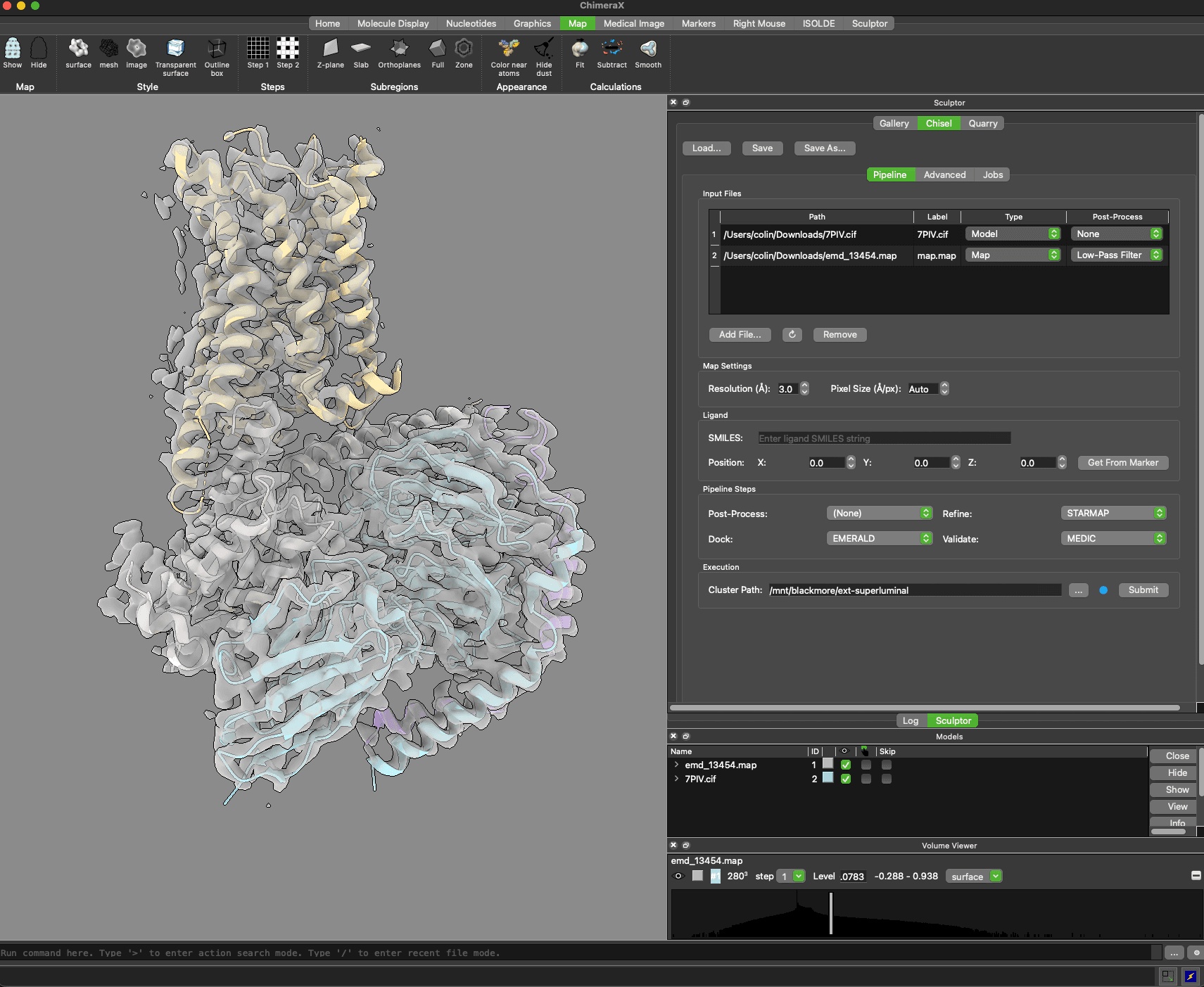
The company’s stated culture prizes collaboration and transparency. Here is a practical expression of collaboration across biology and computing: make the handoff easier. For another research team, the transferable lesson is modest and useful. Automate the repeated work around an experiment so researchers can spend more attention on its result.
04 / The billion-dollar asterisk
Superluminal is building drug assets through its own pipeline and partnerships. In August 2025, Lilly agreed to collaborate on undisclosed GPCR targets relevant to obesity and cardiometabolic disease. Superluminal discovers and optimizes compounds; Lilly receives exclusive development and commercialization rights after candidates meet predefined criteria.
The announced potential value is up to $1.3 billion, covering upfront and near-term payments, an equity investment and development and commercial milestones. Tiered royalties also feature in the terms. The financial breakdown is undisclosed. Counting the entire headline figure as money already raised would give a conditional agreement a rather extravagant promotion.
Those rounds finance a different kind of commitment. The $120 million Series A supported pipeline expansion and clinical development; the $60 million Series B is intended to support the lead program’s first trial and additional discovery. They describe available financing, rather than the cost of building Hyperloop or the amount spent per candidate.
Axcelead supplies another part of the picture. The companies’ June 2025 announcement described earlier in vivo evaluations and joint predictive ADME work, then an intended collaboration on defined molecular targets. Superluminal’s computational expertise operates within a network of experimental capabilities.
05 / The receptor meets the patient
The lead internal program is an oral, selective, biased MC4R agonist for rare genetic forms of obesity and hypothalamic obesity. “Biased” describes a drug designed to favor particular signaling pathways. The aim is therapeutic activity with fewer unwanted effects. The company reports encouraging preclinical selectivity and safety; its September 2026 announcement expects Phase 1 to begin by year-end.
Superluminal shares its market with other GPCR specialists. Septerna’s Native Complex platform recreates receptors outside cells to study their structure and function. Superluminal emphasizes predicted conformational ensembles integrated with experimental structures and testing. Both approaches confront the same commercial question: can the platform produce differentiated medicines?
“It’s really hard to value an algorithm.”
Cony D’Cruz, 2023 interview
That observation is a useful limit on the entire story. Researchers can borrow the feedback loop. Pharmaceutical partners can commission discovery against difficult targets. Patients need clinical evidence. If predicted behavior fails to survive laboratory or human testing, speed alone cannot rescue the molecule. Superluminal’s next chapter will be written in the results.