There is a small cruelty in the way we draw proteins. On a slide, a receptor sits still, as obliging as a keyhole. In a cell, it wriggles. A fold opens, a pocket forms, and then the pocket disappears. If the right molecule arrives in that interval, chemistry may become medicine. If a search looks only at the tidy portrait, it may never see the opening at all.
That is the premise behind Deep Apple Therapeutics. The South San Francisco company studies different shapes of disease-relevant proteins, then searches enormous computer-generated libraries for small molecules that might bind to them. It uses cryo-electron microscopy to see structures, machine learning and molecular dynamics to reason about motion, and large-scale docking to rank plausible matches. The promising suggestions eventually face the less romantic verdict of a laboratory assay.
- What it makes: investigational small-molecule drug candidates, chiefly for inflammatory and metabolic conditions.
- Who pays: pharmaceutical partners can fund discovery and license candidates; Novo Nordisk is the named example.
- What makes it distinct: its search begins with moving protein conformations and project-specific virtual libraries.
- Where it stands: DA-003 had a clinical trial application submitted by August 2026; no approved medicine is listed.
The lock changes shape
Many of Deep Apple's targets are G protein-coupled receptors, or GPCRs. These proteins relay signals across cell membranes. Drugs have long exploited the family, but familiar GPCR medicines reach only part of it. Deep Apple is particularly interested in signaling states that a static structure or a conventional empirical screen might miss. Its academic founders arrived from unusually complementary directions: Georgios Skiniotis studies GPCR structures with cryo-EM at Stanford; Brian Shoichet pioneered large-library docking at UCSF; John Irwin helped build the ZINC database of synthesizable molecules there. Apple Tree Partners assembled the company around their work, with Spiros Liras as founding chief executive.

The workflow is more disciplined than the phrase “AI drug discovery” usually suggests. First comes a target with a plausible role in disease. Structural images and computation expose candidate pockets as the protein moves. Docking software asks which virtual molecules might fit. Orchard.ai, the company's proprietary library tool, expands chemical space for that specific target. Chemists can then make selected compounds and biologists test whether the predicted interaction actually produces the wanted effect. Results feed the next round of models. The experiment, in other words, gets a vote.
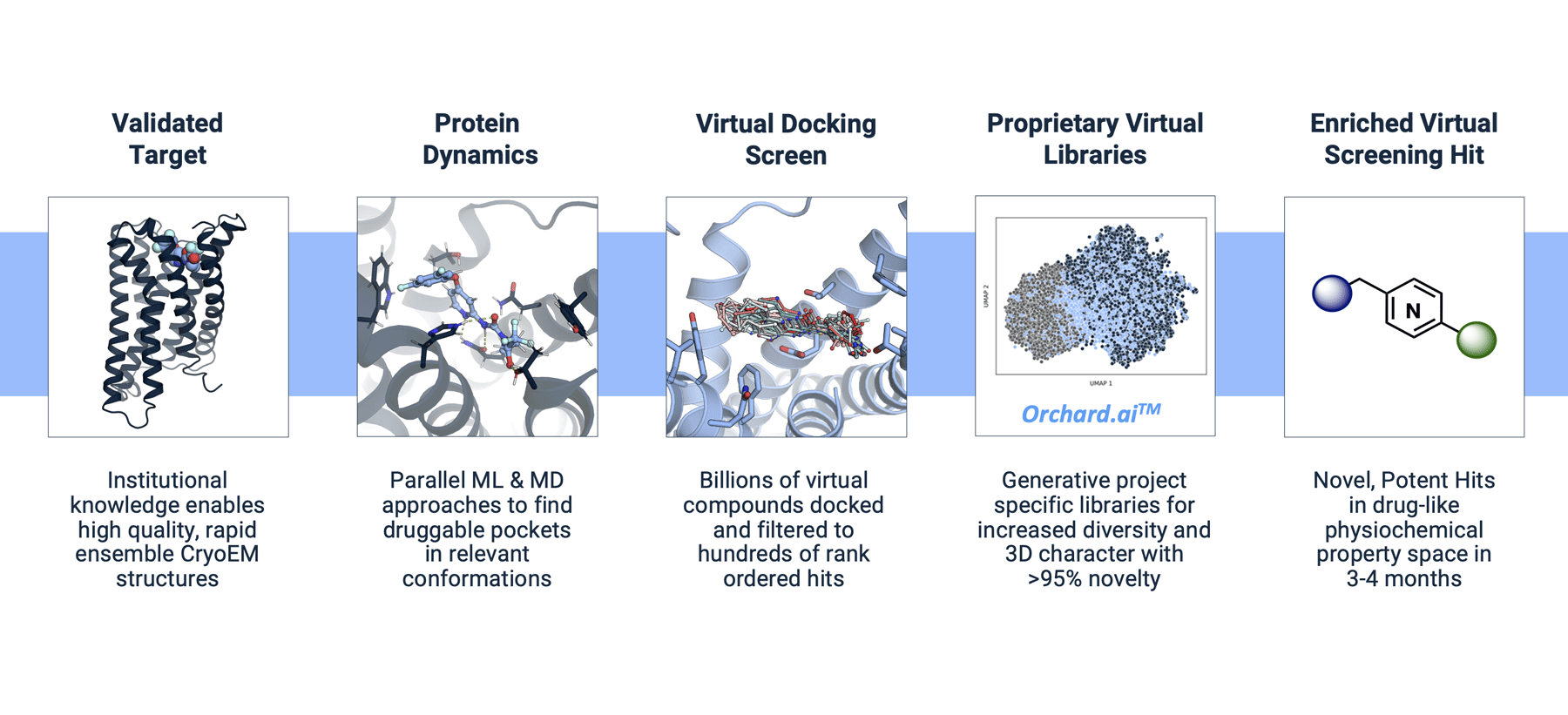
Deep Apple says its Orchard.ai libraries are more than 95% novel relative to ZINC22, and that its discovery engine can move from target identification to lead optimization in 12 months or less. Those are company-reported measures of chemical novelty and discovery speed. Neither predicts that a compound will prove safe or useful in people. There is also no public price list for Orchard.ai: the tool appears to be part of Deep Apple's own research and partnership work, not an off-the-shelf subscription.
The interesting question is not how many molecules a computer can count. It is whether one of them survives the next experiment.Deep Apple's discovery logic, in plain English
From a virtual orchard to an actual candidate
In August 2026, the company offered a more tangible answer than a platform diagram. At the American Chemical Society's Fall meeting, scientist Craig Stivala presented DA-003, an oral antagonist of MRGPRX2. This receptor is involved in mast-cell activation and is being studied for inflammatory conditions including atopic dermatitis, asthma and migraine. The campaign began with a virtual screen of more than 560 million molecules. By the time of the disclosure, a clinical trial application had been submitted.
That is an accomplishment with a precise boundary. A submitted application is a step toward human research, not a completed trial or an approved treatment. The current public account does not establish that DA-003 helps patients. It does establish that Deep Apple's machinery has produced a named candidate with a structure sufficiently developed to be shown to medicinal chemists. In a field where platforms can remain forever in the future tense, that matters.
A deal measured in two currencies
Deep Apple emerged publicly in December 2023 with a $52 million Series A commitment from Apple Tree Partners, the venture firm that created and incubated it. The funding paid for a research organization rather than a drug on a pharmacy shelf. The company now lists programs across immune inflammation, obesity and endocrine disease, with some aimed beyond the well-worn GLP-1 path. Its public pipeline shows several stages from virtual hit identification through lead optimization and development-candidate nomination. Those labels describe research progress, not proven clinical benefit.
Then, in June 2025, Novo Nordisk signed a research collaboration and exclusive worldwide license for oral small molecules aimed at a novel non-incretin GPCR in cardiometabolic disease, including obesity. Deep Apple would discover and optimize compounds. Novo would take responsibility for later development and commercial work. For Deep Apple, this made its platform a business: a large drugmaker was willing to pay for a defined target campaign rather than merely admire the technology.
Deep Apple is eligible for up to $812 million across an undisclosed upfront payment, research costs and milestones. The figure is a contractual ceiling tied to future events, not the amount received in 2025. The upfront sum was not disclosed.
The commercial structure suits the work. A young company can focus on the hazardous early search; a partner with clinical and manufacturing infrastructure can carry a successful candidate farther. That also gives Deep Apple two kinds of customers. Its immediate paying customer is a pharmaceutical research partner. Its eventual intended user is a patient, but only if a candidate survives trials and regulatory review. The distance between those two customers is measured in years, experiments and uncertainty.
What an imitator would have to copy
The obvious imitation is to buy computing power and announce a very large virtual library. That misses the useful lesson. Deep Apple started with a particular biological problem - proteins whose relevant pockets may appear only in certain conformations - and joined three kinds of expertise around it. Its sequence is repeatable in principle: choose a validated target, collect several meaningful structural states, design or select synthesizable molecules for those states, rank them computationally, then let real assays correct the rankings. Each step narrows the next.
The approach also has boundaries. A beautiful docking score cannot resolve a wrong disease hypothesis, poor exposure in the body, toxicity or a failure to make a compound at scale. Some targets resist the structural work needed to reveal their states. Some virtual hits will collapse when tested. Deep Apple's own declared preference for virtual hit identification makes laboratory feedback especially important. The visible change so far is from a funded discovery thesis to a named candidate and a partner willing to contract for the method.
Deep Apple competes with the old-fashioned physical screen, with other structure-based discovery teams, and with AI drug companies that also promise to widen the search. Its real distinction is the order of operations: motion first, pockets second, molecules third, experiments always. The pocket may last only a moment. The evidence for a medicine will have to last much longer.