He thinks a living cell is a set of equations you can solve - not a black box you can only poke. At Syntensor, he is building the solver.
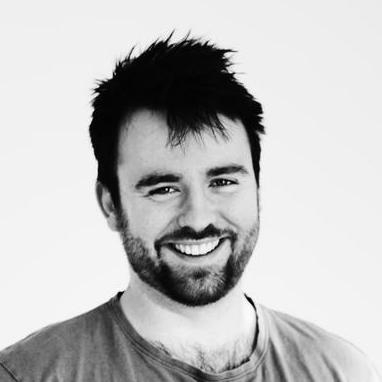
Most of biotech sequences biology. Clayton Rabideau wants to simulate it. His company, Syntensor, is building a mechanistic model of human physiology - software that watches a drug enter a cell and predicts, in advance, whether it will work, whether it will poison, and why a clinical trial three years from now is likely to fail.
That last word matters. Roughly nine in ten drugs that enter human trials never make it out. Each failure can cost hundreds of millions of dollars and a decade of someone's life. The standard industry response is to run more experiments, more carefully. Rabideau's response is stranger: run the experiment inside a computer first, cheaply, thousands of times, and only take the survivors to the bench.
Syntensor describes what it builds as foundation models for cellular biology - the same family of large, pretrained models that power modern AI, pointed at the messy, time-dependent machinery of the cell. The pitch he carries to conference stages is blunt: make biology programmable, iterative, and as fast as software development.
Stack glimpsed in the wild: PyTorch, Python, React, Node.js, on AWS. The name itself - Synthesis + tensor - is biology shaking hands with deep-learning math.
Making complex biological processes tractable at scale for scientists, drug developers and clinicians.
A cell is not a sentence. It does not sit still while you read it left to right. It moves through time - concentrations rise, pathways switch, signals cascade. So while much of AI-for-biology leans on transformers borrowed from language, Rabideau also reaches for an older and more physical kind of mathematics: dynamical systems, the equations that describe how things change.
He is a member of DiffEqML, the open-source group behind TorchDyn - a PyTorch library devoted entirely to neural differential equations. His own pinned project, symtorch, lives in the same world. This is the rare founder who, between fundraises, still pushes commits to a numerical-methods library under the handle clayton-r.
The bet underneath all of it: if you encode the physics of how a cell actually behaves, your model can extrapolate to drugs and conditions it has never seen - instead of just pattern-matching the past.
Syntensor sits on the seam between two AI traditions - and uses both.
In 2023, Rabideau was a co-author on HyenaDNA, a NeurIPS spotlight paper that pushed genomic language models from a few thousand bases of context to roughly a million - at single-nucleotide resolution. The co-author list reads like a deep-learning hall of fame: Yoshua Bengio, Christopher Re, Stefano Ermon among them. The chart below sketches the leap in how much DNA a model can hold in mind at once.
Bars are illustrative of relative context length, not exact benchmark values. Source: HyenaDNA, NeurIPS 2023 (arXiv:2306.15794).
Begins a PhD in chemical engineering and biotechnology at the University of Cambridge, working on computational synthetic biology.
Co-founds Syntensor with Rosie Higgins in January - years before "AI for biology" became a venture-capital chorus.
Completes the Cambridge PhD, carrying the dynamical-systems toolkit straight into the company.
Co-authors a NeurIPS spotlight paper on long-range genomic modeling alongside some of the most cited names in the field.
Syntensor raises a seed round - Lifeforce Capital, Hula, Morningside, Lexi Ventures - and opens a Republic community campaign.
Speaks on "reprogramming biology at cloud speed" and predicting efficacy and toxicity in next-gen drug discovery.
Read his profiles and a temperament shows through. The man co-writes a paper with Turing-laureate company, then quietly returns to maintaining a small numerical library. His GitHub location says Cambridge; his company sits at 6 Montgomery Street in San Francisco. His bio line - "Building foundation models for cellular biology" - is a sentence, not a sermon.
There is something honest in the framing he uses for the work: not a cure, not a moonshot poster, but a tool. A way to make biology iterate. The grandiosity, if it exists, is hidden inside the size of the problem - human physiology, simulated - rather than spread across the marketing.
His Twitter/X handle is @ClaytonRab; his GitHub is clayton-r. Find the work, not just the brand.
He co-founded Syntensor with Rosie Higgins in January 2019 - before the AI-for-biology gold rush had a name.
Syntensor pitches 80%+ accuracy at predicting drug response and toxicity - a number aimed at a 90% failure rate.
His pinned GitHub repo, symtorch, is tagged simply "Initial Commit" - the founder's eternal optimism.
The name Syntensor fuses synthesis with tensor: wet biology meeting the math of deep learning.
He helps maintain TorchDyn, a PyTorch library devoted entirely to neural differential equations.
Reprogramming biology at cloud speed.