The medicine did what it was meant to do. Luis Voloch's grandfather's cancer went into remission after treatment. Then the side effects became so severe that he stopped taking the drugs. It is a cruel kind of success: a tumor retreats, but the patient cannot bear the route. For Voloch and fellow mathematician Noam Solomon, the episode turned a technical curiosity into a more urgent question. Why can the same treatment help one person and defeat another?
The two were working in computing, not running an immunology lab. They founded Immunai in 2018, then brought in researchers who knew the biology they did not: Stanford immunologist Ansuman Satpathy and cancer immunotherapy scientist Danny Wells. Their wager was that the immune system could be measured in enough detail to explain some of those differences. They began with published single-cell data, added clinical information and built what Solomon called a “Google Maps for the immune system.”
The short version
- Immunai measures immune cells and connects their molecular features to treatment outcomes.
- Its buyers are drug developers choosing targets, trial patients, doses and biomarkers.
- The product is a sequence: data generation, a curated atlas, machine learning, lab validation and a recommendation.
- Its disclosed pharma agreements show demand for the work; they do not establish that any resulting drug will be approved.
The atlas had to learn a job
A map is useful because someone wants to go somewhere. Immunai's early pitch could sound like cartography for its own sake: collect immune cells from many diseases, describe their states, and make an extraordinarily detailed atlas. That scientific project became a business when the team attached it to decisions pharmaceutical companies already had to make. Which biological target deserves an experiment? Which dose belongs in a trial? Which patients should be enrolled together, and which are likely to respond differently?
Immunai's database, AMICA - the Annotated Multiomic Immune Cell Atlas - combines single-cell measurements with clinical context. RNA can show which genes a cell is expressing; surface proteins and immune-receptor information add other dimensions. The company harmonizes studies so a cell in one dataset can be compared with one in another. It says the atlas spans hundreds of diseases and cell types. Size matters here, but so does labeling: a million poorly described cells may tell a drug developer less than a smaller set with reliable information about disease, treatment and outcome.
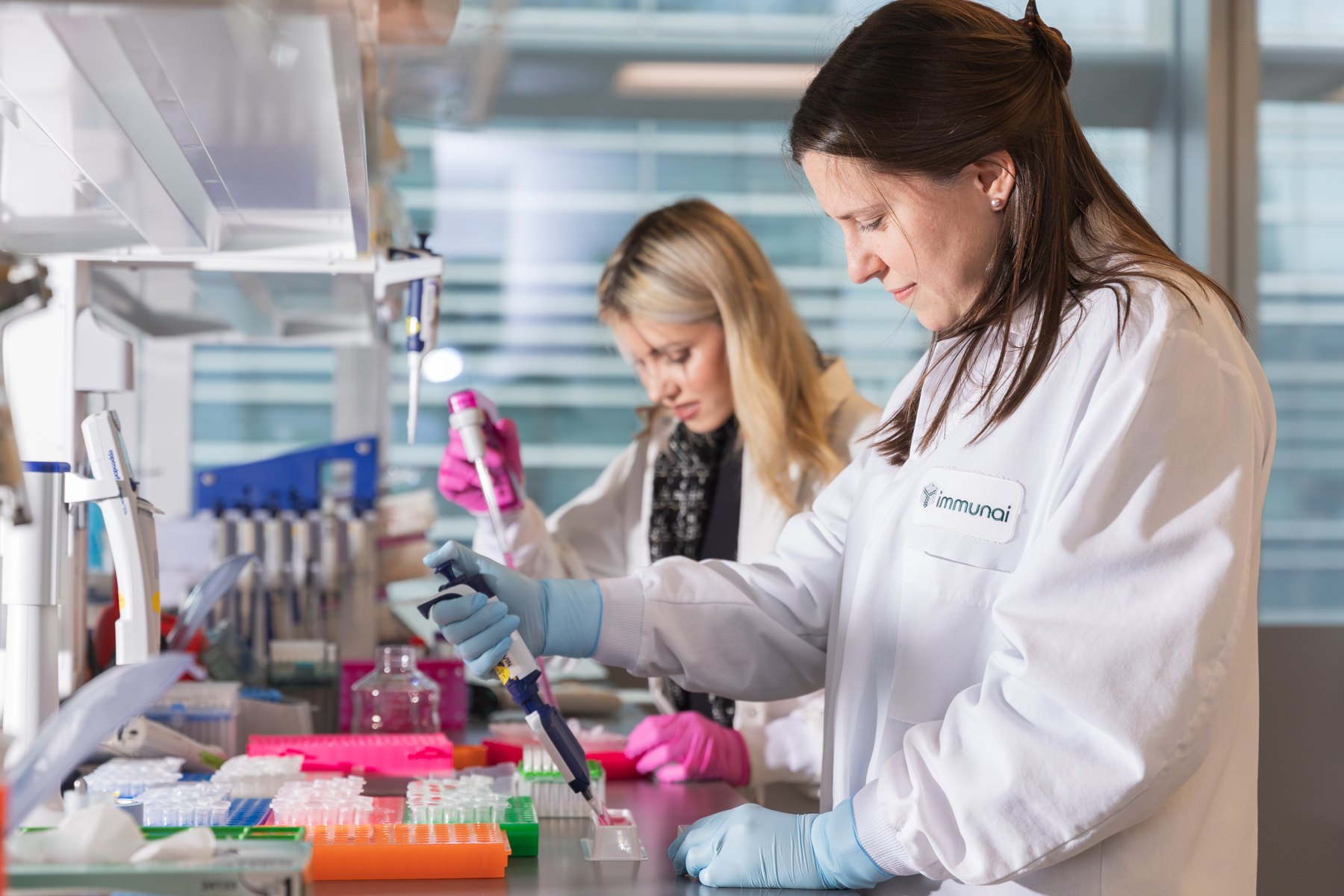
The company strengthened that unglamorous middle in 2021 by acquiring Dropprint Genomics, a single-cell software company, and Nebion, a specialist in data curation. These were purchases of infrastructure and judgment. A clever model trained on mismatched studies can produce a confident mistake. AMICA's promise depends on turning different experiments into comparable evidence.
A therapeutic question goes through five gates
cell data
with AMICA
patterns
in the lab
a move
A prediction is a request for an experiment
The ImmunoDynamics Engine is the analytical layer that searches for immune patterns linked to a question. If a therapy appears to work only in a subset of patients, the system can compare their immune profiles with those of nonresponders. It can propose a biomarker or a mechanism. Immunai then uses functional genomics and other laboratory work to test whether the proposed biology holds up. The platform is now described as AMICA-OS, a combination of atlas, models and validation rather than a database that hands over an answer and leaves.
That distinction is its positioning in the crowded market for AI drug discovery. A pharma company can hire bioinformaticians, contract a sequencing lab, buy data tools or work with another platform. Immunai's offer is to join those pieces around the immune system and return a reasoned choice. It sells expertise as much as software: immunologists, computational biologists, engineers and drug developers have to agree on what a useful result would look like before the first sample enters the machine.

“The most exciting aspect of the platform we have built is the fact that it's vertically integrated.”Noam Solomon, speaking to MIT News in 2024
The word “integrated” does heavy work. It means Immunai can begin with a partner's blood or tissue samples, profile cells, compare them with the atlas, find a candidate signal, test it, then offer a recommendation with the underlying data. It does not mean the platform can turn every correlation into a drug. A trial still has to determine whether a proposed marker predicts a benefit that matters to patients.
Four buyers, four versions of the question
AstraZeneca gives the clearest view of how the business developed. The companies began working together in 2022. A 2024 oncology collaboration brought an $18 million initial phase for work on dose selection, drug mechanisms, responder analysis and biomarkers. In 2025 AstraZeneca secured exclusive rights to develop an inflammatory bowel disease target identified by Immunai's platform; the announced agreement carried up to $85 million in total potential consideration. In May 2026, AstraZeneca expanded the oncology work again through 2027, with Immunai eligible for up to $37.5 million over 2026 and 2027.
Other partners have different assignments. Teva's collaboration uses immune data for clinical decisions in oncology and immunology. Bristol Myers Squibb began a 2026 collaboration to study patient immune responses in clinical development. Boehringer Ingelheim set Immunai a more exploratory problem: search for T-cell dysfunction patterns shared across cancer and autoimmune disease. Its initial program, valued at up to $15 million through 2027, will analyze thousands of patient samples and investigate promising findings in the lab.
That last brief is unusually revealing. Cancer and autoimmune disease are often studied in separate professional rooms. An immune cell does not care about the room. By comparing both settings, Immunai hopes to find biological patterns that disease-specific searches might miss. It is an interesting hypothesis, not a therapeutic result. The disclosed contract buys a search and a set of experiments, not a cure.

What the map demands in return
Immunai's model has another side: access to patient material and clean clinical history. Its academic collaboration proposes a data-for-data bargain. Selected noncommercial research centers bring approved patient cohorts and anonymized metadata; Immunai pays for sequencing and returns raw data, quality reports and cell annotations. The company says it can process cohorts of 100 to more than 1,000 samples. The institution still pays for collection, shipping, regulatory work and insurance. The atlas grows as the researchers get measurements they might otherwise struggle to fund.
This arrangement suggests a practical lesson others can borrow. Build a data resource around a question your customer must answer, insist on metadata that makes comparisons meaningful, and make the model's claim face an experiment. Those steps are less glamorous than a large AI announcement. They are also the steps that let a customer act.
The constraint is biological, not decorative. Immunai's own academic terms require viable cells, appropriate approvals and usable clinical metadata. Without comparable patient cohorts and a testable follow-up, even a sophisticated atlas can only produce a plausible story.
There is no public price list for the pharma work. Nor does a collaboration's ceiling tell us how much Immunai has collected. The funding story is better documented: the company announced a $20 million seed round in 2020, a $60 million Series A in February 2021 and a $215 million Series B that October. The money financed a broad bet on data, labs and people. Whether that bet ultimately improves treatment is a longer experiment than any fundraising cycle.
The founders started with an uncomfortable fact: a medicine can succeed on a scan and fail in a life. Immunai's map will matter if it helps a developer notice that distinction early enough to choose differently. Until then, the map is an impressive object. The medicine is still the test.