There is an old habit in drug discovery: pick a target, make something that binds to it, and hope biology behaves. Dualitas Therapeutics begins with a less tidy proposition. Perhaps the interesting event is not the binding. Perhaps it is the introduction.
On the surface of an immune cell, proteins crowd together like guests at a reception. Some signal. Some receive. Some remain politely useless until the right neighbor appears. Dualitas builds bispecific antibodies - Y-shaped molecules engineered with two different binding arms - to bring selected proteins close enough that the pairing produces an effect neither arm can achieve alone.
This distinction sounds small, almost semantic. It is the difference between ordering two dishes and discovering that the ingredients make a third. A conventional bispecific can combine two known inhibitory jobs. Dualitas wants proximity itself to become the mechanism.
The second arm is not a spare key. It is the person making the introduction.
01 / The reversalStart with the crowd, not the celebrity
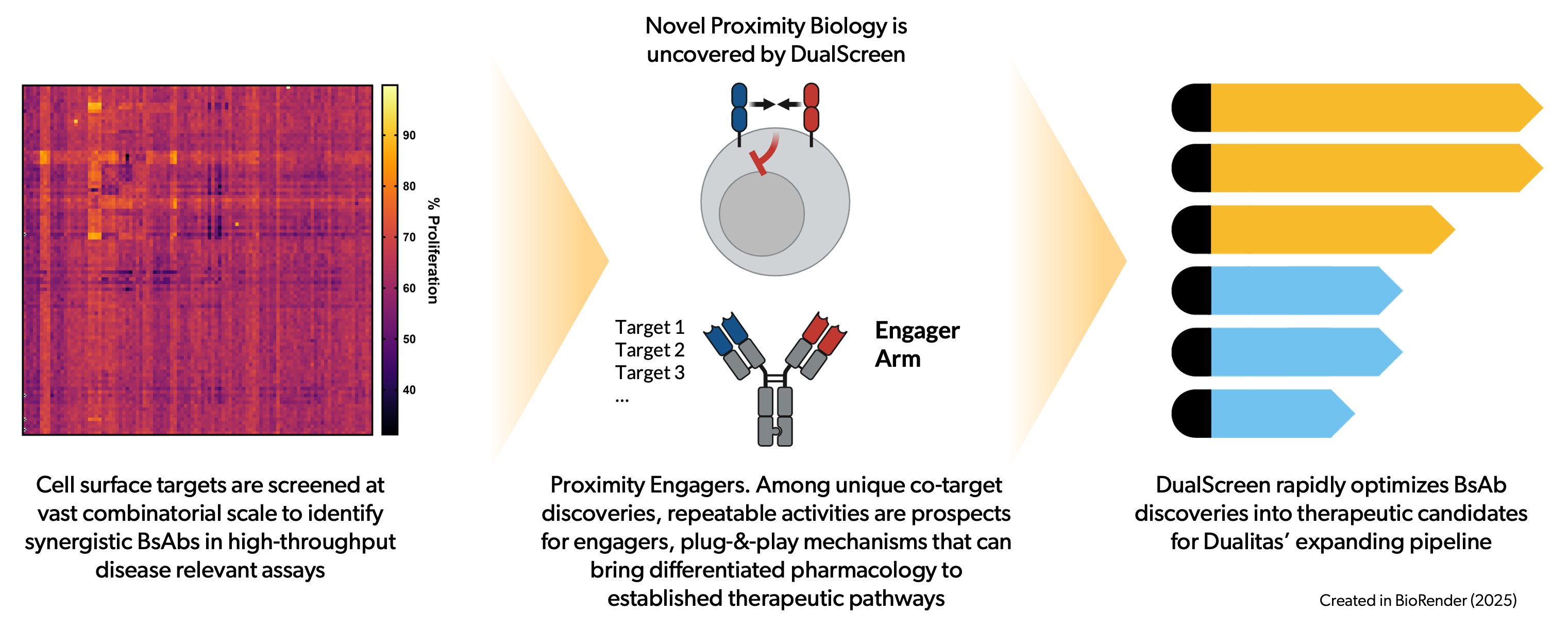
The first thing Dualitas discarded was the tidy shortlist. Traditional programs often nominate two targets from existing biology and then build a molecule around the choice. DualScreen, the company's discovery engine, arrays large libraries of antibody arms and tests the resulting pairs in functional assays. The question is not simply, “Did both arms bind?” It is, “Did the cell behave differently?”
An internal campaign can array more than 100,000 unique combinations. The newly announced Roche collaboration stretches that idea beyond 300,000. At this scale, Dualitas is looking across what it calls the cell surfaceome - the landscape of proteins presented on a cell - for useful relationships a researcher might never have thought to nominate.
02 / What changedA reusable arm, then three different diseases
The company did not publish a romantic origin story about one failed experiment changing everyone's mind. Its technical choice is more useful than that. Instead of building every bispecific from scratch, DualScreen has produced reusable “proximity engager” arms. Pair one of those with an antibody aimed at a validated immune target, and the company can test whether the engager amplifies potency, changes immune modulation, speeds onset or directs activity toward a particular cell type.
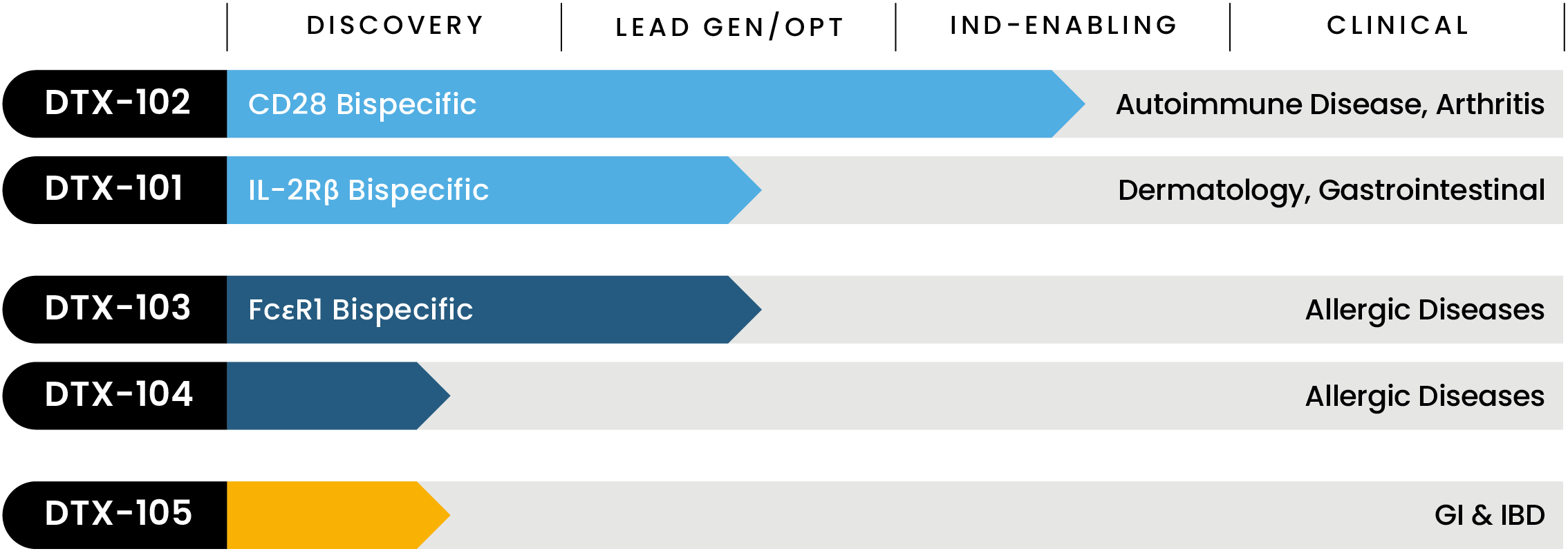
That architecture has produced three disclosed programs. DTX-102, now the lead development candidate, combines an optimized anti-CD28 arm with an immune proximity engager for rheumatoid arthritis. IND-enabling studies are underway, with clinical entry anticipated in 2027. DTX-101 targets IL-2Rβ for dermatologic and gastrointestinal autoimmune disease. DTX-103 targets FcεRI for allergic diseases including asthma, food allergy and chronic spontaneous urticaria; the design is meant to work independently of a patient's IgE concentration.
That last sentence matters. Dualitas says its candidates have beaten commercial or clinical benchmarks in preclinical experiments. This is exactly what a young biotech should try to show, and exactly what cannot yet tell us whether patients will benefit. Cells and animal models are auditions. Human trials are opening night.
03 / The buyer appearsRoche did not buy a drug. It bought a search.
Dualitas was founded in 2023 by antibody engineer Greg Lazar and operator-dealmaker Forbes Huang. It came out of stealth in September 2025 with $65 million from Versant Ventures, Qiming Venture Partners USA, founding investor SV Health Investors, and strategic investors including Eli Lilly and Chugai Venture Fund. That money was meant to advance the pipeline and keep improving DualScreen.


One year later, the platform found its first publicly announced customer. Roche agreed to pay $36.5 million upfront for Dualitas to functionally screen more than 300,000 new bispecific combinations in immunology and inflammation. Roche can select a limited number of programs and will take responsibility for later preclinical development, regulation, manufacturing and commercialization. If research, development and commercial milestones are met, total deal value can reach $1 billion; tiered royalties sit on top.

The headline number is seductive, but the smaller number is more informative. The $36.5 million is committed upfront. The balance is contingent on years of experiments and decisions. In biotechnology, a billion-dollar ceiling often describes the height of the staircase, not the money already in the room.
Still, the deal changes the company. Before Roche, Dualitas had investors and its own preclinical evidence. After Roche, it had a sophisticated pharmaceutical buyer willing to pay for a defined, large-scale campaign. That is commercial validation of the search process, though not clinical validation of any medicine it might produce.
04 / The actual marketThe competitor is the drug that already works
It is tempting to place Dualitas in a neat race against other bispecific platform companies. But the practical competition is harsher. Rheumatologists already have biologics and small molecules. Allergists already have therapies aimed at IgE and other immune pathways. A Dualitas candidate does not win because its mechanism makes a better diagram. It must offer some clinically meaningful mix of efficacy, speed, dosing, safety and access.
DTX-102 will carry that burden first. CD28 is an important immune signaling pathway, which makes potency attractive and safety scrutiny unavoidable. DTX-103 must show that IgE-independent action matters for real patients. DTX-101 must prove that suppressing IL-15 and IL-2 pathways through its chosen architecture creates a tolerable advantage. Until trials begin, the strongest claims belong in the future tense.
05 / The portable lessonWhat another builder can copy
Nobody outside a well-equipped antibody lab can copy DualScreen literally. The more interesting pieces are organizational. Dualitas built the platform and its own products together. The internal pipeline is not decoration; it forces the engine to produce molecules that can survive optimization, manufacturing constraints and development planning. The partnership business is not a vague “platform opportunity”; Roche received a quantified campaign and a clear handoff.
The proximity engager arm can be paired with different validated targets instead of being reinvented for every program.
Functional assays decide which pairs matter. Binding is necessary, but cell behavior is the filter.
Three internal programs make the platform answer to the demands of actual drug development.
“Screen more than 300,000 combinations” is a deliverable. “Transform discovery” is a conference slogan.
The company also made a leadership change at the moment the job changed. In June 2026, Karim Dabbagh replaced interim CEO Rich Murray, who stayed on the board. Dabbagh's background spans immunology research, clinical translation and pharmaceutical collaborations. The appointment coincided with DTX-102 becoming the lead candidate and IND-enabling work getting underway. Discovery had produced choices. The next phase requires saying no to most of them.
That is the paradox of a platform built to search an enormous space. Its value comes from abundance, but a drug company progresses through ruthless subtraction. Hundreds of thousands of introductions must become a few candidates, then perhaps one medicine. Dualitas has shown it can make the introductions. Roche has paid to attend the reception. The clinic will decide whether anyone important actually met.