In June 2026, Perpetual Medicines and Third Rock Ventures announced that they had delivered a development candidate in less than 18 months. The collaboration triggered a milestone payment. For a drug discovery business, this is a consequential kind of receipt: money attached to a molecule that has crossed an agreed threshold. Perpetual had merged with TandemAI the previous year. The result gives a concrete shape to TandemAI’s central proposition: connect the computer’s suggestions to the laboratory’s answers, then keep that conversation going.
- The offer: molecular design, simulation, synthesis and testing connected through TandemViz.
- The buyer: pharmaceutical, biotech and academic discovery teams.
- The business: paid research capacity or a standalone software license.
- The useful lesson: make each experiment inform the next decision.
The next molecule has a memory
TandemAI occupies the stretch of drug development where an idea must become a credible candidate. Its customers need to find promising compounds, improve them and decide which deserve further investment. A medicinal chemist wants to know what to make next. A computational chemist wants to know whether the prediction is useful. A project leader wants both answers before another week disappears.
The company brings together generative AI, physics-based molecular modeling, high-performance computing and in-house wet labs. TandemViz, its browser-based platform, puts those activities into a shared workspace. A researcher can inspect a molecular interaction, compare predictions with measured data and collaborate with colleagues or TandemAI’s scientists. The product is built around the movement from one decision to another.
- 01DesignPropose molecules
- 02SimulatePredict interactions
- 03MakeSynthesize compounds
- 04MeasureTest in the lab
The tools have distinct jobs. TandemDock helps generate binding poses. TandemGen proposes molecular designs. TandemFEP uses free-energy perturbation to estimate binding affinity. Molecular dynamics adds a view of how interactions behave over time. Chemistry and biology services supply experiments against which the ideas can be checked. A convincing picture still has to meet a measured result.
The queue is part of the science
One revealing feature is TandemQueue. It shows compounds moving through synthesis, lets users add notes and allows priorities to change. This sounds almost clerical until you consider the expensive question hiding inside it: which molecule should the team spend its time making? A queue makes the consequences of a design visible to everyone involved.
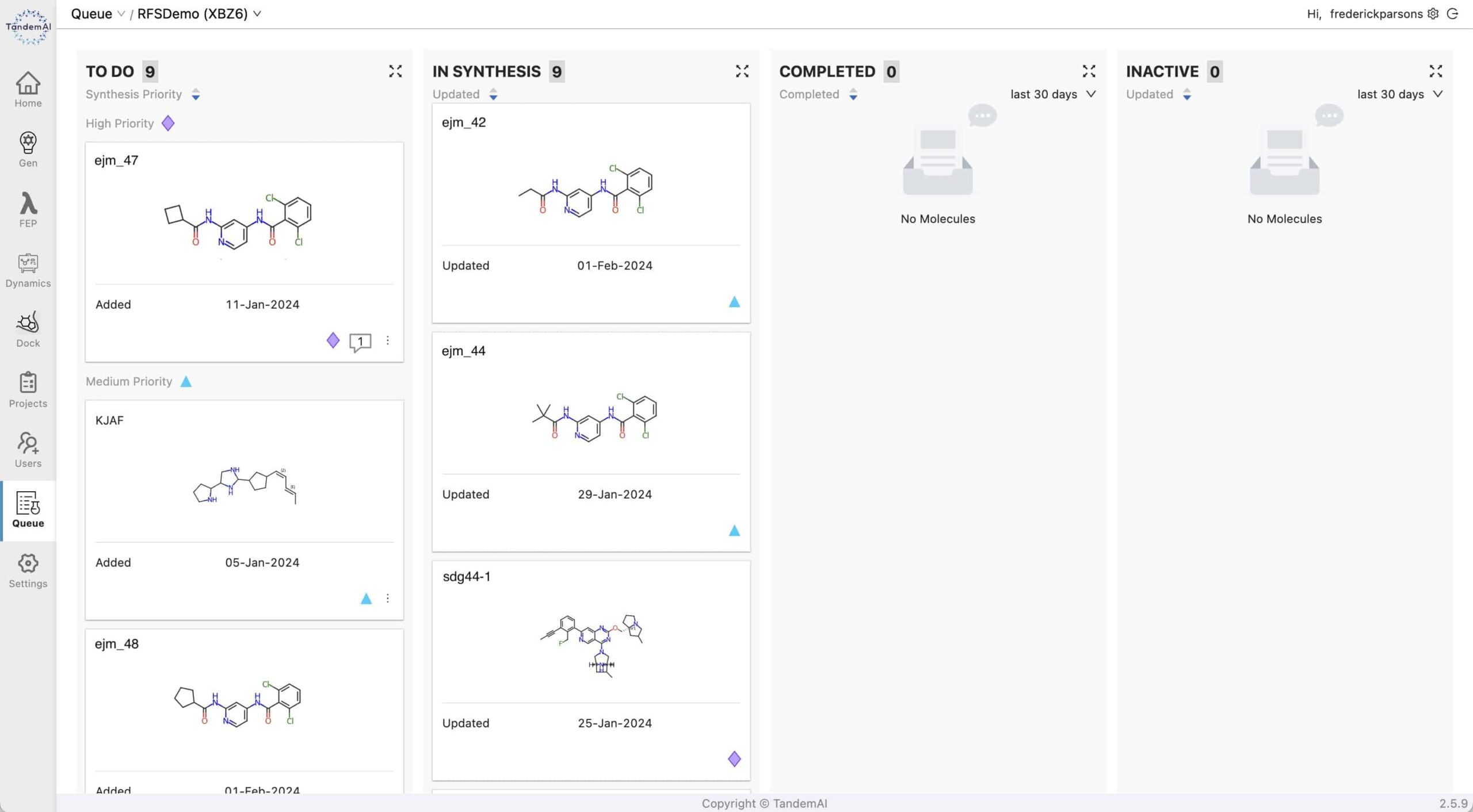
That connection mattered to an early public user. In the March 2023 TandemViz launch announcement, QuantX Biosciences CTO Yax Sun described how computational insights had helped concentrate the company’s first chemistry decisions. The attraction was practical: understand binding, then narrow the work. The latest product updates continue this theme. September 2026 release notes describe CDD Vault integration, bringing molecular datasets and assay readouts into TandemViz.
“These insights have really helped focus our initial medicinal chemistry designs.”Yax Sun / CTO, QuantX Biosciences / 2023
Buying the loop
TandemAI offers two ways in. Customers can buy research services through a full-time-equivalent pricing model, paying for wet-lab capacity with complimentary access to computational tools. Or they can license TandemViz as standalone software. Optional services include GPU computing, deployment in a virtual private cloud and expert application support. A team can choose the combination that matches its own laboratory and computing resources.
There is a substantial infrastructure bill behind that convenience. TandemAI announced $25 million in seed and pre-Series A financing in late 2021, $35 million in Series A financing in March 2023 and a $22 million extension in November 2025. Those disclosed rounds add up to $82 million. The extension was intended to fund model development across modalities and expand wet-lab capacity.
The people behind the physics
The leadership’s biographies explain the emphasis on computation and execution. Co-founder and CEO Jeff He previously helped build HiFiBiO and Harbour BioMed. Co-founder Lanny Sun previously co-founded Silicon Therapeutics. CTO Albert Pan spent more than 12 years at D. E. Shaw Research, working in molecular simulation. This is a business assembled from company builders and people accustomed to asking very small physical questions.


Its market position sits between computational software and commissioned discovery research. Schrödinger offers an established alternative in molecular modeling and FEP. XtalPi also combines AI and physics in discovery services. TandemAI’s distinguishing commercial arrangement is the connection of its own tools and experimental operations through one workspace. The relevant comparison for a buyer is the cost and coordination of assembling that workflow separately.
Peptides change the size of the bet
The Perpetual Medicines merger, announced in July 2025, expanded TandemAI’s reach from small molecules into peptide discovery. Perpetual brought computational design, synthesis capabilities and experienced developers Kerry Blanchard and Ved Srivastava. It remained a separate operating entity within TandemAI. The strategic logic was to apply an integrated approach to another class of therapeutics, rather than assume every molecular problem looks alike.
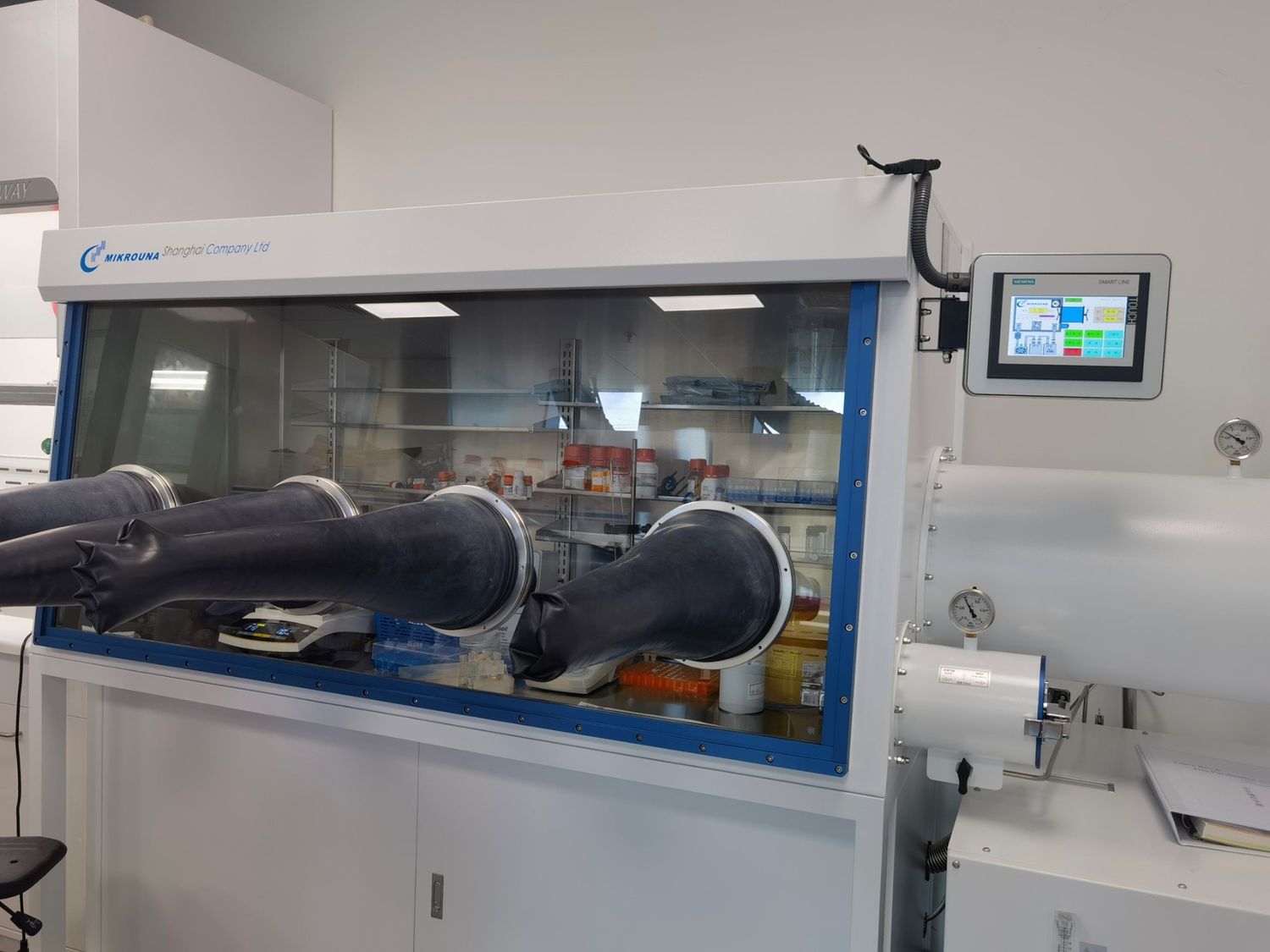
The June 2026 Third Rock milestone offers evidence of delivery on a particular collaboration. It is a development-candidate result, before the larger questions that clinical testing must answer. The announced second program was still in lead optimization. The distinction matters: discovery can move faster while the demands of proving a medicine’s value remain.
Let the flask disagree
LeadRL, introduced in November 2025, illustrates the feedback mechanism. It uses TandemFEP binding data to fine-tune a potency model, then applies reinforcement learning to a generative model proposing related compounds. The company says that if credible improvements are absent, it returns nothing. An empty shortlist can be a sensible answer when synthesis consumes real resources.
A May 2026 partnership with Mila explores a longer horizon: models that capture chemical and atomic-level physical systems well enough to support broader virtual experiments. For today’s reader, the transferable idea is simpler. Keep predictions, priorities and experimental results close together. This approach depends on useful input data, suitable methods and scientists willing to revise a design. The laboratory must retain its right to disagree.