The molecule in the pill
When you swallow a psoriasis pill and your immune system quiets down within weeks, the chain of events traces back to a chemistry lab in New Jersey, a post-doc in Wisconsin, eight years at Bristol-Myers Squibb grinding out medicinal chemistry, and eventually to a modest office building at 7707 Gateway Boulevard in Newark, California - where Dinesh V. Patel has been steering the same company since December 2008.
ICOTYDE (icotrokinra), the first oral peptide to block the IL-23 receptor, received FDA approval on March 18, 2026. Johnson & Johnson will sell it. Protagonist Therapeutics discovered it. The license was struck in 2017. In the time between that handshake and the approval - nine years - Patel kept the rest of the pipeline moving, navigated a clinical hold, held two NDA filings simultaneously, and accumulated $646 million in cash without ever appearing to sweat in public.
That restraint is calculated. "Companies don't fail because a drug program didn't work," Patel has said. "They fail because they deplete their reserves." It's the kind of sentence that sounds like common sense until you realize how many biotech executives ignore it, raising money reactively in bad markets rather than proactively in good ones. Protagonist had cash when its peers were scrambling.
"My singular focus is on innovating and developing new drugs, and finding the most expedited and effective ways of getting them to the patients who need them the most."
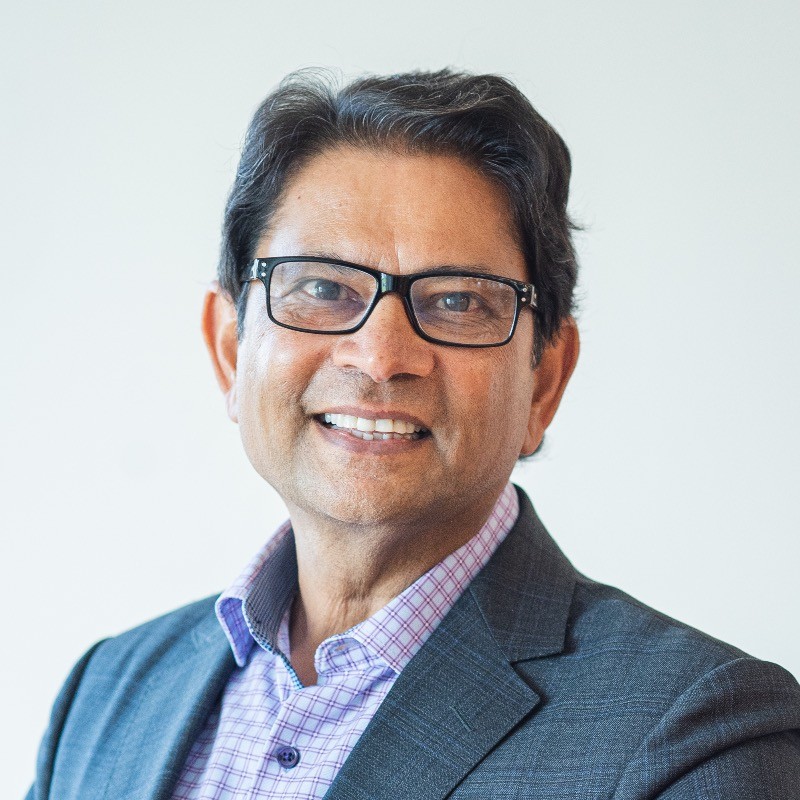
- Dinesh V. Patel, Ph.D., President & CEO, Protagonist TherapeuticsThe chemist who became a CEO
The chemistry came first. Patel earned his B.Sc. and M.Sc. at S.P. University in India, his Ph.D. at Rutgers in New Jersey, and then did post-doctoral work at the University of Wisconsin. In 1985, he joined Bristol-Myers Squibb as a medicinal chemist - the kind of bench scientist who names compounds by catalogue number and dreams in molecular structures.
Eight years later he moved to Affymax, one of the early combinatorial chemistry companies that promised to speed up drug discovery by generating thousands of compounds at once. From there: Versicor, later renamed Vicuron, where he rose to Senior Vice President of Drug Discovery and Licensing. His work there yielded two marketed antibiotics - anidulafungin (Eraxis) and dalbavancin (Dalvance). Pfizer bought Vicuron in 2005 for $1.9 billion.
In 2003 he stepped fully into the operating chair, co-founding and running Miikana Therapeutics, an oncology company acquired by EntreMed in 2005. He then served as President and CEO of Arête Therapeutics from 2006 to 2008 before joining Protagonist. The through-line: a bench chemist who kept moving closer to the decisions that determine whether a molecule ever reaches a patient.
The Pfizer connection - and what it taught him
When Patel was at Versicor/Vicuron, his team advanced two drug candidates through clinical development to FDA approval. Pfizer's $1.9 billion acquisition was partly a bet that a team capable of doing that once could do it again.
His children later challenged him that "anybody can get lucky once." He has cited that remark as the reason he believes so strongly in advancing multiple programs simultaneously - not because one success is insufficient proof, but because platform viability requires replication.
At Protagonist, he now has ICOTYDE approved and rusfertide under FDA review. Two is not luck.
The road to Protagonist
Building the peptide platform - one patient at a time
When Patel arrived at Protagonist in December 2008, the global financial system was melting. Lehman had collapsed three months earlier. Biotech funding was drying up. The company he was joining had a peptide technology platform with no approved drugs, no late-stage programs, and no guarantee that oral peptides - molecules that most of the industry assumed couldn't survive the digestive system - were a viable drug class at all.
Seventeen years later, that platform produced the first approved oral peptide that precisely blocks the IL-23 receptor. The drug works by a mechanism that previously required biologic injections. ICOTYDE's approval for plaque psoriasis is the proof-of-concept the field had been waiting for. It also happens to be taken once a day with water, 30 minutes before breakfast.
The company's wholly owned programs - which Patel can advance without a partner - now target obesity, IL-17 pathways, and other indications. With $646 million in cash and milestone payments due from J&J's commercialization of ICOTYDE, Protagonist is "well equipped to fund all internal wholly owned programs to clinical proof-of-concept," in Patel's words.
How he runs a company
Patel describes Protagonist as "a discovery company at heart" - notable language for a CEO whose company now has an FDA-approved drug. It's the kind of statement that signals where his identity still sits: not in investor presentations and PDUFA dates, but in the chemistry that makes those dates possible.
In 2021, rusfertide hit a clinical hold - a regulatory pause that sends most biotech stocks into freefall. What Patel emphasizes about that period is not the regulatory navigation, but the communication. He kept the team informed honestly and directly. He credits that transparency as critical to maintaining morale.
His leadership philosophy leans heavily on the informal. He values stopping by the espresso machine and grabbing lunch in the cafeteria as genuinely important leadership moments - not PR exercises, but the texture of a culture that either holds or doesn't when things get hard. At a 130-person company, those moments are the management system.
On market volatility, he preaches a version of humility that goes against biotech's natural optimism bias: stay grounded when the market is high, raise money before you need it, and recognize that "unbridled optimism that the best is always yet to come" is only sustainable when the foundation is solid. Under Patel's watch, Protagonist has navigated two major market downturns without a crisis.
Creating a culture of passion, conviction and transparency leads to ultimate success.
Failures are only failures if you don't turn them into valuable learning experiences.
Companies don't fail because a drug program didn't work. They fail because they deplete their reserves.
Achieving transformational innovation means committing to a challenging and long journey.
What comes next
The FDA approval of ICOTYDE in March 2026 triggered a $50 million milestone from J&J. But the real number Protagonist investors are watching is the royalty stack: 6-10% on global ICOTYDE sales, plus up to $580 million in additional milestones across psoriatic arthritis, ulcerative colitis, and Crohn's disease trials currently underway.
Rusfertide, the hepcidin mimetic for polycythemia vera, is under FDA review after the NDA was submitted in December 2025. Phase 2 REVIVE data showed durable hematocrit control below 45% for over three years in PV patients - the kind of long-term data that the agency respects. If approved, it would be Protagonist's second marketed drug in under 12 months.
And then there are the wholly owned programs - the oral obesity candidate, the IL-17 program, and whatever else comes out of a peptide platform that Patel has been refining for nearly two decades. "We see the next 12 to 24 months as a period of significant growth and value creation," Patel said in February 2026. By March, one element of that growth had already materialized.
The details
Protagonist Therapeutics operates from Newark, California - a city better known for its industrial corridor than its biotech scene. At 130 employees, it punches far above its weight class.
Before Protagonist, his drug-discovery work at Versicor/Vicuron yielded two FDA-approved antibiotics - anidulafungin (Eraxis) and dalbavancin (Dalvance) - the foundation of Pfizer's $1.9B acquisition in 2005.
His post-doctoral research was in Madison, Wisconsin - far from the Bay Area biotech cluster where he would eventually build his most enduring company.
Patel has held three CEO roles across three distinct therapeutic areas: oncology (Miikana), metabolic syndrome (Arête), and peptide therapeutics (Protagonist). Each taught a different language of risk.
He joined Sai Life Sciences' board of directors in March 2025, adding a CRO board role to his portfolio while simultaneously preparing two NDAs at Protagonist.
The peptide platform at Protagonist has been under development for 17+ years - making ICOTYDE one of the longest-incubation drug approvals in modern biotech. The espresso machine saw a lot of conversations along the way.