There are easier ways to spend a career than asking molecules to confess what they can do. Molecules are poor conversationalists. They bind, refuse to bind, degrade, behave beautifully in one experiment and become troublesome in the next. Yongqi Deng has spent more than three decades in this company. First came the formal education: bachelor's and master's degrees at Peking University, a doctorate at Michigan State University, then postdoctoral chemistry at MIT from 1997 to 1999. After that came more than 20 years inside Schering-Plough and Merck, where the questions grew narrower, the teams larger, and the consequences of a wrong answer more expensive.
His publication record reads like a map of the targets that occupied medicinal chemistry in the 2000s and 2010s. Deng coauthored work on CDK2, a protein involved in the cell cycle; ERK, a kinase in a signaling pathway frequently studied in cancer; mTOR; and IDO1. One 2014 paper described a screen that used affinity selection to find compounds binding to two forms of ERK2. The method mattered as much as the target. Instead of beginning with a theory about which molecule should fit, the experiment asked a large collection of molecules to show which ones actually did.
That instinct - measure the encounter, then improve the candidate - eventually became the operating idea of a company.
The apprenticeship before the incorporation
Deng did not rush from university into a founder title. His company biography counts 30 papers, more than 2,000 citations, and 32 granted patents. Those figures are less interesting as trophies than as evidence of repetition. A medicinal chemist learns through cycles: design, make, test, inspect the failure, and design again. Large pharmaceutical companies can run those cycles across chemistry, biology, structural science, pharmacology, formulation, and clinical development. Deng saw the entire relay for more than two decades.
The résumé also contains a second kind of leadership. In Massachusetts, Deng signed a 2011 welcome letter as principal of Newton Chinese Language School. He later chaired its board from 2013 to 2016. At a school-hosted local election debate in 2015, he welcomed Newton aldermanic candidates and encouraged community members to register and vote. It is a modest civic footnote, easy to lose between patents and financing rounds. It also shows that his experience running rooms did not begin when a company printed business cards.
In 2018, Deng returned to China and founded Keythera Pharmaceuticals in Shenzhen. The company moved to Suzhou in May 2020. That September, it announced a Series A round of nearly RMB 100 million. In March 2021, less than six months later, Keythera disclosed another RMB 100 million A+ round as its lead program, KF-0210, entered its first human study.
Fundraising announcements favor velocity. Chemistry favors memory. Deng's advantage was the accumulated knowledge of where programs tend to break: a promising hit that cannot be optimized, a potent compound with awkward properties, a tidy laboratory result that fails to travel. Keythera's design suggests a founder trying to compress those loops without pretending they can be skipped.
A machine for asking better questions
Keythera calls its central technology ADMS, short for Affinity Detection by Mass Spectrometry. One workstation can screen up to 250,000 compounds a day. The platform combines mass-spectrometry binding measurements with bioinformatics, chemical informatics, structural chemistry, computer-aided drug design, and combinatorial chemistry. Artificial intelligence enters the process too, but with an important companion: experimental data that can rapidly test a prediction.
Imagine a crowded coat check where every molecule claims it has the right ticket. Computation can decide which claims look plausible. Affinity detection watches who actually takes the coat. The metaphor is imperfect - chemistry always is - but it captures the appeal. Measured binding gives a research team something firmer than elegance on a screen.
Keythera describes six programs: two in Phase 1, one in Phase 2, one at the IND-filing stage, and two at proof-of-concept stage. Positions are based on the company's 2026 pipeline description.
There is a useful founder lesson here, even for people who never touch a mass spectrometer. The choice of instrument can become the choice of company. A platform is not merely a technical asset parked beneath a pipeline. It determines which questions can be asked cheaply, which failures arrive early, and what kind of evidence guides the next dollar.
Deng put the relationship plainly during Keythera's first financing announcement: the company had set a three-part strategy with the drug pipeline at its core and platform technology in support. That order is revealing. The platform serves products. The products, in turn, prove whether the platform deserves its keep.
The compound that carried the thesis
KF-0210 became Keythera's first program to cross into clinical development. It is an oral, selective antagonist of EP4, a receptor involved in inflammatory signaling and the tumor environment. A Phase 1 study began in March 2021, evaluating the compound alone and in combination with atezolizumab in advanced solid tumors. The registry records 14 participants and lists the study as completed in April 2023.
At the American Association for Cancer Research meeting that year, Deng and seven Keythera colleagues presented preclinical and early clinical work on the compound. Their abstract described binding and cellular assays, pharmacokinetic and toxicity studies, and mouse models used to evaluate KF-0210 alone and with checkpoint antibodies. It was the public grammar of biotech progress: mechanism, model, safety, then the carefully limited claim that more study was warranted.
The company subsequently explored the same EP4 mechanism in knee osteoarthritis. By 2026, Deng was preparing to present exploratory Phase 2a findings at the OARSI World Congress. He announced the appearance himself on LinkedIn: “I'm excited to share that I will be presenting our KF-0210 Phase 2a clinical results at the 2026 OARSI World Congress, on behalf of Keythera.” The abstract received the congress's “Highest Rated Late Breaking Abstract” designation.
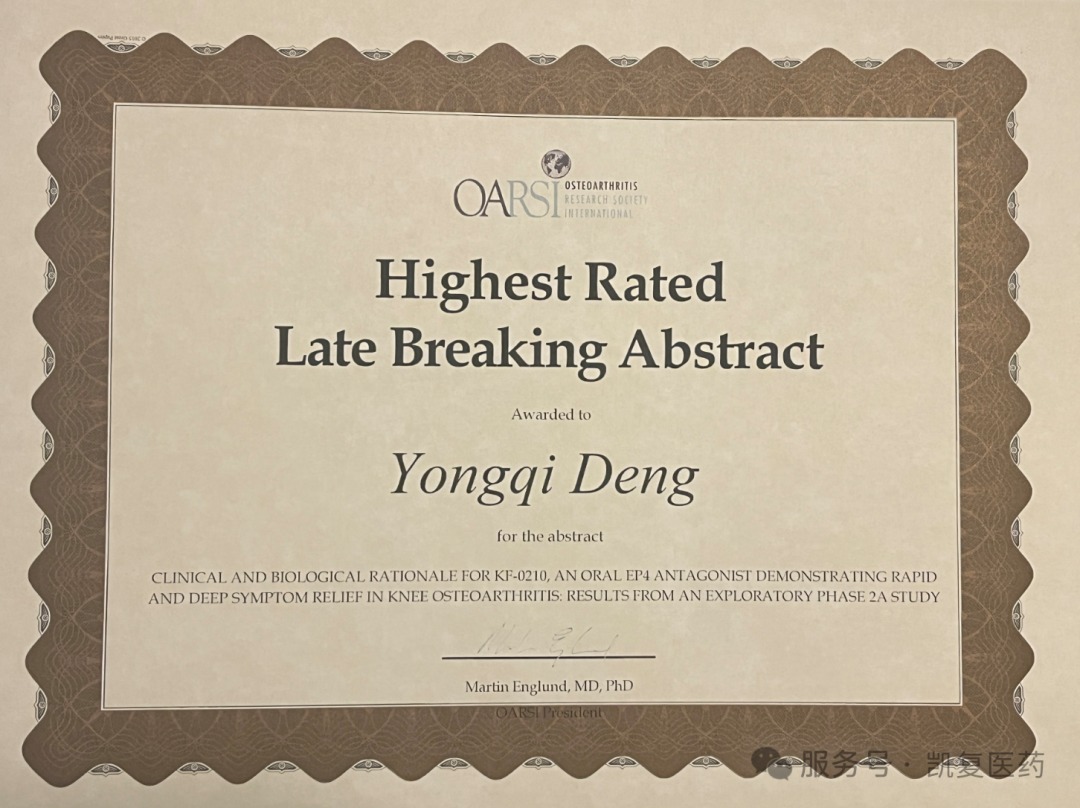
Keythera reported that participants receiving the studied doses showed changes across pain, stiffness, and physical-function measures over three weeks, with effects observed by day eight. These were exploratory results, and the company said it was moving toward a randomized, double-blind Phase 2b study with an active comparator. The distance between an encouraging conference result and an approved medicine remains large. Deng, after decades in the industry, needs no lesson in that arithmetic.
A career built across borders
Deng's working life has a two-city rhythm. Newton, Massachusetts, places him near the academic and pharmaceutical institutions where he trained, published, and volunteered. Suzhou places Keythera inside a dense Chinese biopharmaceutical cluster. His LinkedIn profile connects both: Newton Centre as home base, Suzhou as the location of the company he leads.
The bridge is more than geographic. Keythera's founding team brought experience from multinational drug companies into a Chinese startup aimed at both domestic and global development. The company has worked with investors including Oriza Seed, Richland Equities, Juming Venture Capital, and others named in its financing announcements. Deng's published papers connect him with broad Merck teams across discovery chemistry, structural chemistry, pharmacology, process chemistry, and drug metabolism. His patents add another changing cast of collaborators. Drug discovery may reward individual insight, but it leaves a decidedly collective paper trail.
What emerges is not the familiar sketch of a lone scientist with a sudden revelation. It is a portrait of accumulated systems knowledge. Deng learned the chemistry, watched large organizations move compounds, helped build community institutions, then assembled a smaller organization around a specific screening method. The company has collected awards and financing, but its harder ledger is the one that advances by stages: discovered, optimized, filed, dosed, measured, reconsidered.
His route also complicates the usual story about returning talent. Deng did not simply carry a Western laboratory playbook east. Keythera joined long pharmaceutical experience to a platform built for repeated local experimentation, then pursued studies in Australia and China and presented results at international meetings. The pattern is circular rather than one-way: education in Beijing, training and industry work in the United States, company building in Shenzhen and Suzhou, and research discussed before global scientific audiences. Each crossing added collaborators, constraints, and another test of whether the underlying chemistry could travel.
That is why the 250,000-compound statistic is both striking and incomplete. Speed at the first gate only creates more candidates for judgment. Someone still has to recognize a useful signal, choose what to make next, and decide when evidence is strong enough to take a compound into people. Instruments multiply observations. Careers build taste.
Deng's latest public chapter places him at a lectern with Phase 2a data, far from the early screens but still inside the same basic loop. Ask a question. Measure the answer. Carry the useful uncertainty forward. For a medicinal chemist turned founder, progress is rarely a grand arrival. It is a succession of better questions, each expensive enough to demand patience and precise enough to earn the next one.