The object at the center of Milan Patel's third startup is almost aggressively untheatrical: a glass array punctuated by circles, spots and genetic probes. No chrome, no cinematic vapor, no robot waving hello. Yet this little stage is where Patel's whole career meets. Electrical engineering supplies the logic. Biomedical engineering supplies the language. An MBA asks who pays. Decades in operations ask whether a lab technician can make it work before dinner.
Patel is the co-founder and CEO of PathogenDx, a Scottsdale biotechnology company built around multiplexed molecular testing. Its D3 Array is designed to identify many genetic targets in a single well. The commercial promise is plain enough to fit on a sticky note: fewer separate procedures, more information, and answers within a working shift. The science is intricate. The pitch is about Tuesday afternoon.
That instinct to translate complexity has roots far beyond Arizona. Patel was born in Kenya and arrived in the United Kingdom as a refugee when he was five. He grew up in London until about 17, then came to the United States. At the University of Detroit Mercy he studied electrical engineering and later business. At the University of Michigan he added a master's degree in biomedical engineering. Three degrees gave him three dialects, but no obvious destination.
A career built sideways
The useful mess before the mission
Patel's early career refused to stay in one lane. He worked in the automotive industry on Team Mustang, developing cars and trucks. He ran an electronics manufacturing company. At Intel, he learned how technology and finance behave inside a semiconductor giant. Later came smaller companies in government services and biotechnology. Each switch added another constraint to his mental model: factories have yield, boards have expectations, customers have budgets, and elegant inventions can remain elegant forever if nobody commercializes them.
There was also a failure, stated without perfume. Patel says his first startup went belly up. He entered without enough capital and chose the wrong partners. These are familiar errors until the payroll is yours. His second startup was GMSBiotech. PathogenDx became the third. The sequence matters less as a redemption arc than as an upgrade in questions. How much money will this really take? Who belongs at the table? Which market will tolerate the time required for proof? What does the customer need to stop doing?
“Always listen and don't assume.”Milan Patel on the habit behind customer connection
In 2006, another education began. Paresh Ghelani and Haresh Bhungalia, founders of 2020 Company, LLC and first cousins of Patel's wife, gave him the CFO job. Patel credits Ghelani's vision and Bhungalia's operational discipline as formative. He says the company grew from roughly $5 million or $6 million to $75 million before it was sold. More telling is the detail he remembers: their chemistry made work feel like fun. A spreadsheet lesson became a lesson in partnership.
A good idea still needs an exit from the lab
The technology behind PathogenDx began in a parent company focused on specialized transplant diagnostics. Patel joined that business in 2012 and saw a capable technology trapped inside a narrow commercial frame. Outbreaks and contamination across food, agriculture, water and the environment suggested a wider application. The team licensed the technology and founded PathogenDx in 2014. “Dx” was simply diagnostic shorthand. The larger act was choosing to turn research into a product.
Patel often describes biotech as a translation problem. Researchers may optimize the science. Customers describe a particular operational headache. Product builders must connect the two without mangling either. He calls this the bridge between pure science and purposeful product development. His own background makes him a plausible bridge inspector: enough engineering to follow the mechanism, enough finance to interrogate the economics, and enough startup scar tissue to ask when “perfect” has become procrastination in a lab coat.
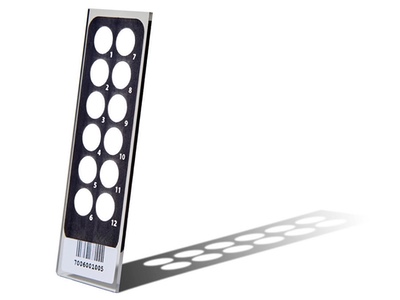
A conventional workflow may split different organisms or targets across separate tests. PathogenDx's approach prints genetic probes on an array and concentrates many targets into a well. Amplified genetic material binds with corresponding probes, and an imager reads the resulting pattern. Patel compares the concept to a digital barcode. That metaphor is doing serious commercial work: customers need to understand the benefit without first enrolling in graduate school.
One well can hold a panel, not merely a question
Cannabis was the classroom
PathogenDx first found meaningful commercial traction in cannabis testing. The choice was less cultural than procedural. State-regulated labs were processing hundreds of samples, rules varied by jurisdiction, and microbial testing created a stubborn delay. Patel and his team could put arrays into partner labs, observe the work, and learn which steps deserved to disappear. The customer was not an abstraction. The customer was a person holding a pipette and a deadline.
The market also forced the company to earn belief. Laboratory routines develop for reasons, and a new method that removes familiar enrichment steps can sound suspiciously convenient. Patel's answer was independent validation, certification and published performance data. Novelty opens the conversation; repeatability pays the invoice. The company later pushed toward a common automated platform, Octa, meant to reduce manual work and give labs a consistent protocol even when state rules differ.
Customer feedback became product management in its least glamorous and most useful form. Reduce steps. Increase throughput. Cut waste. Lower cost per target. Automate where the friction repeats. Patel has joked that continuous improvement is in the company's DNA, a pun with the decency to label itself. Beneath it sits a sober warning: if PathogenDx does not improve the lab experience, somebody else will.
“One person doesn't move a mountain.”Patel on teams, scale and giving everyone a voice
A CEO who interviews from every direction
Patel's hiring method follows the same preference for multiple signals. Candidates meet the manager, peers and direct reports. The decision is democratic, with the hiring manager combining those views. His stated filter is purpose: does the person want to make an impact, and can they place the company's cause above their title? He says everybody has a voice regardless of position. It is a management philosophy with a built-in anti-flattery device. A future direct report may notice what the chief executive misses.
He reduces his own leadership habits to three points. Understand the other person's motivation. Listen instead of waiting to speak. Remember that the team matters more than the individual. None is novel enough for airport hardback status. Together, they reveal a preference for operating systems over charisma. Patel's public comments repeatedly return to workflow, process, milestones and practical use. Even his aspirations arrive with a unit economics appendix.
That combination appears in his view of access and sustainability. Technology needs profit to persist, he argues, but profit cannot erase customer, social or environmental benefit. A test that is too expensive to travel creates imbalance. A workflow that throws away needless plastic transfers a laboratory problem to a landfill. These are not side notes to the product. In Patel's framing, they are requirements that decide whether an innovation deserves staying power.
From one regulated wedge to the poultry line
By 2026, PathogenDx was applying the same platform logic to poultry operations. At the International Production & Processing Expo, the company launched a unified Salmonella testing system. Its four parts cover detection, quantitation, serotyping and identification of a vaccine strain. The vocabulary grows technical quickly. The operating thesis remains legible: replace several disconnected answers with a coordinated workflow that can return useful information during the production day.
Patel said the products were shaped with processors, researchers and public-sector scientists, including engagement with USDA Agricultural Research Service partners. He emphasized facilities of different sizes and tools that work under real production conditions. This is the PathogenDx pattern after twelve years: begin with dense molecular information, then keep sanding the experience until it can live beside ordinary equipment, ordinary budgets and a clock that does not care how impressive the science is.
The career pattern is equally clear. Kenya, London, Detroit, Ann Arbor, automotive work, a failed company, Intel, finance, government services, biotech, Scottsdale. A tidy résumé would have deleted half the plot. Patel instead appears to have used the detours as components. The engineer can read the system. The CFO can price the constraint. The founder can survive disbelief. The operator knows a technology has not arrived until someone outside the building can use it repeatedly.
Asked whom he would like to meet for lunch, Patel chose Patagonia founder Yvon Chouinard, intrigued by an eccentric climber who transferred ownership of his company in service of a larger purpose. The choice is revealing. Patel is interested in companies that last, but also in deciding what they are for. His glass array offers a modest answer: make more of the invisible visible, within the hours people actually have. For a third startup, that is enough ambition to keep a laboratory busy.