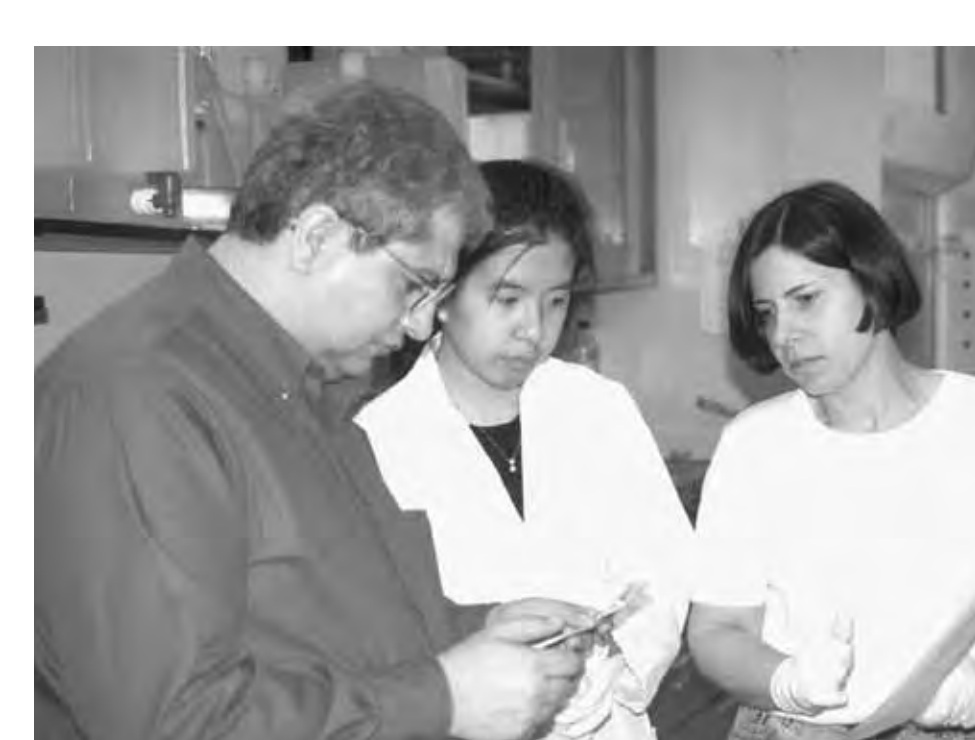
The photograph has none of the usual founder furniture. There is no stage, no logo wall, no ceremonial handshake. Three people stand in a University of Washington laboratory, all looking down at a report. At the right is Dalia Alfi, identified in the caption as a research technician. Her attention is fixed on the page. It is the late 1990s, and the laboratory's subject is molecular epidemiology: the careful business of telling one bacterial strain from another, then using the difference to locate the source of trouble.
That image supplies an unusually apt first chapter. Two years after a 1999 conference program listed Alfi on work about microrestriction fingerprinting of E. coli O157:H7, she and microbiologist Mansour Samadpour founded IEH Laboratories and Consulting Group. The company began in 2001. Its purpose would grow far beyond one technique or one room, but the habit visible in the photograph remained useful: assemble the evidence, separate signal from background, and move quickly enough for the answer to matter.
The clue before the company
The Seattle laboratory was studying a problem with a stopwatch attached. Traditional outbreak investigations could take months. Molecular fingerprinting offered investigators a way to compare samples and focus on cases produced by an identical strain. In the account accompanying that old photograph, Samadpour described the value as the ability to “weed out the background.” The phrase is clinical, even modest. Its consequence is not. A faster match can narrow an investigation, guide a recall and keep a local incident from acquiring a much larger geography.
Alfi's documented role in that lab matters because it places her inside the technical problem before she became an executive in the business built around it. She was not introduced to food safety as a market category. She appears in the record where pipettes, samples and reports meet public decisions. The distinction helps explain the shape of IEH. The company does not merely produce test results. It combines laboratories with consulting, regulatory support, outbreak investigation, process validation and crisis management. The laboratory finds the clue; the operating system decides what to do with it.
A food-safety laboratory often sells an odd product: the bad day that never arrives.
Scaling the non-event
Prevention is a peculiar thing to put on an invoice. A loaf of bread can be counted. A factory can be toured. The absence of a recall is harder to display. Much of the value exists in events that do not occur: a contaminated lot does not ship, an allergen does not go undeclared, an outbreak does not widen, a production line does not remain closed while uncertainty accumulates. The work is visible mainly when it fails. Success resembles an ordinary Tuesday.
Alfi and Samadpour turned that hidden value into a repeatable operation. IEH describes itself as family-owned and operated, and says it grew both organically and through acquisitions. The network now extends to more than 100 locations in more than 10 countries. Its company profile lists operations in the United States, Canada, Mexico, Germany, England, Austria, Poland, the Netherlands, China and Australia. This is not simply geographic decoration. Food production crosses borders, so testing capacity must be close enough to samples and fast enough for manufacturing clocks.
Expansion also changed what the enterprise could see. IEH's listed services now span food microbiology, analytical chemistry, allergens, bioengineered foods, toxicology, forensics, whole-genome sequencing, metagenomics and bioinformatics. Its consultants work on sanitation, environmental monitoring, shelf life, labeling, risk assessment and validation studies. Acquisitions added specialist laboratories, including the Canadian ecotoxicity business AquaTox in 2021 and Brooks Applied Labs, known for trace-metals work. A network that began with microbial evidence now reads a wider spectrum of risk.
The acquisition pattern is revealing. IEH did not simply reproduce the same laboratory in another postal code. It added distinct instruments, methods and subject knowledge. One operation could examine environmental toxicity; another could measure trace metals; another could help identify whether a food's stated species matched its contents. In practical terms, the network became a cabinet of different lenses. A client with a complicated problem could ask more than one kind of question without first assembling a loose committee of providers. Breadth, here, is a way of shortening the distance between suspicion and a defensible answer.
The executive in the paperwork
Alfi herself remains far less conspicuous than the company. There is a LinkedIn profile, a title and a small collection of corporate records. There is no reliable archive of keynote speeches, breezy founder interviews or quotable manifestos. The documentary trail instead resembles the work: formal, specific and distributed. A research caption here. A conference abstract there. A corporate filing in Britain. A signed public-services agreement in Washington.
Those records still show movement. In the late 1990s she was a research technician. In 1999 her name appeared with Samadpour and Linda Grimm on a presentation about a new tool for studying the molecular epidemiology of E. coli O157:H7. In 2001 she became a co-founder. By 2013 she was a director of Bio-Check in the United Kingdom, and British corporate records later identified her as an American national with a significant ownership and voting stake in that business. In June 2025, a City of Everett agreement carried her electronic signature and the plain title “CEO.”
It is tempting to fill silence with personality. The facts do not permit it, and they do not need it. Alfi's public record is already coherent without invented color. It connects technical participation to ownership, ownership to expansion, and expansion to executive responsibility. The restraint of the record may even suit the enterprise. Laboratories are not rewarded for theatrical conclusions. They are rewarded for conclusions that survive scrutiny.
A wider field of vision
The contemporary IEH portfolio reads like an index of modern anxiety about products. Is the label accurate? Is the species what the package claims? Are pesticide residues present? Can an allergen be detected? What does whole-genome sequencing say about two bacterial isolates? Are microscopic particles or persistent chemicals hiding where older tests did not look? Each new capability adds another way to ask whether the thing being sold is the thing it says it is, and whether its production process behaves as intended.
That breadth also reveals why a laboratory network needs operators as much as scientists. A method can be elegant and still arrive too late. A result can be precise and still fail to reach the person empowered to stop a shipment. The company Alfi leads sits in the interval between measurement and action. It has to manage laboratories, acquisitions, accreditation, logistics, client confidentiality and the awkward tempo of a crisis, when everyone wants certainty faster than science usually provides it.
The old photograph becomes more interesting in this light. Three people are looking at one report. Nobody is performing authority for the camera. They are trying to understand what is in front of them. The scene contains the basic unit from which the larger organization was assembled: trained attention shared across a table. Scale added sites, instruments, services and borders. It did not repeal the need to look closely.
The larger the network became, the more its purpose returned to a small act: notice the clue before the consequence.
The ordinary Tuesday
There is an old bias in business storytelling toward the conspicuous rescue. We remember the recalled product, the closed plant, the investigator at the microphone. Prevention has worse publicity. Its proof is dispersed across negative tests, corrected processes, supplier checks and decisions made before the public ever hears a name. The reward for doing the work well is that nothing dramatic needs to happen.
Dalia Alfi's career belongs to that quieter genre. Its decisive artifacts are not slogans but a lab photograph, a scientific program, incorporation records and the footprint of a company that kept adding places where evidence could be produced. The progression from technician to co-founder to CEO is substantial, yet the subject stayed remarkably consistent. Find the difference. Trace the source. Give someone enough confidence to act.
More than a quarter-century after the photograph, Alfi still works from the Seattle area. IEH's headquarters is in nearby Lake Forest Park, while its laboratories and associated businesses reach across continents. The distance between those two facts is the story: a local technical practice made portable, then made operational at scale. Somewhere in that network, another report is landing on another table. If the system works, the result may be wonderfully dull. The shipment is held. The process is corrected. Tuesday remains Tuesday.