A sick chicken does not wait for a courier. The swab can leave a farm promptly; the useful information often returns after a trip to a laboratory, a queue and a report. By then, the relevant question may have changed from “Is this flock infected?” to “Where has the infection gone?” Alveo Technologies, an Alameda diagnostics company, has built its most tangible business around shortening that interval.
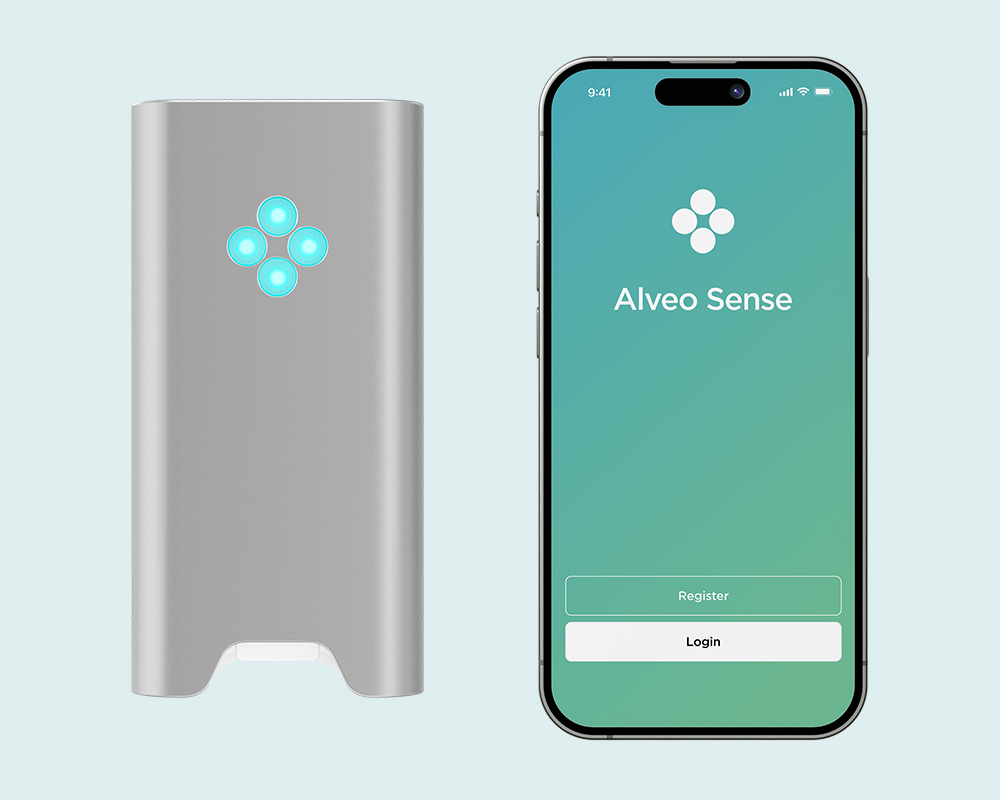
Its Alveo Sense poultry test puts a molecular assay in a single-use cartridge. A reusable, palm-sized analyzer reads it; a phone guides the process and displays the result. Alveo says the test detects avian influenza Type A and distinguishes H5 from H7 or H9, depending on the panel, in about 45 minutes. It accepts throat and cloacal swabs, the two sample routes that matter when a virus does not behave identically in every bird.
- Alveo sells a field molecular-testing system for poultry disease surveillance.
- The hardware, disposable cartridges and app are built for veterinarians, producers and animal-health organizations.
- Royal GD and x-OvO helped shape the bird flu test; distributors are taking it into multiple regions.
- A field result can guide faster action, while positive or presumptive positive results still require authorized laboratory confirmation.
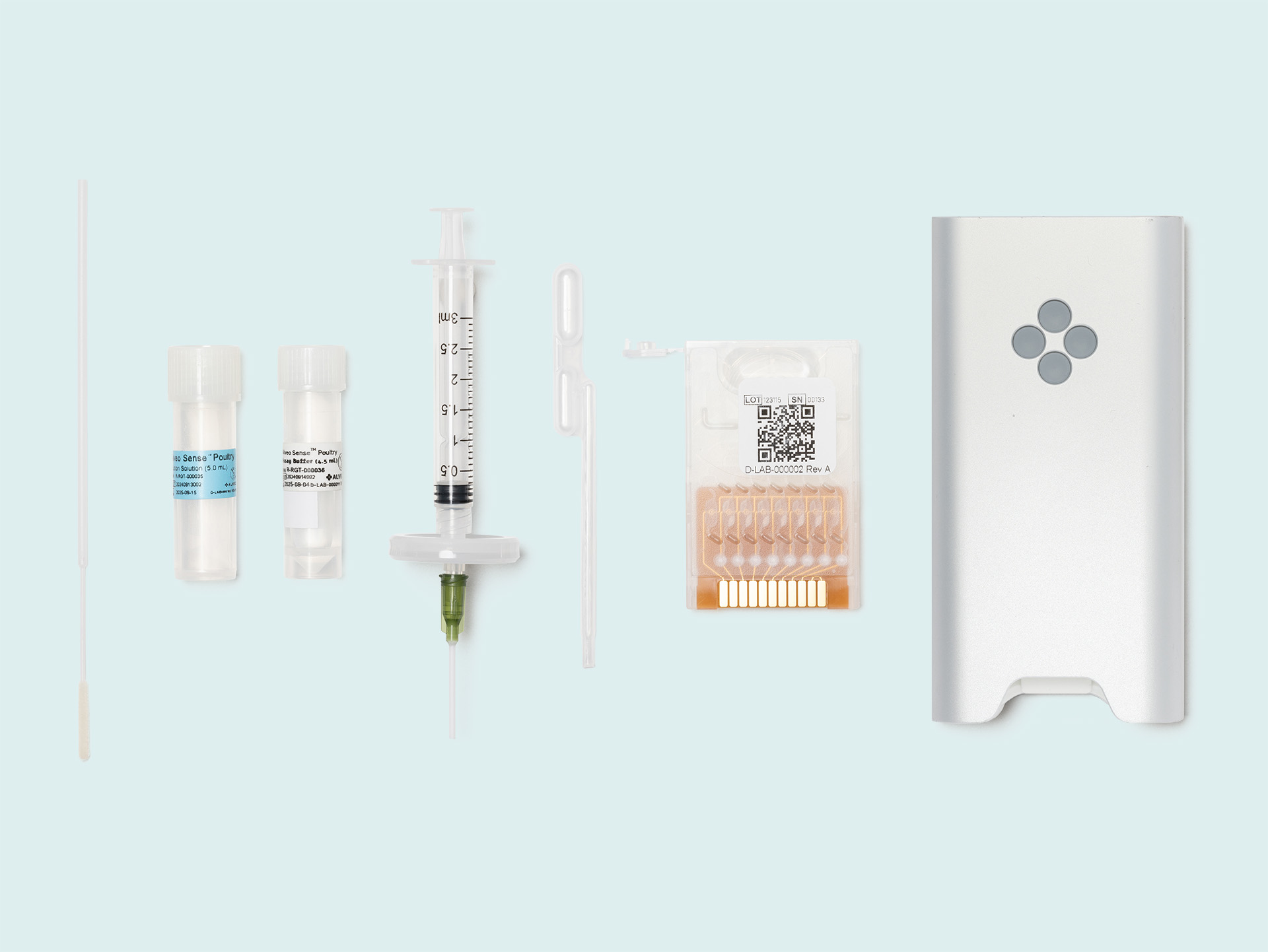
The expensive part is waiting
Laboratory RT-PCR is a powerful reference method. It also asks farms to transport samples and wait for a centralized workflow. Alveo’s published cost model puts a six-test surveillance cycle at €780 for its system, against an estimated €795 to €2,270 for comparable lab PCR once shipping is included. Those are the company’s model assumptions, not a universal price list; local fees, volumes and contracts will move the arithmetic. The more dependable distinction is temporal: Alveo lists less than 45 minutes on site, compared with 24 to 72 hours or more including laboratory logistics.
That difference matters because the customer is buying a decision. A producer may need to isolate a house, call a veterinarian or intensify surveillance. A public-health agency may need a location and a timestamp as well as a yes-or-no answer. Alveo’s app can upload geotagged results to its Vista portal. The physical sample stays on the farm; the data can travel at once.
The published 2025 laboratory validation tested the assay against avian influenza strains and other bird pathogens, reporting high specificity and detection at clinically relevant viral loads. Its authors also called for further field validation across species. Alveo’s product page reports at least 99% positive and negative agreement against a reference RT-PCR assay in its validation studies. Neither statement makes a field test a substitute for the official confirmatory process. Alveo itself tells users to send positive or presumptive positive results to an authorized reference laboratory.
A platform finds its flock
Alveo was founded in 2014 by Ron Chiarello, Lawrence Blatt and Mike Aicher. Its original pitch was wide: infectious-disease information should be affordable and available outside specialist labs. A $38 million Series A announced in January 2018 was intended to optimize and commercialize the platform. During the pandemic, its be.well COVID-19 test was named one of five grand-prize winners in the 2021 XPRIZE Rapid COVID Testing competition. A prize, though, is not a distribution channel.
The sharper commercial question arrived through partners. In 2025, Alveo executive Erik Tyrrell-Knott wrote that partners had identified the need for a point-of-need bird flu test. Royal GD brought veterinary diagnostic knowledge and market access; x-OvO brought avian expertise. The product that emerged did not promise to test everything. It addressed a specific hazard, for specific customers, with two influenza panels and a process designed around poultry samples.
“Our partners helped identify the critical need for a Point of Need Bird Flu test.”Erik Tyrrell-Knott, Alveo, January 2025
This is the useful lesson of Alveo’s “open platform” language. Openness here means other organizations can co-develop assays on the reader and cartridge architecture. It still takes primer design, assay optimization, validation, regulatory work and manufacturing transfer before a new cartridge can be sold. Alveo describes supported projects, where it does much of that work, and more self-sufficient partnerships, where collaborators take more of the development load. In both cases, the partner’s knowledge of an actual testing problem is essential.
Selling the whole loop
Alveo’s business is business-to-business: reusable instruments, repeat cartridge sales, software-supported reporting and co-development deals. Its direct users include veterinarians, poultry integrators and producers. Animal-health groups and public agencies can use the results for surveillance; regional distributors help reach customers and support them locally. That is a more demanding sale than simply placing a gadget on a shelf. A testing program needs training, available cartridges, a trusted workflow and a route for confirmatory results.
The map is widening. In December 2025, Alveo and Global Animal Health announced an initial Egyptian deployment of 1,000 analyzers and 10,000 cartridges. In September 2026, Alliance Global signed to distribute the poultry platform across Africa, Central Asia and selected Eastern Mediterranean countries. Royal GD expanded its collaboration the same month, committing research resources to tests for cattle, swine and more poultry pathogens, with expanded offerings expected by 2027. These are announcements about deployment and development, not proof that every proposed test is already on the market.
Human diagnostics remain part of the plan. Under a U.S. CDC agreement, Alveo developed a point-of-care assay intended to distinguish seasonal influenza A and B from A(H5) in people, and announced completion of agreed development milestones in August 2025. A 2026 CEPI grant asks whether its sensing platform can help in vaccine manufacturing. The common thread is a measurement that becomes more valuable when it is made near the decision. The evidentiary and regulatory demands vary sharply by market.

The next test is a business test
One 2026 project with AgriNerds pairs Alveo’s farm test with migratory-bird risk scores, so a producer could test when local risk rises rather than on a blind schedule. The proposal is appealing because it treats the test as part of a decision system. Its practical value will depend on whether risk alerts improve timing and outcomes in real farms.
The poultry product also has a hard boundary: Alveo says it is for veterinary use and is not available for sale or distribution in the United States. Availability elsewhere depends on local approvals. For a U.S. farmer today, the AgriNerds partnership is a development story, not an invitation to buy the current poultry cartridge. That distinction is the sort that separates a good diagnostic idea from a useful diagnostic service.
Alveo’s early pitch imagined diagnostics anywhere. The bird flu test makes “anywhere” specific: a poultry house, a veterinarian’s kit, a phone in someone’s hand. The company has learned that a faster assay is only half the work. The other half is getting the result to the people, procedures and markets that can do something with it.