The short sequence
- Centrillion writes DNA probes onto wafers with light, adapting semiconductor manufacturing to molecular measurement.
- Its products span spatial biology, custom assays, genotyping and pathogen genomics; the shared asset is the fab beneath them.
- The business earns through chips, services, custom programs and licensing. 10x Genomics publicly credits a Centrillion license.
- The useful lesson: make the expensive, repeatable layer reusable, and let each customer configure the question.
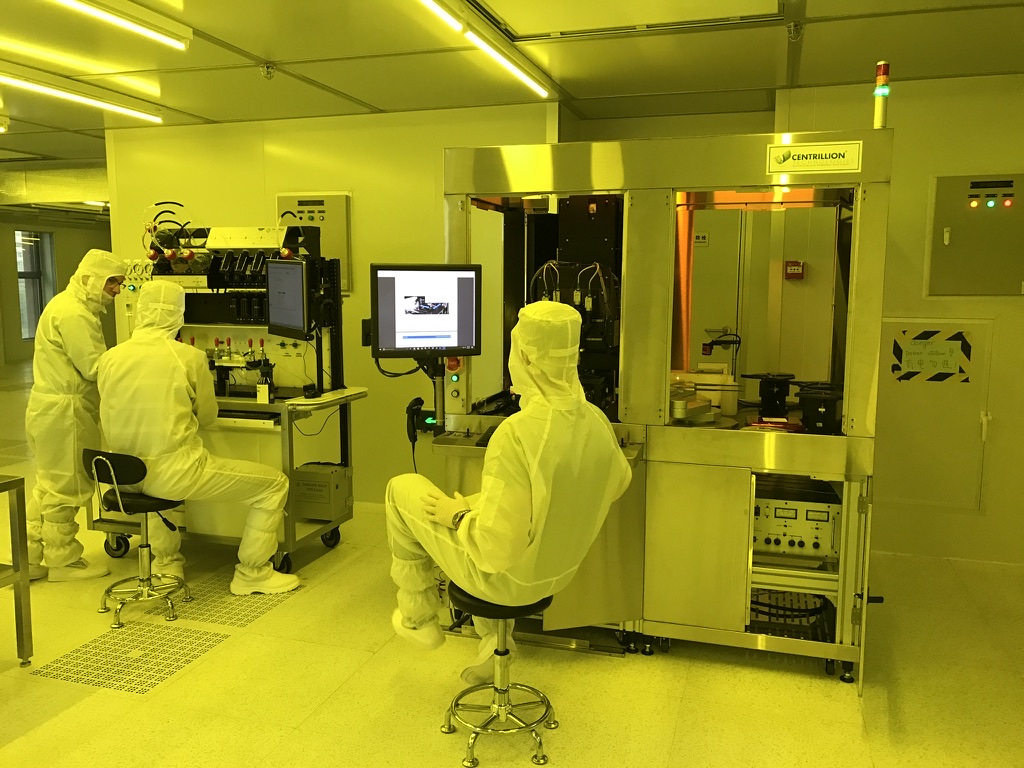
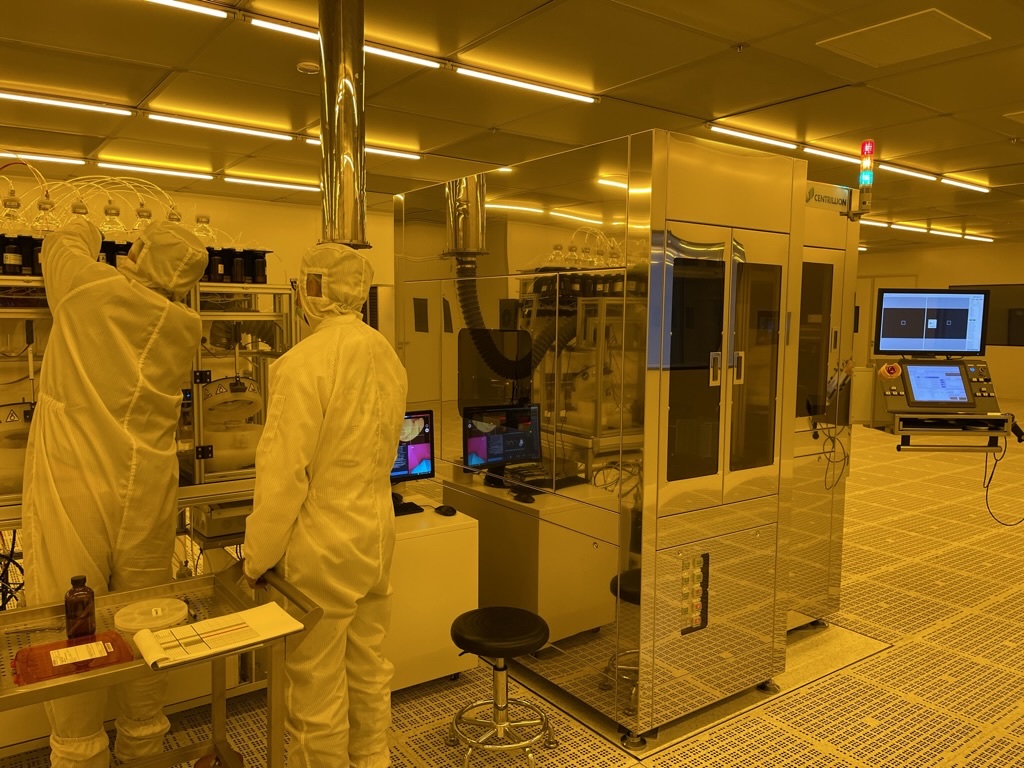
The first surprise is the color of the room. Centrillion Technology's cleanroom is yellow, not because a designer wanted biotech to resemble a late-1970s detective film, but because ordinary light can interfere with photosensitive chemistry. Inside, technicians in white suits tend machines that look borrowed from a semiconductor plant. Which, in a sense, they were. The machines expose selected spots on a wafer to ultraviolet light. A protective group comes off. One DNA base attaches. Then the cycle begins again.
This is how a molecular question becomes a manufactured surface. At every known coordinate sits a known DNA probe. Change the pattern and the same production foundation can look for genetic variants, capture RNA from a tissue slice, recognize pathogens or preserve clues about the neighborhood of a long DNA molecule. The chip changes. The factory does not have to start over.
A fab disguised as a biology company
Centrillion was founded in 2009 by Wei Zhou, a scientist, lawyer and former Affymetrix executive. The combination sounds eccentric until one considers the business. A DNA-chip company lives simultaneously in chemistry, precision engineering, intellectual property and regulated life science. Zhou had worked in colon-cancer research and bioinformatics, trained in George Church's lab, earned a Stanford law degree and helped at a company that made microarrays a commercial category. Centrillion is the institutional version of that résumé.
Its Palo Alto operation integrates surface chemistry, optics, lithography, automation, scanners, assays and bioinformatics. That vertical stack is expensive. Public reporting on securities filings described $55.6 million across two 2018 financings, followed by a multi-million-dollar strategic investment from WeDoctor. A 2015 NIH/NHGRI small-business award contributed $652,000 toward phased whole-genome work. The capital did not buy a single clever assay. It helped assemble a system that could repeatedly manufacture many of them.
The product is a question with coordinates
Take Sequoia, Centrillion's commercial spatial chip. A researcher places tissue on an array whose tiny features each carry a molecular address. When RNA is captured, the address travels with it. Sequencing can then report not merely which genes were active, but where in the tissue they were active. That distinction matters in tumors, where neighboring cells can play very different roles, and in drug discovery, where a treatment's effect may depend on the cellular neighborhood.
Sequoia comes in 5-by-5-millimeter and 10-by-10-millimeter formats. Its features run continuously at 2 micrometers, with as many as 25 million positions in the larger format. Customers can use standard poly(dT) chemistry or specify capture probes around a particular study. The point is not merely density. It is density with an address.
At the other end sits ATOM, a custom chip just 1 millimeter square. During COVID-19, Centrillion used the format for VirusHunter, arranging pathogen targets, antibiotic-resistance markers and controls in high-throughput plates. A related QuadCore workflow read SARS-CoV-2 genomes and generated variant output. The pandemic supplied an unforgiving demonstration: targets change, volume matters, and a reprogrammable surface is more useful than a frozen design.
The same catalog now extends to custom genotyping arrays with 50,000 to 2 million variants, pathogen-genomics collaborations and an early-access effort that uses molecular “zip codes” to preserve the context of long DNA before it is fragmented. These are not identical markets. That is the point. Centrillion sits beneath conventional category lines, closer to an enabling foundry than a one-test diagnostics company.
The quiet power of being underneath
The strongest validation of Centrillion's position appears in small type on someone else's product page. 10x Genomics says its HD 3′ Gene Expression product is “manufactured under license from Centrillion.” The companies signed a nonexclusive license and technology-transfer agreement in January 2023 covering specified spatial and single-cell applications. 10x also acquired Centrillion's Taiwan pilot chip facility, while Centrillion retained engineering and bioinformatics capabilities there.
That agreement reveals the business model better than a pitch deck could. Centrillion can sell its own arrays and genomic services. It can take a partner from design review to “tape-out,” the fab term for releasing a finished design to mask production. It can license technology to a larger commercial operator. In custom programs, the partner keeps its application design and associated intellectual property while Centrillion supplies the difficult common layer: chemistry, engineering and wafer-scale repeatability.
The partner brings
A biological question, assay concept, probe content and a market worth serving.
Centrillion brings
Surface chemistry, photolithography, process integration, automation and production.
The handoff
A design reaches tape-out, then becomes a repeatable molecular surface.
The revenue
Product sales, services, custom manufacturing programs and technology licenses.
What a smaller company can steal
Few teams should build a cleanroom. The transferable idea is organizational, not photochemical. Centrillion chose a hard shared layer and made applications configurable above it. It defined an interface - probe design, chip geometry, assay workflow, tape-out - where a partner's knowledge can meet its manufacturing expertise. And it allowed commercialization to travel through other companies rather than insisting every product carry its own badge.
A usable version of the playbook
- Find the costly process customers repeatedly rebuild, then standardize that layer.
- Keep configuration flexible while freezing the parts that benefit from process control.
- Name the handoff. “Tape-out” tells both sides when exploration becomes manufacturing.
- Let partners own the application and its IP when that expands the platform's reach.
- Use one urgent project to test the platform, not to trap the company inside that project.
There are limits. Wafer economics reward density, repeatability and enough volume to justify design and setup. A lab asking one low-plex question a handful of times may be better served by a simpler assay. Researchers who need an open-ended read of unknown sequence may prefer conventional next-generation or long-read sequencing. Custom production also depends on technical fit and scheduling; Centrillion explicitly says capacity is selective.
But where biology demands millions of known questions at known locations, the fab becomes an advantage. Centrillion's most interesting achievement is not that it squeezed more dots onto glass. It is that those dots belong to a production language: design, expose, synthesize, measure, repeat. In the yellow room, biology is still complicated. It is simply being given an address and a manufacturing plan.