The trouble with a medicine made for one person is that the factory may be built for a million. Industrial production likes repetition: the same formula, the same batch, the same equipment running for as long as possible. A personalized cancer therapy asks for something more awkward. The sequence changes with the patient. The batch may be tiny. The clock, for someone waiting for treatment, does not politely stop while a production suite is cleaned and reset.
Nutcracker Therapeutics, founded in Emeryville in 2018, treated that mismatch as an engineering problem. Co-founders Igor Khandros and Benjamin Eldridge came from a world where chips are made through controlled, repeatable steps. They asked whether RNA drugs could be made with similar discipline. Their answer was a series of compact manufacturing systems, culminating in NMU-Symphony: a machine that uses disposable microfluidic biochips to make small batches of RNA medicine.
The short version
- Nutcracker combined RNA design software, delivery chemistry and biochip manufacturing in one platform.
- Its target customer became the drug developer who needs many different small batches, not one enormous run.
- It reported a three-week path from RNA sequence to released, nanoparticle-formulated product in 2025.
- Medici Therapeutics acquired the company later that year to bring RNA manufacturing inside its cancer platform.
First, shrink the factory
The first public version was called ACORN. In 2020, as the company announced a $60 million Series B, it described a computer-controlled path that began with a nucleic-acid sequence and ended with nanoparticle-encapsulated RNA. Dedicated, single-use biochips kept each run in an isolated fluid path. That detail matters more than the cheerful “push-button” nickname: isolation can reduce the handoffs and cleaning burden that become expensive when every patient needs a different product.
The newer Nutcracker Manufacturing Unit, or NMU-Symphony, followed the same small-batch logic. In 2024 the company said its chips compressed a bioreactor, a purification column and process monitoring into nine square inches. In June 2025 it introduced a redesigned chip and ProcessVision, a monitoring system with more than 20 on-system measurements. It reported quantities of 1 to 200 milligrams per run and a manufacturing process taking less than four days on the system. Its full sequence-to-released-product target was three weeks.
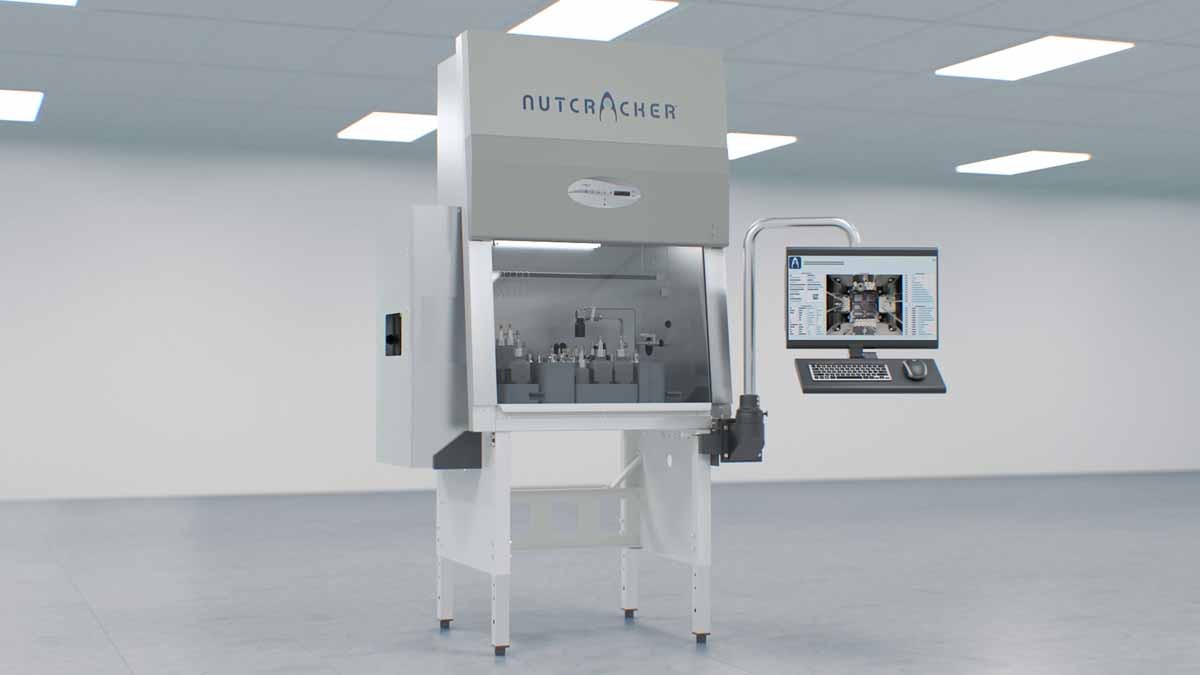
Those are company-reported production capabilities, not a published price list or proof that a therapy works in people. The distinction is essential. Manufacturing speed can help a developer reach a trial, but it cannot settle whether a drug is safe, whether it reaches the right cells, or whether a patient benefits. Nutcracker built around a bottleneck it could measure and control.
CodonCracker
Choose and optimize an RNA construct for the intended protein or therapeutic effect.
NMU-Symphony
Run the sequence through a disposable biochip with controlled synthesis and purification.
Nutshell
Formulate RNA in a nanoparticle vehicle so it can reach cells rather than disappear en route.
The machine was only one-third of the answer
Early on, Nutcracker learned a useful lesson about a clever machine: it cannot rescue a weak molecule. Former business chief Geoff Nosrati told BioCentury that manufacturing alone was insufficient; the company also had to improve sequence design and delivery chemistry. That changed the shape of the business. CodonCracker software worked on the RNA design. Nutshell nanoparticles worked on delivery. The manufacturing unit made the chosen construct in a controlled process. The customer could ask for the entire chain, not merely time on equipment.
The delivery work was substantial enough to produce a 2024 paper in ACS Nano on peptoid-based nanoparticles. Meanwhile the internal drug pipeline showed what the stack could attempt. NTX-0250, an mRNA immunotherapy aimed at HPV16-driven cancers, produced encouraging results in mouse experiments reported at a 2022 scientific meeting. NTX-472, described at the 2024 ASCO meeting, encoded a multispecific molecule aimed at CD19, CD20 and CD47 in B-cell lymphoma. Those were preclinical studies. They show a platform being tested against difficult biological problems; they do not establish clinical efficacy.
“You need to do so much more than just solve the manufacturing.”Geoff Nosrati, Nutcracker's former chief business officer, to BioCentury
The company’s founders had a taste for process control. Khandros had built companies in semiconductor-related technology, including FormFactor and Berkeley Lights. Eldridge brought engineering leadership. This explains Nutcracker’s unusual emphasis on the factory itself. Many biotech stories begin with a molecule and find a way to make it later. Here, the factory was part of the initial proposition.
Then the customer changed the story
For years, Nutcracker developed its own oncology candidates while refining the machinery beneath them. In November 2024 it formally introduced contract research, development and manufacturing services for other RNA drug developers. A company building a personalized cancer vaccine, for instance, could use Nutcracker’s system to manufacture a small, patient-specific batch under a repeatable process. Larger clinical programs could scale by running multiple manufacturing units, rather than forcing each new patient sequence through a single giant batch.
The commercial terms were private. Nutcracker did not publish a per-dose price, a machine price, or a customer roster. It did say it had reviewed data from more than 2,000 RNA production cycles, and, by the June 2025 Symphony launch, had completed manufacturing for several partner programs. Its Emeryville site was described as capable of more than 2,000 patient-specific therapeutics a year. Capacity is a design claim, not evidence that 2,000 patients received treatment.
Figures are from Nutcracker's public announcements. No independent per-dose cost comparison was disclosed.
This is where the economics become interesting. Nutcracker’s disclosed Series B and C rounds alone totaled $227 million. Industry databases put its total funding at roughly $241 million, though the exact total varies by source. That money bought years of engineering, a manufacturing facility and a platform broad enough to sell as a service. It does not tell us what one dose costs. The lesson for anyone copying the approach is narrower and more useful: define the unit of production around the actual order. If the order is one patient, optimize the changeover between patients, the quality record for each run, and the steps before and after the machine.
A faster machine still needs a template
A July 2025 pilot with Elegen made that last point plain. RNA manufacturing begins with a DNA template. If making that template depends on slow or contamination-prone steps, a fast RNA unit waits for its raw material. Elegen proposed a cell-free DNA process; Nutcracker would pair it with its cell-free, biochip-based RNA process. The pilot was a plan to test an integrated route, not a completed clinical outcome. But it exposed the next constraint in the chain: shortening one step simply makes the neighboring step more visible.
A developer with only a handful of changing patient sequences may value this design. A manufacturer producing vast quantities of one unchanged vaccine may prefer a different kind of plant. The biochip system also requires reliable templates, delivery formulations, quality controls and regulatory work. A neat machine does not erase those obligations. It makes them easier to organize around small, repeated batches.
The buyer wanted the factory inside
In March 2025, Khandros retired as chief executive and board member Cynthia Collins became executive chair and interim CEO. Later that year Medici Therapeutics acquired Nutcracker. Medici, backed by ARCH Venture Partners and the Parker Institute for Cancer Immunotherapy, was assembling an oncology platform. A Medici investor said the acquisition brought RNA manufacturing in-house. No purchase price was disclosed.
That ending is revealing. Nutcracker started by asking whether a drug factory could be made smaller. Its later customers suggested that the answer might be worth buying as a service. Medici’s acquisition suggested something else: when treatments are individualized, controlling the factory may be as strategic as owning the drug design. The nine-square-inch chip was never the whole company. It was the place where a complicated promise had to become a repeatable batch.