The object that explains Axbio is not a strand of DNA. It is a camera sensor. Before Hui Tian co-founded the company in 2016, he spent years making CMOS image sensors - the silicon squares that turned cameras from special equipment into cheap, omnipresent eyes. At Genia and then Roche Sequencing, he saw the same industrial trick applied to biology: place molecules close to dense electronics, translate their activity into signals, and let semiconductor manufacturing do what it does best. Make many tiny things at once.
Axbio is the company that followed. Tian, a physicist and electrical engineer, reunited with materials scientist and serial entrepreneur Igor Ivanov. Together they built a business around what Tian once called “a marriage between integrated circuits and molecules.” The phrase is romantic. The work is not. It requires nanopores, enzymes, surface chemistry, microfluidics, custom silicon, firmware, base-calling algorithms, cartridges, quality systems, and the discipline to make the entire procession happen again tomorrow.
The short read
- Axbio makes sequencing and molecular-diagnostic instruments, Bio-CMOS chips, reagents, software, and custom R&D services.
- Its AXP-100 is a research-use long-read sequencer built around electrical detection and one million sensor channels.
- Its EL-100 is a compact microarray analyzer designed to detect as many as 54 nucleic-acid targets in one assay.
- The company raised about $100 million in a 2022 Series B and reported $1.21 million of revenue in 2025.
- The playbook to copy is integration. It works only if the biology, chip, workflow, and economics improve together.
A sequencer without the light show
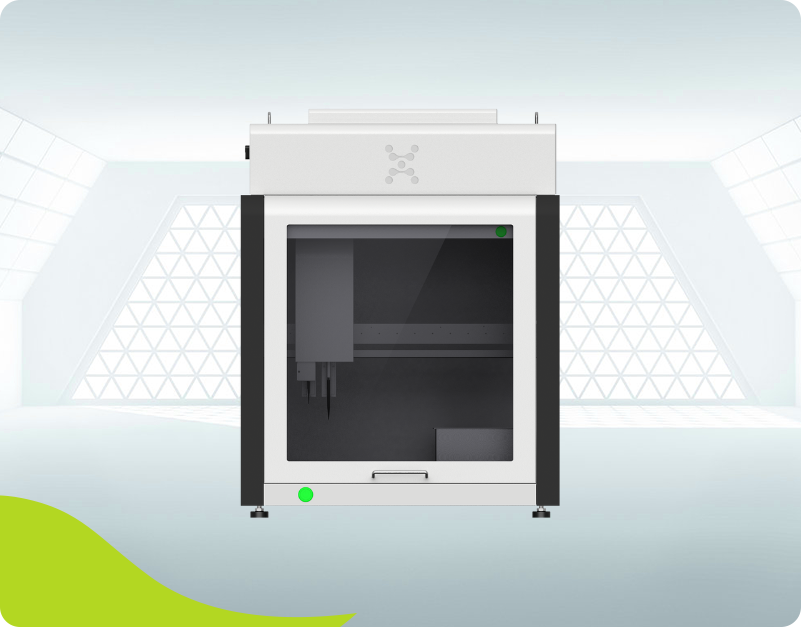
Many sequencing systems are elaborate optical readers. Fluorescent chemistry marks an event; lasers and cameras find the flash. Axbio’s wager is that electricity can do more of that work. The AxiLona AXP-100 uses nanopore sequencing-by-synthesis: a DNA polymerase adds tagged bases while a nanopore and a Bio-CMOS array register changes in electrical impedance or current. The template is circularized, allowing the machine to read the same molecule repeatedly and form a consensus. In principle, repetition answers a familiar long-read problem - individual noisy measurements can become a more credible result when they agree.
The published specifications are attractive: reads of at least 10 kilobases, maximum reads up to 100 kilobases, as much as 100 gigabases per run, and a run time under four hours. The box weighs about 6.85 kilograms. Those are Axbio’s claims, not a universal benchmark across sample types. The distinction matters. In sequencing, the machine is only the visible part of the bill. Sample preparation, consumables, failed runs, compute, accuracy, usable yield, and staff time determine whether “low cost” survives contact with a laboratory.
The first thing that failed was the plan
Hardware founders like solvable failure. If a circuit misbehaves, inspect the equation, change the design, test it again. Tian carried that instinct into biotechnology. Roche changed his mind. Drug developers might begin with ten programs and end nine early, because protecting a bad idea is more expensive than abandoning it. Tian came to call this “fail fast.” Ivanov put the ratio more bluntly in a 2020 interview: “90% of your effort is failures.”
“When you develop a product, there are many more failed parts than successful ones.”Hui Tian, co-founder and CEO
Axbio has never itemized what its first failed component cost. Publicly, it has described something more useful: what failure changed. The company established a microfluidic screening system that could sift roughly one million polymerase mutants for salt tolerance. Researchers found that a vortex-based method produced droplets with uneven sizes and impurities. They moved to continuous-flow microfluidics, settled on smaller, more uniform droplets, and found polymerase variants that performed better in salt. The lesson is portable. Do not ask one heroic experiment to rescue an integrated system. Build a cheap, high-throughput way to kill weak options.
That is also the condition under which Axbio’s model works. Dense chips are useful only if enzymes behave on them. Long reads matter only if accuracy and library preparation hold. A compact instrument helps only if customers can keep it supplied, serviced, and fed with samples. A clever sensor does not forgive a weak workflow.
One platform, several doors
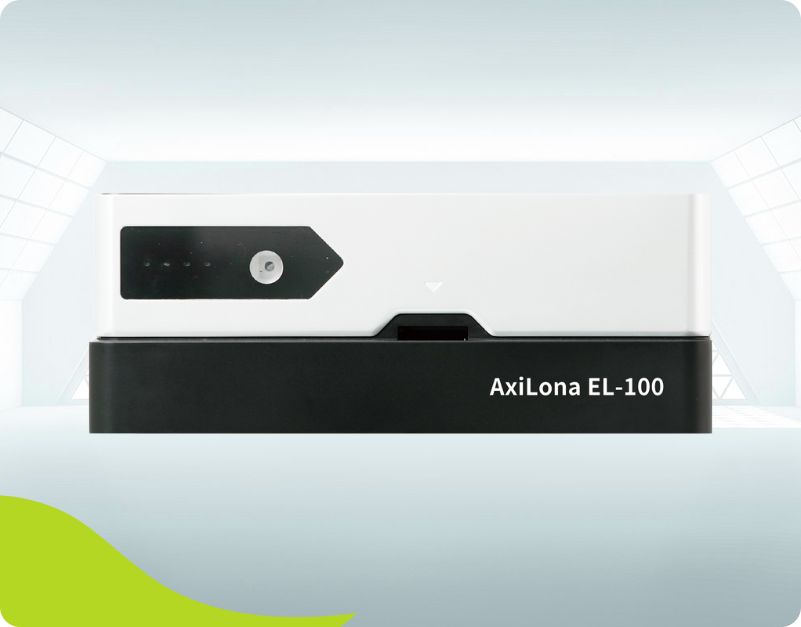
The AXP-100 is the glamorous door, but Axbio has built several. The AxiLona EL-100 is a compact electrochemical microarray analyzer. Capture probes bind amplified target sequences; the chip converts those events into electrical signals. Axbio says the device can examine up to 54 targets, with on-chip hybridization and signal detection measured in minutes. Its menu reaches respiratory infections, antimicrobial-resistance surveillance, foodborne pathogens, inherited disease, pharmacogenomics, and protein detection. The platform received CE marking in 2023 and, according to Axbio’s company history, a Jiangsu Class II medical-device registration certificate in 2025.
Around the instruments sit the recurring pieces of the business: sequencing kits, library-preparation kits, extraction products, sampling kits, diagnostic panels, and chips. An automated library-preparation system handles up to eight samples per batch. Custom chemistry, sequencing-panel design, bioinformatics, and protein-engineering services provide additional routes to revenue. MetaCONNET, an open-source deep-learning tool published with academic collaborators in 2024, polishes errors in metagenomic long-read assemblies. The parts are less photogenic than the machines. They may be more important to the business.
A machine outside the building
The most meaningful achievement in Axbio’s chronology may be smaller than its financing. In November 2024, the company installed an AXP-100 in Peter Belenky’s laboratory at Brown University, following a microbiome collaboration begun the year before. For an instrument startup, this is a border crossing. A prototype works while its inventors hover nearby. A product must work in someone else’s hands, on someone else’s schedule, beside someone else’s centrifuge.
The customers Axbio wants range from large research laboratories to smaller clinics, with possible applications in cancer research, infectious disease, human and agricultural genomics, environmental monitoring, and food safety. Not all of those markets arrive at once. The AXP-100 remains labeled for research use. Clinical diagnostics demand product-specific validation and regulatory authorization. A machine good at full-length 16S microbiome work is not automatically a cancer diagnostic, however elegant the slide deck.
Where Axbio fits: Illumina remains the familiar short-read alternative; Oxford Nanopore and PacBio define much of the long-read conversation; MGI and established diagnostic platforms compete for instrument budgets and workflows. Axbio’s proposed difference is architectural - electrical Bio-CMOS sensing, circular-consensus correction, and a vertically integrated stack from enzymes to software.
When the approach does not work: when a lab needs a deeply standardized, broadly supported ecosystem today; when local approvals do not cover the intended clinical use; when sample volume cannot justify a new workflow; or when total cost per usable answer fails to beat an incumbent after consumables, labor, and analysis are counted.
The $100 million bridge
In June 2022, AstraZeneca-CICC’s healthcare fund and Yunfeng co-led an approximately $100 million Series B, joined by investors including CBC Group, SDIC China Merchants, and 5Y Capital. The money was meant to optimize the sequencing technology, build manufacturing capacity, and push commercialization. Axbio opened a roughly 4,100-square-meter GMP-compliant production base in Wuxi. It also maintains R&D operations associated with Santa Clara and Shenzhen and a chemistry center in Tianjin.
Capital can pay for the bridge between prototype and production. It cannot shorten the bridge by decree. Reporting on Axbio’s renewed Hong Kong listing application says revenue rose from about $479,000 in 2024 to $1.21 million in 2025, while net losses remained above $22 million in each year. The May 2026 application is not a completed IPO; the exchange notice says approval and an offering are not assured. Still, the filing makes the next exam plain. Axbio has spent a decade proving that its stack can exist. Now it must prove that enough customers will pay for it repeatedly.
What can another company copy? Not the patents, and probably not the fab process. Copy the division of labor. Axbio put semiconductor talent next to enzyme engineers, built screening tools for the biology, designed consumables with the instrument, and placed an early system with an external research lab. Copy the founders’ revised relationship with failure: measure it quickly, make it cheap, and stop confusing persistence with attachment. The tiny doors on the chip are impressive. The larger door is commercial, and it has only begun to open.