In the old ritual, the scientist puts a piece of designed DNA into a circular plasmid, persuades a bacterium to accept it, waits for the bacterium to multiply, and then breaks open the descendants to retrieve the copies. It is ingenious. It is also rather like hiring a flock of sheep to photocopy a memo. The sheep have needs, preferences and, occasionally, objections to the memo.
- Elegen makes long, NGS-verified DNA using cell-free cloning, then sells it to research and drug-development teams.
- Its standard linear product runs from 300 bp to 7 kb and ships in 6-8 business days; difficult sequences cost more.
- Customers use the DNA in mRNA, protein-expression, genome-editing, cell-therapy and synthetic-biology work.
- The company has raised $35 million in a Series B and works with GSK, IDT and Nutcracker Therapeutics.
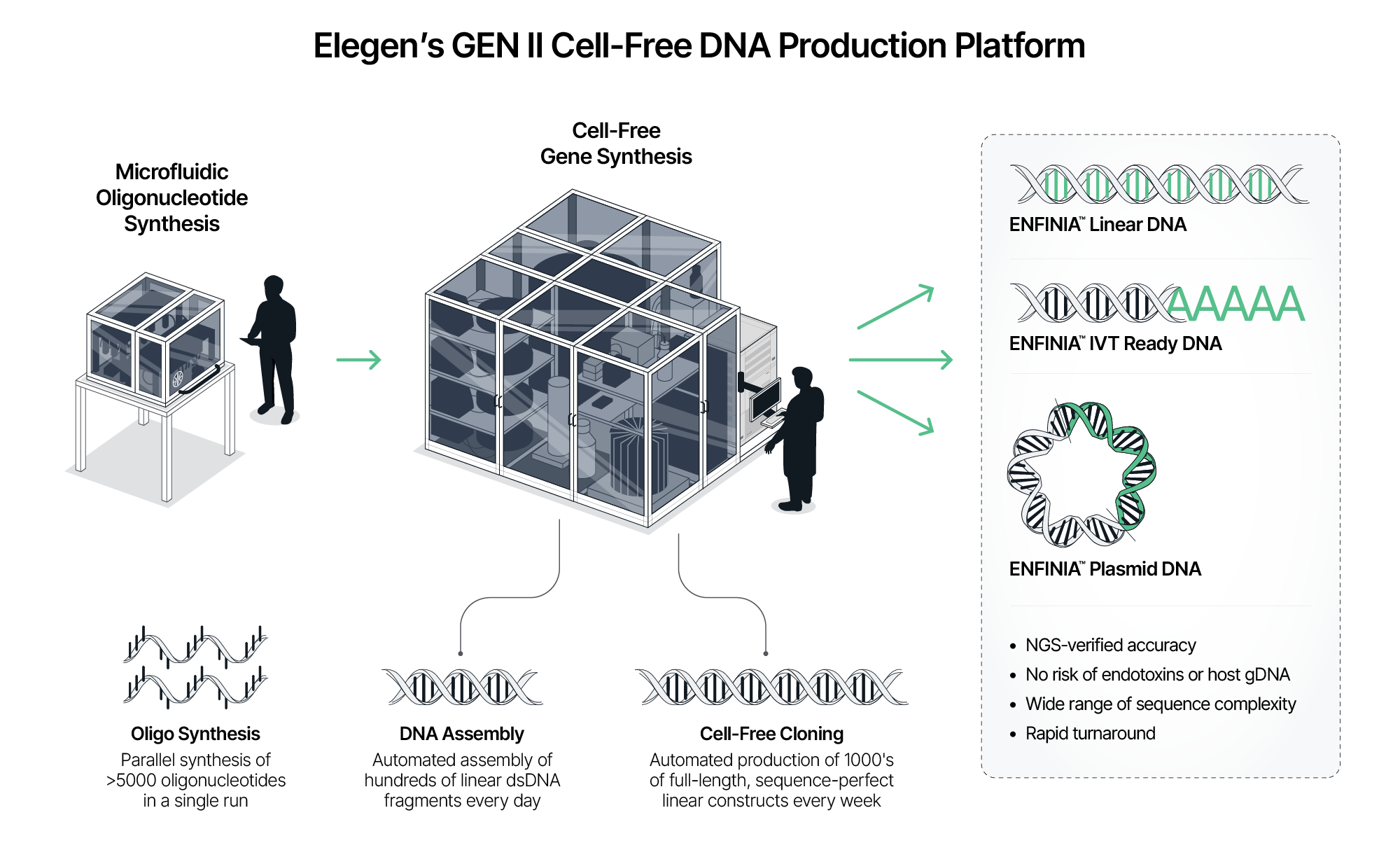
Elegen's bet is that the living copy shop can be replaced. The Menlo Park company uses microfluidics to make many short oligonucleotides, assembles those pieces into longer double-stranded DNA, and selectively amplifies correct molecules outside cells. The result is ENFINIA, a family of made-to-order DNA products. A researcher uploads a sequence. Elegen runs feasibility checks, manufactures it, verifies it with next-generation sequencing and ships the result in a plate.
The distinction sounds academic until the sequence is unpleasant. Repeats can recombine. High-GC stretches form stubborn structures. Some genes burden or poison the bacterial host asked to carry them. In an ordinary cloning workflow, the copy machine can edit, reject or simply fail to grow with the customer's design. Cell-free production removes that particular negotiation.
The founder had already met the bottleneck
Matthew Hill did not arrive at DNA manufacturing by admiring it from afar. He earned a genetics doctorate at Stanford, then spent eight years in research and development at molecular-diagnostics company Natera. There, he helped commercialize five diagnostic products, including noninvasive prenatal testing. Product development kept colliding with the same slow object: making the DNA required to test the next idea.
That frustration changed the scale of the question. Instead of optimizing one assay around the delay, Hill founded Elegen in 2017 to attack the delay itself. The company's task became the “build” in synthetic biology's design-build-test-learn loop - the physical moment when a digital sequence has to become matter.
“When we founded Elegen, our goal was to make DNA production as fast and precise as digital design.”Matthew Hill, founder and CEO
The product is DNA. The customer buys Tuesday.
ENFINIA Linear DNA is the cleanest expression of the idea: double-stranded constructs from 300 base pairs to 7 kilobases, delivered in 6-8 business days, with a reported median error rate as low as one in 70,000 bases. Elegen sells higher-complexity production for sequences with longer repeats, wider GC ranges or homopolymers. This is not a universal “yes,” but it is a wider door.
Two newer products move closer to therapeutic workflows. ENFINIA Plasmid DNA puts inserts as long as 15 kb into selected vector backbones and ships in as few as 10 business days. The insert begins with Elegen's cell-free process, though the finished plasmid still uses an E. coli host for cloning and preparation. ENFINIA IVT Ready DNA adds the poly(A) tail needed to make messenger RNA, so a team can move toward in-vitro transcription without first cloning and linearizing a plasmid. For a scientist screening vaccine candidates or cell-therapy constructs, the saved item is not DNA. It is the next experimental Tuesday.
A price card with asterisks worth reading
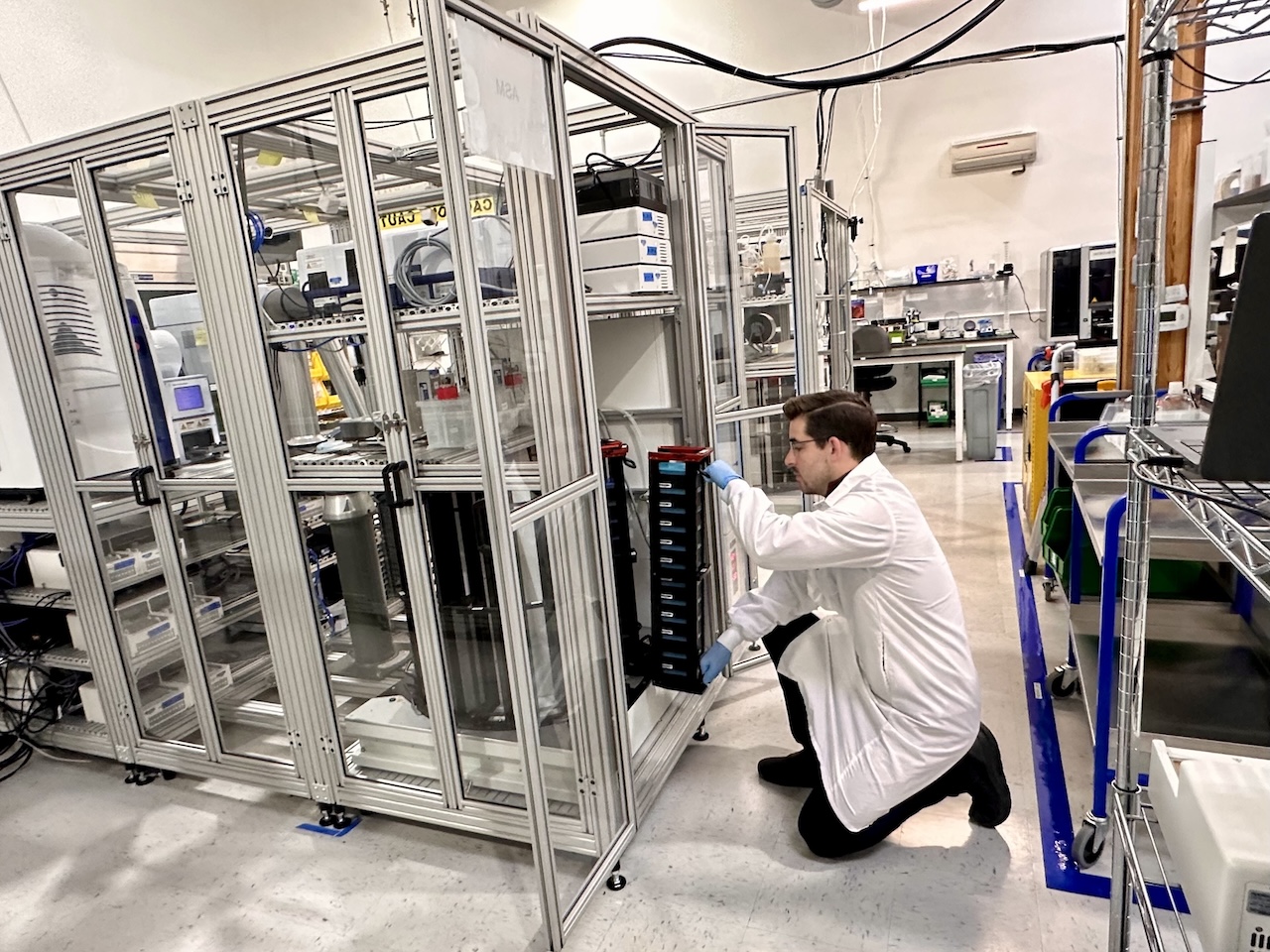
GEN II, Elegen's second-generation production platform, combines the microfluidic synthesizer with automated assembly and cell-free cloning. The company says the small synthesizer can generate more than 5,000 oligos in a run, while a 56-square-foot setup can reach 40,000 unique oligos a week. More throughput and better success rates changed management's view of price: the 2025 starting price of $0.15 per base pair fell to $0.07 in January 2026.
Linear
$0.07/bpStandard complexity, 1-7 kb. A 7 kb construct lists at $490 before yield upgrades.
Plasmid
$0.12/bpStandard-complexity inserts, 1-15 kb. Cloning and mini-prep are included.
IVT Ready
$0.07/bpBase price plus a $225 poly(A)-tail fee; 10 µg yield is included.
The asterisks matter. High-complexity linear and IVT-ready sequences run from $0.14 to $0.20 per base pair. Difficult plasmid inserts can reach $0.30. Extra yield adds hundreds or, for 50 µg of IVT-ready DNA, more than a thousand dollars. A short standard sequence below 1 kb has a flat minimum. Elegen is less a vending machine than a specialist print shop with an unusually legible menu.
The alliances reveal the market
In January 2024, GSK signed a multi-year collaboration and licensing agreement to use Elegen's technology in vaccines and medicines, including RNA vaccines. The agreement contemplated as much as $35 million in support and fees, in addition to product sales and a possible GSK investment. Four months later, Elegen raised a separate $35 million Series B led by Triatomic Capital, with GSK, Andreessen Horowitz, 8VC, Agilent and others participating. The money was directed toward clinical manufacturing, where quality systems and reliability matter as much as speed.
The next partnerships outline two other routes. Integrated DNA Technologies paired its reach with Elegen's long, complex synthesis in a 2025 early-access program. Nutcracker Therapeutics connected Elegen's cell-free DNA to its cell-free RNA manufacturing system for personalized cancer therapies. One alliance says “pharmaceutical platform,” another says “distribution,” and the third says “a complete manufacturing chain without cells.”
The useful caveat
Cell-free does not mean failure-free. Elegen publishes acceptance windows for GC content, repeats and homopolymers. Some plasmids need a second attempt; after two unsuccessful rounds, the construct is declared infeasible and the customer is not charged. Certain long homopolymers are also difficult for current quality-control methods to measure confidently.
The lesson is smaller than “reinvent biology”
Elegen's market includes Twist Bioscience, GenScript and, in some product categories, its partner IDT. Shorter commercial fragments can arrive in fewer days. In-house cloning can be cheap when the laboratory has the people, equipment and a cooperative sequence. Elegen becomes most interesting when labor is scarce, the construct is long or awkward, verification matters, and each week of delay holds up an expensive development program.
There is a practical idea here that travels beyond DNA. Find the living step in a technical workflow. Ask which virtues it supplies and which delays merely come from keeping it alive. Then replace only the latter. Elegen did not abolish plasmids - it sells them. It did not promise every sequence - it prices complexity and admits infeasibility. It removed the bacterium from the copying stage where the bacterium was behaving less like a miracle and more like a moody subcontractor.
That restraint may be the company's most convincing quality. The ambition is large: make DNA writing keep pace with digital design. The operation is satisfyingly literal: take a file, manufacture the molecule, check every order and put it in the mail.