● BREAKING
$153M Series B led by Kinnevik closes Aug 2025
Regeneron & Amgen join the cap table — Lilly returns
STX-001 logs complete responses in checkpoint-resistant tumors
Total raised tops $250M
An MIT spinout wrote a programming language for mRNA
STX-003 lung-cancer trial slated for 2026
● BREAKING
$153M Series B led by Kinnevik closes Aug 2025
Regeneron & Amgen join the cap table — Lilly returns
STX-001 logs complete responses in checkpoint-resistant tumors
Total raised tops $250M
An MIT spinout wrote a programming language for mRNA
STX-003 lung-cancer trial slated for 2026
Dispatch / Cambridge, MA
A drug that knows where it is
Inside a tumor in an advanced cancer patient, something unusual is happening. A medicine that was injected days ago has not washed out, faded, or drifted into healthy tissue. It is sitting where it was placed, quietly making copies of itself, and instructing the tumor to manufacture a cytokine so toxic that doctors spent thirty years afraid to give it to anyone. This is the entire premise of Strand Therapeutics: a drug that knows where it is, what to make, and - the part everyone else missed - when to stop.
Strand is a clinical-stage biotech headquartered in Boston, with roughly 89 employees and a single, slightly unreasonable idea: that mRNA can be programmed like software. Not used as a one-shot vaccine, the way the pandemic taught the world to think of it, but engineered with logic - sensors, switches, self-replicating loops - so the molecule behaves differently depending on the cell it lands in. The company calls this “programmable mRNA.” Most of the industry, until recently, called it ambitious.
Where synthetic biology meets mRNA therapeutics.
— Strand Therapeutics, company tagline
The Problem
mRNA could make anything. It just couldn’t be told where
The COVID vaccines proved mRNA works: you inject genetic instructions, your cells read them, they make a protein. Clean, fast, manufacturable. But a vaccine has the easy job. It only needs to make one protein, briefly, more or less anywhere, and then go away.
Treating cancer is a harder assignment. The proteins that fight tumors best - cytokines like interleukin-12 - are spectacular at recruiting the immune system and spectacular at making patients dangerously sick when they circulate through the whole body. IL-12 has been a tantalizing cancer drug since the 1990s and a clinical disappointment for almost as long, because the dose that helps the tumor tends to harm everything else.
So the field had a paradox dressed up as a platform. mRNA could, in principle, instruct the body to make any protein. What it could not do was confine that instruction to the one place it was needed, hold it there, and switch it off before it became a problem. Conventional mRNA expresses everywhere and fades fast. That is fine for a vaccine. It is close to useless for a tumor.
Strand exists to close that gap. The bet is that the missing ingredient was never chemistry - it was control.
The toxic-cytokine problem isn’t that IL-12 is too weak. It’s that it goes everywhere. Strand’s answer: make the tumor build it on-site.
— YesPress, on the central tension
The Founders’ Bet
They wrote a programming language for RNA, then dared it to cure things
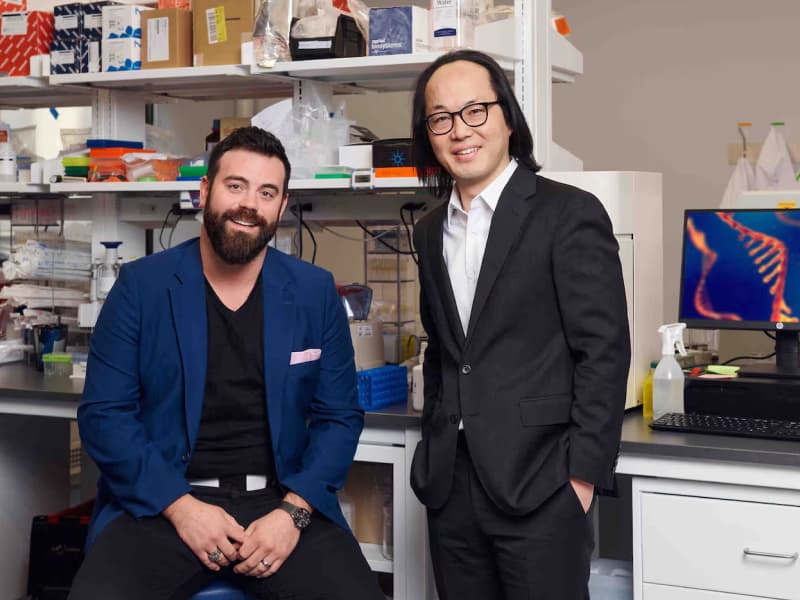
In 2017, Jake Becraft and Tasuku Kitada walked out of MIT’s Synthetic Biology Center with a thesis and a chip on their shoulder. Working alongside synthetic-biology pioneers Ron Weiss and Darrell Irvine, they had built what they describe as the first programming language for mRNA - genetic logic gates and circuits encoded directly into the molecule. Their academic colleagues found it elegant. Their bet was that elegance, applied to cancer, could become a medicine.
Becraft, a synthetic biologist with a PhD in biological engineering from MIT, became CEO. Kitada, who had pioneered synthetic mRNA gene circuits in the lab, became president and head of R&D. The founding insight was almost insultingly simple to state and brutally hard to build: if you can give mRNA logic - if this cell, then express; if not, stay quiet - you can aim a drug the way you aim a cursor.
Jacob “Jake” Becraft
Co-Founder & CEO
Tasuku Kitada
Co-Founder, President & Head of R&D
Ron Weiss
Scientific Co-Founder
Darrell J. Irvine
Scientific Co-Founder
The future is incredibly bright.
— Jake Becraft, CEO, on the road ahead for mRNA
The Product
Self-replicating, self-limiting, and rude to tumors
Strand’s lead candidate, STX-001, is a self-replicating mRNA designed to express IL-12 locally inside the tumor microenvironment. The self-replicating part matters: a small dose keeps producing the protein on-site rather than fading in hours, the way ordinary mRNA does. The local part matters more: the tumor becomes the factory, so the cytokine that was too toxic to give systemically is now built exactly where it is supposed to fight - and largely nowhere else.
It is being studied as a monotherapy and in combination with Merck’s Keytruda. Behind it sits a platform, not a one-off. STX-003 targets non-small cell lung cancer, with a Phase 1 trial expected in 2026, and the company has additional programs aimed at blood malignancies and autoimmune disease - eight programs in all, drawn from the same underlying toolkit.
Lead · Phase 1STX-001
Self-replicating mRNA expressing IL-12 inside solid tumors. Tested alone and with Keytruda.
Next up · 2026STX-003
Programmable mRNA aimed at non-small cell lung cancer. Phase 1 expected to open in 2026.
PlatformProgrammable mRNA
Logic circuits and cell-type sensing that control where, when, and how much protein gets made.
PipelineEight programs
Spanning solid tumors, blood cancers, and autoimmune disease - all from one toolkit.
Field Note
The clever bit isn’t the on switch. Plenty of drugs turn on. Strand’s mRNA comes with a built-in off switch - logic that limits where and how long it expresses. In oncology, knowing when to shut up is its own kind of breakthrough.
The Proof
Money follows results. The results came first
Skeptics are right to ask whether “programmable” is marketing. Two things make it harder to dismiss. First, the clinic: at ASCO 2025, STX-001 produced multiple RECIST responses - including complete responses - in patients whose tumors had already shrugged off checkpoint-inhibitor immunotherapy, alongside a favorable safety profile. Second, the cap table: Kinnevik led a $153M Series B, and the venture arms of Regeneron and Amgen wrote checks, with Eli Lilly returning. Strategics tend to be unsentimental about biology.
Capital raised, by round
USD, approximate · cumulative total > $250M
The bars get taller; so does the burden of proof. A bigger Series B buys more shots on goal, not certainty. Figures are approximate, from public reporting.
The partnerships read like a vote of confidence from people who compete with each other. Merck’s Keytruda anchors the STX-001 combination arm. Regeneron, Amgen, and Lilly - three companies with their own ambitions in immuno-oncology - all chose to fund the platform rather than route around it.
Complete responses, in patients who had run out of options. That is the sentence every oncology platform wants to be able to write - and most never do.
— YesPress, on the ASCO 2025 readout
The Mission
Lead the genetic-medicine revolution, then keep going
Strand’s stated mission is to lead the genetic-medicine revolution with programmable mRNA - starting with cancer and autoimmune disease, and expanding to new delivery systems for tissues across the body. The phrasing is grand. The work underneath it is not: it is the slow, unglamorous business of proving, one trial at a time, that a molecule can be trusted to follow instructions inside a human being.
What makes the company worth watching is less any single drug than the claim implied by all of them - that medicine can be written, versioned, and debugged. If that holds, a win in solid tumors is not the finish line. It is the compiler check that says the rest of the program might run.
If you can program one protein to behave, you can program the next one faster. Platforms compound. That is the whole pitch.
— YesPress, on why the platform matters more than the drug
Why It Matters Tomorrow
Back inside that tumor
Return to where we started: a medicine sitting inside a tumor, replicating quietly, instructing the cancer to manufacture the very cytokine that was once too dangerous to use. A few years ago that sentence would have been a grant application’s wishful thinking. Now it is a Phase 1 patient with a documented response, a $153M round, and three pharma strategics watching closely.
The tumor that used to be a problem has been handed a job. The cytokine that used to be a liability is now a local employee. And the drug, when its work is done, is built to stand down. Strand has not cured cancer - nobody should say that, and they don’t. What they have done is change what the inside of that tumor looks like, and made a credible case that the change is programmable, repeatable, and theirs to scale. The rest is data, and data takes time. They appear to have bought some.