The future of pharmaceutical manufacturing may smell faintly of bread. In a Boulder laboratory, Khona Scientific is betting that ordinary yeast, fed ordinary sugar, can be persuaded to make decidedly unordinary things: rare natural compounds, pharmaceutical key starting materials and, eventually, active ingredients that now arrive through long and brittle global supply chains. The microbe is familiar. The choreography inside it is not.
Khona's core technology is called BiDS, short for a patented system of bidirectional, multi-enzymatic scaffolds. The plain-English version is better: a molecular assembly line. Rather than letting a collection of enzymes bump around a cell and hoping every intermediate finds the next station, BiDS physically organizes the pathway. The target molecule moves through a sequence, with fewer chances to wander into a useless byproduct, diffuse away or poison its microscopic host.
sugar
yeast
pathway
compound
The first enemy was biological traffic
What failed first was not Khona itself. It was the conventional pathway design the company set out to improve. Biosynthesis works neatly when a product requires only a handful of biological steps. Add a dozen more and every handoff becomes another opportunity for loss. Intermediates drift. Side reactions multiply. Some compounds stress the cell that is supposed to make them. Expensive reagents can erase the cost advantage of fermentation.
Cannabinoids made a brutal first test. Khona describes their full biosynthesis as a chain of more than 20 steps. Its early public material focused on non-psychoactive compounds including CBG, CBC and CBD variants, with yeast converting sugar over roughly 24 hours. After fermentation come separation and chromatography. The company has reported 85 to 90 percent conversion efficiency and targets isolates above 99 percent purity. Those are company-reported process figures, not evidence of broad commercial sales.
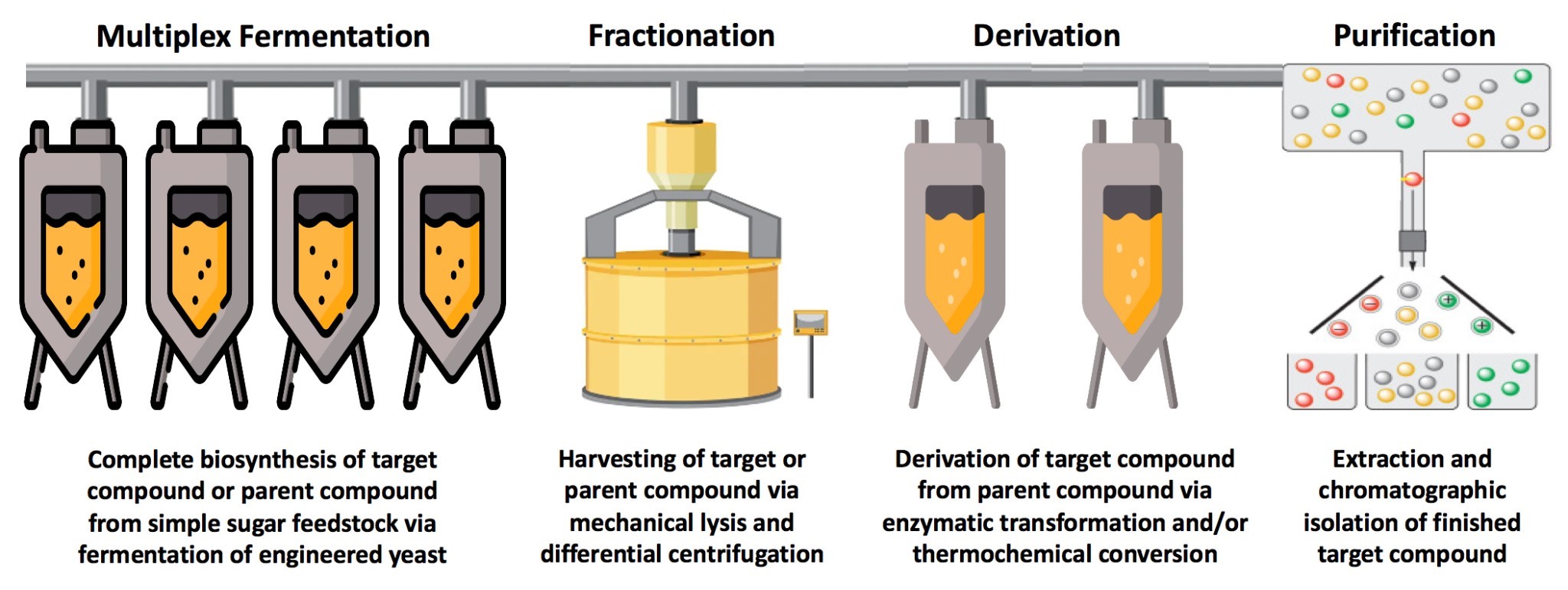
That distinction matters because precision fermentation has a graveyard of beautiful diagrams. A pathway that performs in a small vessel may behave differently when heat, oxygen, mixing and contamination risk grow with the tank. Then the molecule must be recovered and purified cheaply enough to beat extraction or chemical synthesis. Khona's answer is not merely higher yield. It is modularity: prove one organized architecture, then reconfigure it for a family of difficult compounds.
The clever bit is not asking yeast to make a molecule. It is arranging the shop floor so the molecule stops getting lost.YesPress analysis of Khona's BiDS design
The target got more serious
The company's public story has changed since the cannabinoid-heavy website of 2023. The engine remains BiDS, but the destination has widened. By 2026, Khona was talking explicitly about pharmaceutical key starting materials, or KSMs, and active pharmaceutical ingredients. The reason is less fashionable and more durable than the cannabinoid boom: many important drug inputs are sourced overseas, sometimes without an easy alternate route.
That appears to be what changed the company's mind about where to point its platform. Khona did not abandon cannabinoids; its patents still grow from that work. Instead, a hard demonstration market became the technical base for a supply-chain business. The shift is visible in its collaborators. A January 2026 letter of intent with Benuvia Operations pairs Khona's fermentation know-how with Benuvia's experience in GMP manufacturing, regulatory work and controlled substances. The arrangement is an evaluation framework, not a commercial production contract. That restraint is exactly what regulated manufacturing requires.
In April, Khona announced acceptance into the BioMaP Consortium, a BARDA-supported network built around domestic biopharmaceutical manufacturing preparedness. Membership offers access to government needs, possible project opportunities and industry collaborators. It is not the same as receiving a BARDA award. In May, Michael A. Gonzalez, a green-chemistry and pharmaceutical-manufacturing veteran, joined Khona's board. In July, Bright Path Labs publicly backed Khona's investment in domestic KSM capacity.
Then came a second letter of intent, this one with hormone-therapy company EVEXIAS. The parties plan to explore bioidentical progesterone, estradiol, estrone and estriol made through Khona's platform, followed by rigorous validation before any use in formulations. It is a revealing product choice. Steroid hormones are complex enough to suit Khona's architecture, established enough to have known demand and exposed enough to international sourcing risk that a redundant route could matter.
A business model with three rungs
Khona sells to businesses, not to the person browsing a supplement aisle. Its likely users are pharmaceutical and nutraceutical formulators, ingredient buyers and biotechnology manufacturers with a pathway that works poorly or costs too much. The company also offers process-design and production solutions. Its partner pipeline is unusually legible for an early biotech.
How a pathway becomes a business
That structure gives a four-person team several ways to earn. Development work can support a program before a factory exists. Licensing can extend reach without Khona financing every steel tank. Ingredient production captures more value but also carries more capital, quality and execution risk. The Benuvia relationship shows why partnerships are central: Khona can design a pathway, while a regulated manufacturer supplies the compliance machinery and operating history.
The financing record is modest by industrial-biotech standards but larger than some company databases suggest. SEC notices show $511,000 sold in a debt offering, roughly $2.11 million sold cumulatively in an equity offering, and $340,000 in a separate 2025 convertible-note offering to three investors. The filings do not disclose a valuation or name the investors. Khona also said it qualified in 2024 for Colorado's Advanced Industry Investment Tax Credit program, which can make eligible investments more attractive to in-state backers.
What a founder can steal
The copyable lesson is not "put yeast in a tank." It is to find where a process repeatedly loses value, then redesign the sequence rather than polishing one isolated step. Khona began with a problem that made the weakness obvious: a long cannabinoid pathway. It patented the organizing logic, added a service ladder around the platform and only then aimed at adjacent markets where reliability may command more attention than novelty.
A second lesson is to sell the transition, not only the final molecule. Proof-of-concept work, optimization, production and licensing are different products for buyers at different levels of readiness. This lets an early company participate before commercial volume arrives. A third is to borrow missing credibility through a specific partner. "We do regulated APIs" is a claim. Evaluating a pathway with a company that already operates inside controlled-substance and GMP rules is a program.
Where it can work
Targets that are scarce, costly to extract, exposed to fragile sourcing, made through long enzyme pathways and valuable enough to absorb purification and compliance costs.
Where it probably will not
Cheap bulk molecules with efficient incumbent chemistry, compounds toxic to the host, pathways that collapse at scale, or products whose downstream purification costs overwhelm fermentation gains.
Khona also faces a familiar industrial-biotech trap: being right about biology and wrong about economics. Sugar is inexpensive, but reactors, technicians, chromatography media, validation batches and quality systems are not. A bioidentical molecule still has to meet a specification every time. Pharmaceutical programs add stability, traceability and regulatory expectations. Letters of intent can focus work, but they are not purchase orders.
Competition comes from several directions at once. Plant extraction has agricultural variability but established suppliers. Chemical synthesis can be superb for the right molecule. Other precision-fermentation companies, including firms such as Antheia, Manus and Capra Biosciences, are pursuing adjacent natural-product and pharmaceutical opportunities with different organisms and process architectures. Khona's defensible wedge is its pathway organization, protected by U.S. patents granted in 2022 and 2025. Its proof will be repeatable production economics.
The small factory test
Khona occupies an interesting spot in the market: upstream of drug brands, downstream of pure research and alongside contract manufacturers. It is selling a way to turn biological complexity into an ingredient specification. That can help a customer lower raw-material costs, add a second source, avoid agricultural contaminants or access a compound that nature produces grudgingly.
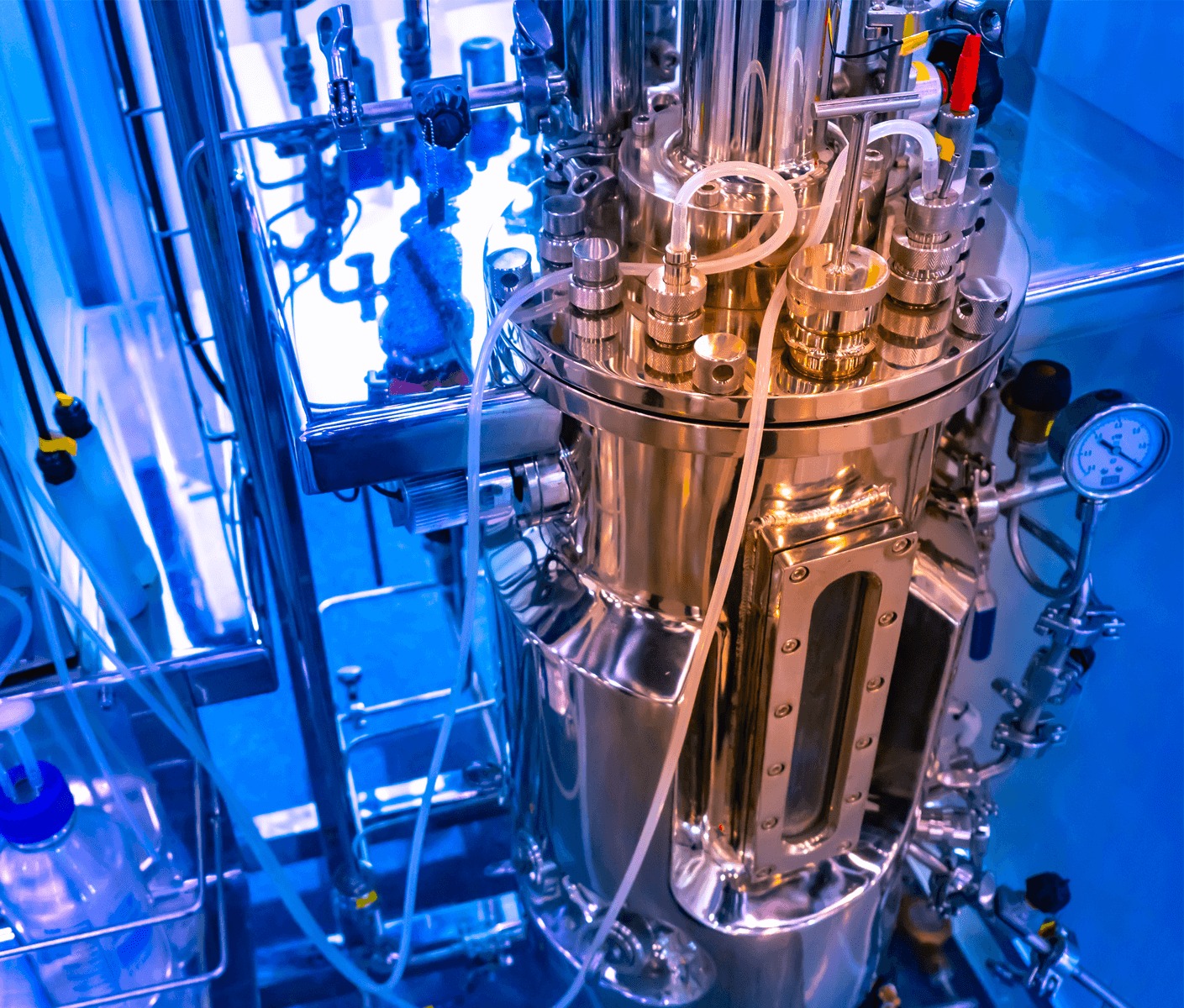
The company has already moved from patent drawings to a Boulder lab expansion and announced equipment capable of 300-liter scale-up. The next informative milestones will be less photogenic: validated yields at larger volume, definitive manufacturing agreements, named commercial products and evidence that purification costs behave. Until then, Khona is a compact company carrying an industrial-size hypothesis.
It is also a timely one. Pharmaceutical resilience is usually discussed in maps, ports and national stockpiles. Khona starts several orders of magnitude smaller, inside a cell. If the enzymes can be kept in line, a bit of sugar and a domesticated fungus may become something more useful than a metaphor: an alternate route when the old supply chain stops answering the phone.
Continue exploring
Meet the microbes' management
Company performance figures in this profile are identified as company-reported. Partnership letters described here are exploratory unless a definitive agreement has been announced.