The revealing number in Cataya Bio's story is not the nine ingredients in its public catalog, or even the roughly $63 million that company databases say it raised through 2023. It is 15,000 liters. That was the size of a 2025 demonstration run Cataya completed with the Japanese trading and specialty-chemicals group NAGASE for an unnamed personal-care ingredient. The batch met its target specifications and commercial performance measures. A molecule had escaped the flask.
That handoff is the plot of industrial biotechnology. Scientists can program microbes to make useful compounds, but customers do not buy an elegant strain. They buy a consistent ingredient, at the right purity and price, with paperwork that survives regulators and a supply chain that does not blink. Cataya was founded in Shanghai in 2021 to close that gap. It engineers biological production routes, develops the fermentation process, handles scale-up and makes the finished material in company-controlled plants.
Its current markets are deliberately unromantic: the tubs, drums and specifications behind beauty products, nutrition formulas and, eventually, pharmaceutical ingredients. The personal-care shelf includes bisabolol, squalane, ceramides, adenosine, ectoine and cellulose. The nutrition side lists three human milk oligosaccharides, or HMOs: 2'-fucosyllactose, 6'-sialyllactose and 3-fucosyllactose. These are known ingredients with buyers, benchmarks and regulatory pathways. Cataya is changing how they are made.
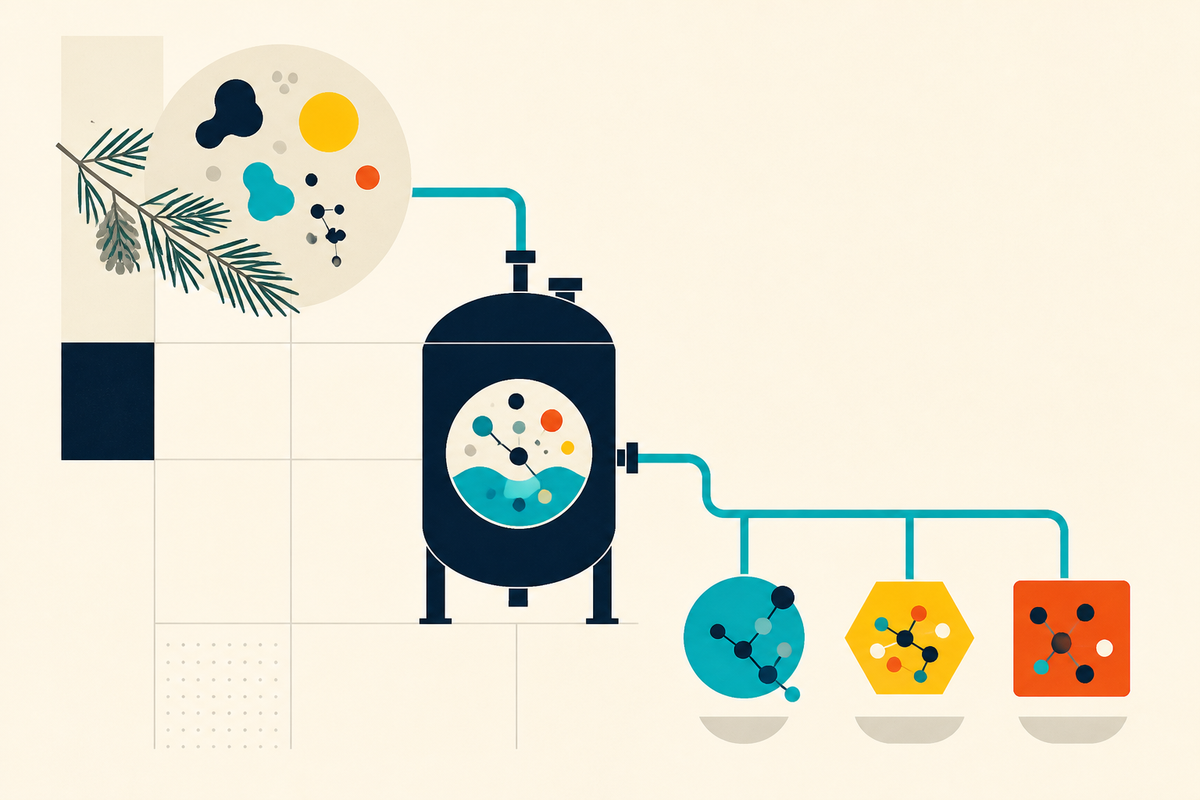
A product company wearing a platform underneath
Synthetic-biology companies often lead with the platform: automation, strain design, data and a theoretically vast menu of molecules. Cataya's website leads with products. BisaPure Bisabolol is pitched around high purity and low farnesol content. Catalisse Squalane aims to reproduce the sensory quality once associated with shark-derived material. The ceramide range is skin- and hair-identical. Adenosine is listed at 99 percent purity. Each claim speaks the language of a formulator, not a venture-capital demo day.
Underneath is the reusable machinery. Cataya describes an engineering-biology platform that combines automation, miniature high-throughput experiments, large datasets and AI. Its Qidong base, near Shanghai in Jiangsu province, has a pilot line and two multifunctional production lines that the company says can deliver kiloton-scale output. Procurement, production, quality control, warehousing and logistics sit in one system. The business model is B2B ingredient sales plus selected joint development, scale-up and commercialization work.
That makes Cataya less like a contract research shop and more like an integrated ingredient supplier. Personal-care brands and their formulators care about texture, stability and sourcing. Infant-nutrition manufacturers care about safety, consistency and permission to sell. Pharmaceutical customers care about documentation and repeatability. All of them can ignore the elegance of the organism if the shipment is late.
Competition comes from two directions. Established chemical and ingredient groups already know the buyers, own global distribution and operate proven plants. Other synthetic-biology companies can offer alternative fermentation routes or engineering platforms. Cataya's answer is not a single scientific trick. It is the bundle: targeted molecules, strain and process engineering, owned capacity, regulatory work and a partner model for commercialization. That bundle can shorten the awkward chain of handoffs between a research team, a contract manufacturer and an ingredient distributor. It can also give customers one accountable counterparty when purity, volume or timing slips. NAGASE brings the market reach and application knowledge of a global chemicals group; Cataya brings the process and production system. The relationship is a useful picture of where the company fits. Cataya does not need to replace every incumbent. It needs to become the dependable biological manufacturer behind products that incumbents and consumer brands already know how to sell.
“Our R&D is built for speed and scale from day one.”Cataya Bio
The founder has seen the expensive part before
Founder, chairman and CEO Lishan Zhao spent from 2008 to 2021 at Amyris, the ambitious American synthetic-biology company. The American Institute of Chemical Engineers says he served as vice president of research and development, helped move more than ten products from lab to market and built the company's business in China. Before that, he engineered enzymes at Diversa. Cataya's co-founders are general manager Liuyang Diao and senior vice president Shiyuan Hu; the management roster also includes leaders for technology, manufacturing, engineering, AI, product and business development.
The useful inference is not that Zhao discovered a secret molecule. It is that he organized the new company around the old industry's recurring failure: scale can arrive late, cost more than expected and expose biology that behaves beautifully only in small vessels. Cataya's answer is to make manufacturability an early design constraint. A strain, recovery process and target specification develop together. The company then has somewhere to run the result.
Choose value
Start with an ingredient whose purity, sourcing or performance commands a margin.
Design the route
Engineer the organism and downstream process against real plant constraints.
Prove the handoff
Run with a commercial partner at a volume that exposes process weaknesses.
Earn access
Treat safety files, quality systems and regulatory review as product work.
The NAGASE run is the cleanest public example. The companies jointly developed and scaled a personal-care ingredient; at 15,000 liters it met specifications and key commercial measures. Cataya framed the result as a path to market, not a launch. That distinction matters. A demonstration lowers technical risk, but customer orders, repeat batches and competitive unit economics still have to follow.
Regulation is part of the product
The HMO portfolio shows a second barrier. Cataya's 2'-FL received an FDA no-questions letter in June 2025 under GRAS Notice 1238, covering infant formula and other foods at specified levels. Later that year, Cataya announced Chinese approval for uses including infant and young-child formulas and baby foods. Its 6'-SL followed in the United States: the FDA's March 2026 response to GRN 1275 covered infant formula, baked goods and several beverage categories.
Those letters do not turn Cataya into a consumer brand. They make its ingredients usable by customers in defined products. The regulatory dossier, manufacturing description, specifications, exposure analysis and safety narrative are therefore commercial assets. Cataya has also pursued routes in Australia and New Zealand for 2'-FL, while a European Union application seeks to add its production strain and company to the novel-food specification.
The customer proposition becomes unusually practical: a familiar molecule, a fermentation-derived supply route, regulatory support and the capacity to deliver. Sustainability is present, but it is not asked to carry the sale alone. Cataya promises customers that cleaner sourcing need not sacrifice quality, cost or security. In industrial materials, that is a more durable pitch than virtue without parity.
What it costs to own the bridge
This model consumes capital. Cataya completed a $16 million Series A in 2022, followed by an A+ round reported at more than 100 million yuan and a 250 million yuan Series B in September 2023. Reported investors include Source Code Capital, Bits x Bites, Sherpa Healthcare Partners, Eight Roads Ventures, Sequoia China, F-Prime Capital and Hengxu Capital. Databases put total funding near $63.2 million, although conversions and round labels vary.
The next bill is larger. In January 2026, Cataya broke ground on the second phase of a Qidong pharmaceutical-excipient project. Local government reporting puts planned investment across three phases at 1.05 billion yuan, or about $151 million. Phase one leased a 3,660-square-meter facility for a pilot line. Phase two carries a 500 million yuan plan for 2,200 metric tons of annual capacity. A third 500 million yuan phase would expand again. At full operation, local projections attach more than 225 million yuan in annual sales to phase two. These are plans, not results.
The conditions that break the playbook
Vertical integration looks powerful when the molecule is valuable, demand is visible and fermentation beats the incumbent route. Reverse any of those conditions and the factory turns from moat to burden. A conventional supplier can cut price. A regulator can ask another question. A customer can love the sustainability story and still reject a formulation on feel, stability or cost. The risk arrives in steel: idle fermenters keep charging depreciation.
It works when
The ingredient has defensible value, production is repeatable, approvals unlock real buyers and capacity fills in measured stages.
It fails when
Commodity pricing compresses margin, scale changes the biology, regulation drags or plants are built ahead of signed demand.
There is also portfolio tension. Cosmetics move faster than infant nutrition; HMOs demand more regulatory work; pharmaceuticals add another quality regime. Shared tanks and technical talent help only if the products can coexist operationally. Cataya's discipline will be tested by how selectively it adds molecules and how often its lines change over without surrendering yield or reliability.
For now, the company has assembled the pieces that laboratory biotech often leaves scattered: experienced operators, known ingredient markets, partner validation, regulatory progress and owned production. Its name comes from Cathaya, the rare Chinese silver fir. The botanical reference is gentle; the operating model is not. Cataya is placing microbes, dossiers, tanks and warehouses on one balance sheet. The payoff is control over the hardest handoff in biotech. The price is having nowhere to hide when the factory starts.