A laboratory has flattering manners. It lets the scientist choose the vessel, watch the temperature, and fuss over every variable. A factory is blunter company. It asks whether the organism will behave in a tank, whether the product can be separated without ruining the economics, whether the next batch will resemble the last, and whether a customer will still be waiting when it arrives. Lishan Zhao has spent a career in the conversation between those two rooms.
The conversation began with chemistry. Zhao earned bachelor's and master's degrees at Fudan University in Shanghai, then moved to the University of Minnesota for doctoral work with chemist Hung-Wen Liu. His dissertation studied enzymes involved in making unusual sugars and used biosynthetic engineering to create modified antibiotic analogs. The vocabulary was academic, but the instinct was already practical: understand a biological pathway closely enough to persuade it to make something new.
After completing the doctorate in 2000, Zhao entered industrial biotechnology at Diversa Corporation. There he worked on discovering and engineering enzymes for industrial applications. His patent trail from that period wanders through cellulolytic enzymes, aldolases, epoxide hydrolases, and enantioselective chemistry. A patent list is not a personality test, but it does show the range of stubborn molecular problems that occupied his days.
The education of an industrial biologist
Zhao spent a short chapter at BioVerdant before joining Amyris in 2008. The timing put him inside one of synthetic biology's defining industrial experiments. Amyris was engineering yeast to produce molecules that had usually come from plants or petroleum-based chemistry. Biology could sketch a route; fermentation had to make that route repeatable at commercial scale.
During Zhao's tenure, he rose to vice president of research and development and president of China. He helped develop Amyris's synthetic-biology platform and bring more than ten products from laboratory work toward market. The programs included artemisinin, farnesene, and steviol glycosides. He also built the company's business in China, adding partner conversations and supply-chain choices to a résumé that had begun with enzyme mechanisms.
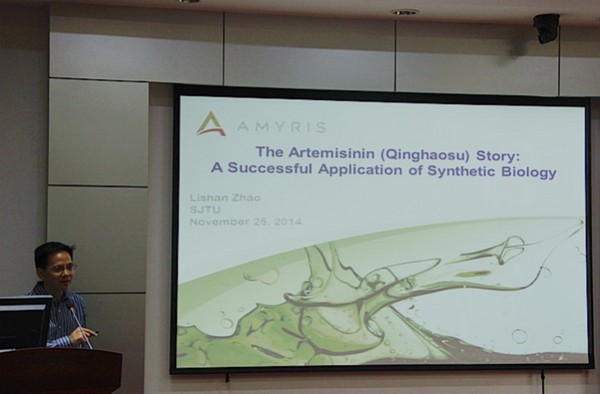
In late 2014, Zhao spent a month at Shanghai Jiao Tong University. He gave two talks, taught graduate students, and advised research groups from the perspective of corporate R&D. One lecture was titled “The Artemisinin Story: A Successful Application of Synthetic Biology.” The other examined engineered yeast for commercial farnesene production. Together they form a tidy diptych of his career: a biological pathway on one side, the demands of production on the other.
“I strongly believe that if we all work together, we can pave the road for synthetic biology to play an important role in replacing petroleum one day.”Lishan Zhao, at a Six Academies symposium
The farnesene program also produced an unusually visible marker of industrial progress. In 2014, the US Environmental Protection Agency gave Amyris its small-business Presidential Green Chemistry Challenge Award for engineering yeast that converts plant sugars into farnesene, which can be turned into a diesel and jet-fuel component. The award belonged to Amyris; the lesson belonged to everyone who had wrestled the process out of the lab.
A founder shaped by the handoff
Zhao founded Cataya in Shanghai in 2021. The company's name arrived after two decades of accumulated handoffs: researcher to process engineer, process engineer to manufacturer, manufacturer to customer, and the United States to China. Handoffs are where knowledge cools. Every organizational seam creates a chance for a useful detail to be lost or a difficult assumption to survive too long.
Cataya's answer is integration. Its public operating model connects computational and strain design, enzyme engineering, high-throughput testing, fermentation, separation, purification, scale-up, regulatory work, and manufacturing. The familiar design-build-test-learn loop keeps turning, but the tests include the sort performed by steel tanks and customer specifications.
The factory gets a vote
This changes the order of questions. A team does not wait until a strain performs beautifully to ask whether downstream purification will be miserable. Product selection can account for market need and manufacturing reality at the beginning. Fermentation failures become information for the design team. Production is not a distant service department. It is an instrument that happens to be made of plumbing, pressure, heat, and inconvenient invoices.
The strategy was legible to investors. Cataya announced an early round in 2021, a Series A exceeding RMB 100 million in 2022, and another round above RMB 100 million later that year. In September 2023 it announced a RMB 250 million Series B, its fourth financing in roughly two years. Zhao said the company had been founded to combine advanced R&D with large-scale production. The new capital, he explained, would strengthen both sides and accelerate commercialization.
Doctorate completed at the University of Minnesota; industrial enzyme work follows.
Joins Amyris and begins a thirteen-year run in R&D leadership.
Founds Cataya in Shanghai around an integrated development model.
Cataya announces a RMB 250 million Series B to expand platform and production capability.
A Qidong production project makes the scale-up thesis concrete.
When the thesis becomes concrete
By 2025 and 2026, Cataya's announcements had moved from financing to production and market access. The company and Japanese trading group NAGASE reported a successful 15,000-liter demonstration run for a personal-care ingredient. Cataya also disclosed US regulatory milestones for two of its food-ingredient products and displayed its personal-care portfolio at an industry gathering in Paris. Each item is administrative in isolation. Together they show a company leaving the comfortable ambiguity of a platform pitch.
Then came concrete in the literal sense. In January 2026, Cataya broke ground on the second phase of a pharmaceutical-excipient project at the Qidong Life and Health Science and Technology Park. The publicly announced plan calls for RMB 1.05 billion across three phases. The phase under construction carries a proposed RMB 500 million investment, while the wider project targets 2,200 metric tons of annual capacity when fully operating. Zhao praised Qidong's location, industrial base, and practical government support.
A rendering of a future plant is not the same thing as material shipped. Biomanufacturing allows no such poetry. Equipment must be installed, processes qualified, batches repeated, and economics defended. Yet the project gives physical form to Zhao's argument. A founder who spent years guiding molecules through other people's organizational systems is building one where R&D and production can argue across a shorter hallway.
Zhao has also tried to place the company inside a larger industrial map. In a 2023 commentary co-written with Wei Luo, Yang Zhang, and Jun Peng, he surveyed synthetic biology in China across research, applications, and commercial players. The paper described familiar constraints: uneven translation from academic work, the need for stronger platform technology, manufacturing economics, talent, and financing. It also identified advantages in fermentation infrastructure and supply chains. Cataya's structure looks like an operating answer to that diagnosis. Instead of waiting for an ecosystem to close every gap, the company is collecting several of the missing capabilities inside its own boundary.
His patent history offers another view of this continuity. Early filings concern enzyme classes and chemical selectivity. Later work moves through terpene synthases, engineered yeast, myrcene, and glycosyltransferases used in producing steviol glycosides. The list is technical and collaborative, with Zhao appearing among teams of inventors rather than as a solitary figure. Its shape matters: individual tools accumulate into platforms, then platforms support product families. Cataya applies the same logic at company scale. A useful enzyme becomes more valuable when it sits inside a system that can test, scale, purify, and sell what the enzyme helps produce.
The useful product is not a clever molecule alone. It is a reliable route from organism to specification.
The quiet advantage of having been there before
Cataya's leadership roster reinforces the point. Co-founders Liuyang Diao and Shiyuan Hu sit beside executives responsible for technology, product management, manufacturing, engineering, AI, and business development. The team includes experience from Amyris, Evonik, and Chinese fermentation companies. These are less like decorative biographies and more like repairs made in advance. Industrial biology punishes a company for discovering a missing discipline late.
Zhao's own route is useful because it refuses a neat label. He is a chemist whose work moved into molecular biology, a scientist whose job expanded into patents and product programs, an R&D leader who built commercial relationships in China, and a founder now investing in production assets. The transitions were not departures from science. They were an enlargement of what the scientific result had to survive.
There is also a modest founder lesson hiding here. Startups are advised to move fast, but physical systems set their own tempo. Yeast grows on biological time. Fermentation tanks require cleaning. Purification dislikes inspirational slogans. Customers pay for specifications, not potential. The operator's advantage comes from respecting those constraints early enough that they can guide invention.
This is where Zhao's biography and Cataya's architecture meet. His doctoral work asked how enzymes make unusual molecules. Diversa asked whether engineered enzymes could solve industrial problems. Amyris asked whether designed microbes could become products. Cataya asks how to make the entire chain behave like one learning system. The questions have grown larger, but they still begin with chemistry and end with repetition.
A flask can produce a beautiful result once. Zhao is building for the ordinary batch that must work again next Thursday. In industrial biotechnology, ordinary is an achievement with a purchase order attached.