The least efficient part of making a rare cannabinoid is often the cannabis plant. You grow the whole leafy contraption for months, tend it, harvest it, dry it, extract it and then discover that the molecule you wanted was present in trace amounts. BIOMEDICAN, a small biotechnology company in Fremont, California, looked at that long agricultural sentence and reached for a red pen. Keep the molecular instructions, it reasoned. Delete the plant.
Its replacement is Yarrowia lipolytica, a yeast with the useful habit of accumulating oil. BIOMEDICAN engineers the organism with genes and enzymes that steer its metabolism toward a target compound, then feeds it sugar and water inside a fermenter. The analogy favored by company executives is brewing beer. The meaningful difference is that the output is not a pint. It is a purified ingredient such as CBG, CBGA, CBN, THCV or THCA, intended for manufacturers of pharmaceuticals, supplements, cosmetics, food, beverages and pet products.
This is a business built around an omission. BIOMEDICAN does not need greenhouses, favorable weather or acres of plants. It wants a repeatable organism, a controlled tank and a downstream purification process. The company says fermentation takes days rather than months and can lower production costs by 70 to 90 percent versus conventional routes. Those are BIOMEDICAN's figures, not a published factory audit, but they explain why the idea attracted investors and two granted U.S. patents.
A tiny molecule inside a very large crop
Rare cannabinoids have an awkward name and an even more awkward supply chain. They are chemically related to familiar CBD and THC, but plants generally produce far less of them. The lower the concentration, the more biomass a producer must process for each kilogram of isolate. Crop variation adds another nuisance: a formulation company that needs the same input every month does not enjoy botanical surprises.
BIOMEDICAN's founding insight was not that fermentation is new. Food, enzymes and medicines have been made with microbes for decades. The insight was to match an oil-producing host to oil-soluble cannabinoids. Founder Maxim Mikheev came from genomics and software ventures, and his team focused on reshaping Yarrowia's pathways. The yeast makes lipid droplets that can shelter cannabinoids inside the cell, a useful feature because these compounds can be hostile to microorganisms that produce them.
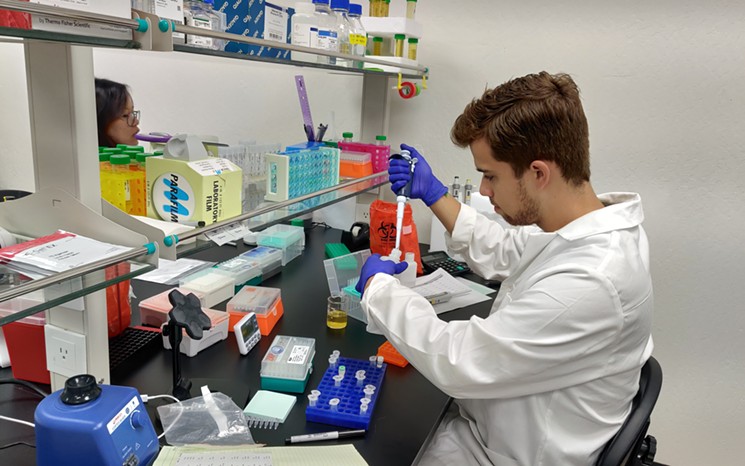
The plant-free production loop
Why the company walked past CBD
CBD was the obvious target during the late-2010s boom. BIOMEDICAN deliberately passed. President Dennis O'Neill said prices had collapsed and the category had become a commodity full of lookalike products. That changed the company's target list: not the cannabinoid everyone could already buy, but the ones that remained expensive because plants barely made them.
“We purposefully stayed away from CBD. Prices have collapsed and it has become a commoditized market full of me-too products.”Dennis O'Neill, BIOMEDICAN president, 2020
The shift is the most copyable part of the story. A crowded market can still contain an excellent business one layer below the crowd. BIOMEDICAN did not try to invent a cleverer bottle of CBD. It attacked the supply constraint behind ingredients that product companies wanted but could not source cheaply or consistently. The reusable asset was not a consumer brand. It was the organism-engineering and fermentation playbook.
The catalog reflects that thesis. CBG and its precursor CBGA came first in public announcements. CBN and CBNA, THCV and THCVA, and THCA followed on company product pages. The business is B2B: sell high-purity isolates or commercialize the platform through manufacturing, licensing and partnerships. Public materials name pharmaceutical, nutraceutical, cosmetics, food, beverage and pet-care companies as intended customers. They do not name current buyers, volumes or revenue.
The cost claim, indexed
Illustrative index based on BIOMEDICAN's claim of 70-90% lower cost. It is not reported production data. Feedstock, fermentation yield, purification, testing and capacity utilization determine the real number.
One platform, two sales teams
In 2020 BIOMEDICAN used the same broad approach to develop astaxanthin, a red antioxidant pigment used in animal feed and human nutrition. The company said the development took less than six months and claimed production could undercut existing routes. It looked like proof that the platform could travel beyond cannabis.
Then distribution supplied the correction. Cannabinoid buyers and astaxanthin buyers did not overlap enough. The company planned to spin the product into a separate venture called SciFeed, with its own management team focused first on salmon, trout and cattle feed. The technology had transferred. The customer relationships had not.
That is a more useful failure than a laboratory explosion. Platform companies like to imagine that each new product rides the same commercial rails. Often the organism and equipment are reusable while regulation, quality specifications, procurement calendars and buyer trust start again from zero. BIOMEDICAN changed its organizational plan when it found no meaningful crossover sales. A founder copying the model should budget for a new go-to-market motion before celebrating a new molecule.
04 / The moatPatents are proof of ownership, not proof of scale
BIOMEDICAN's hardest public evidence sits in the patent record. U.S. Patent No. 11,149,291 issued in October 2021, covering aspects of cannabinoid production in genetically modified yeast. A continuation, No. 11,939,613, followed in March 2024. Both name Mikheev and Difeng Gao as inventors. A maintenance-fee payment recorded in 2025 kept the first grant current.
First U.S. application filed around cannabinoid-producing pathways in yeast.
Patent 11,149,291 issues to BIOMEDICAN.
Continuation patent 11,939,613 adds a second granted asset.
The patents make the technical position more tangible. They do not answer the commercial questions: fermentation yield at industrial volume, genetic stability across batches, purification loss, regulatory status, capital needed for equipment, or a customer's willingness to qualify a new ingredient. Synthetic biology lives or dies in that translation from a persuasive flask to an obedient tank.
05 / The playbookWhat to steal, and when to leave it alone
The BIOMEDICAN playbook fits on a lab label. Choose a compound whose existing production route is structurally expensive. Pick a host organism naturally suited to the chemistry. Engineer a pathway, protect the useful claims, find buyers and only then commit to steel. Treat every adjacent molecule as a fresh customer-discovery project, even when it runs through the same fermenter.
It can work when
- The target is scarce and valuable.
- The host tolerates and stores the output.
- Fermentation yields rise faster than purification costs.
- Buyers prize consistency over botanical provenance.
It breaks when
- Plant extraction is already cheap.
- Scale reduces yield or genetic stability.
- Downstream recovery eats the margin.
- Regulators or customers reject the production route.
There is also a semantic trap. BIOMEDICAN describes its products as bioidentical and its process as natural biosynthesis, while the production organism is genetically engineered. Those statements can coexist chemically, but customers and regulators may hear them differently. A purified molecule can match one found in a plant even when the microbe that produced it was modified. Clear labeling matters, particularly in food, wellness and cosmetics.
The company reported roughly $3 million in funding in supplied records, including a $2 million convertible note in 2019, and later offered a community round through Wefunder. It has not publicly disclosed a valuation or revenue. LinkedIn places the team in the 11-to-50 range; supplied company data says 13. That makes BIOMEDICAN less a finished factory than a compact wager on intellectual property, microbial know-how and the economics of scarcity.
For prospective customers, the practical use is straightforward: a dependable source of isolated rare cannabinoids without contracting a field. For researchers, cheaper isolates could make experiments easier to repeat. For founders, the company is a lesson in choosing the unglamorous constraint and letting a commodity collapse sharpen the strategy. For investors, it is a reminder that a patent and a production announcement live several expensive steps away from a purchase order.
BIOMEDICAN's lasting idea is not that yeast can replace every plant. It is that nature often packages a valuable molecule inside a costly supply chain, and biology can sometimes be edited into a shorter route. Sometimes the route ends in a tank. Sometimes it ends in a spinout. The useful discipline is knowing which problem belongs to the microbe and which one still belongs to people.
Keep digging
BIOMEDICAN website · research and platform overview · company press room
LinkedIn · X / Twitter · Facebook · YouTube interviews and company videos
First cannabinoid-yeast patent · patent portfolio · laboratory interview · the SciFeed spinout