Michele Stansfield’s startup story contains a room full of people who needed a factory. There were investors, researchers, government representatives and companies working on precision fermentation. They had ideas about what microbes could make. They also had a problem: an ingredient that exists in a laboratory cannot feed a market until somebody can manufacture it. In February 2022, they sat down together to work out what to do.
Stansfield had asked Main Sequence partner Phil Morle to introduce her to people in the field. He assembled the gathering. She was running Agritechnology, a regional New South Wales bioscience business with decades of fermentation work behind it. The meeting settled on that business as a foundation for the next step. The origin of Cauldron has the pleasingly practical quality of people discovering that the answer was already wearing work clothes.
Today she is Cauldron Ferm’s co-founder and chief executive. The company’s ambition turns on an industrial question: how do you make bio-based ingredients in quantities large enough, and at costs low enough, for ordinary commercial use? It is a question with pipes attached. A persuasive answer has to survive the journey from a clever organism to a working production line.
A long apprenticeship before the new name
Stansfield’s preparation happened well before Cauldron’s founding in 2022. She studied cellular and molecular biology at the University of Western Sydney, earning a science degree with honours, and went on to a doctorate at the University of Sydney. Her education record lists the PhD years as 2003 to 2013. That is a substantial stretch of a life to spend learning what biological systems do, and how to investigate them.
At Agritechnology, she worked for more than a decade, including as general manager. The business used microbes in work spanning food, feed and fuel. Her expertise grew around scaling and commercialising continuous fermentation. She eventually drove the management acquisition that brought Agritechnology’s technology into Cauldron. The new company inherited experience as well as intellectual property. The date on a startup registration tells only a fraction of that story.
The inheritance mattered to her personally. When she reflected on Cauldron’s creation, Stansfield said she was proud that the formation and funding of the company recognised the value of the intellectual property developed through her Agritechnology work. There is a particular satisfaction in seeing years of effort become legible to people outside the laboratory. Suddenly, the thing you have been patiently doing becomes something other people are willing to back.
She also had commercial learning to do. Stansfield joined UNSW Founders’ 10x accelerator in 2022 and later described it as an ignition point. She had begun with an idea without fully understanding the business’s value. The program helped change that. Scientific familiarity and commercial confidence need not arrive together; even a person who understands a process deeply can benefit from learning how to explain what it is worth.
Ask more of the tank
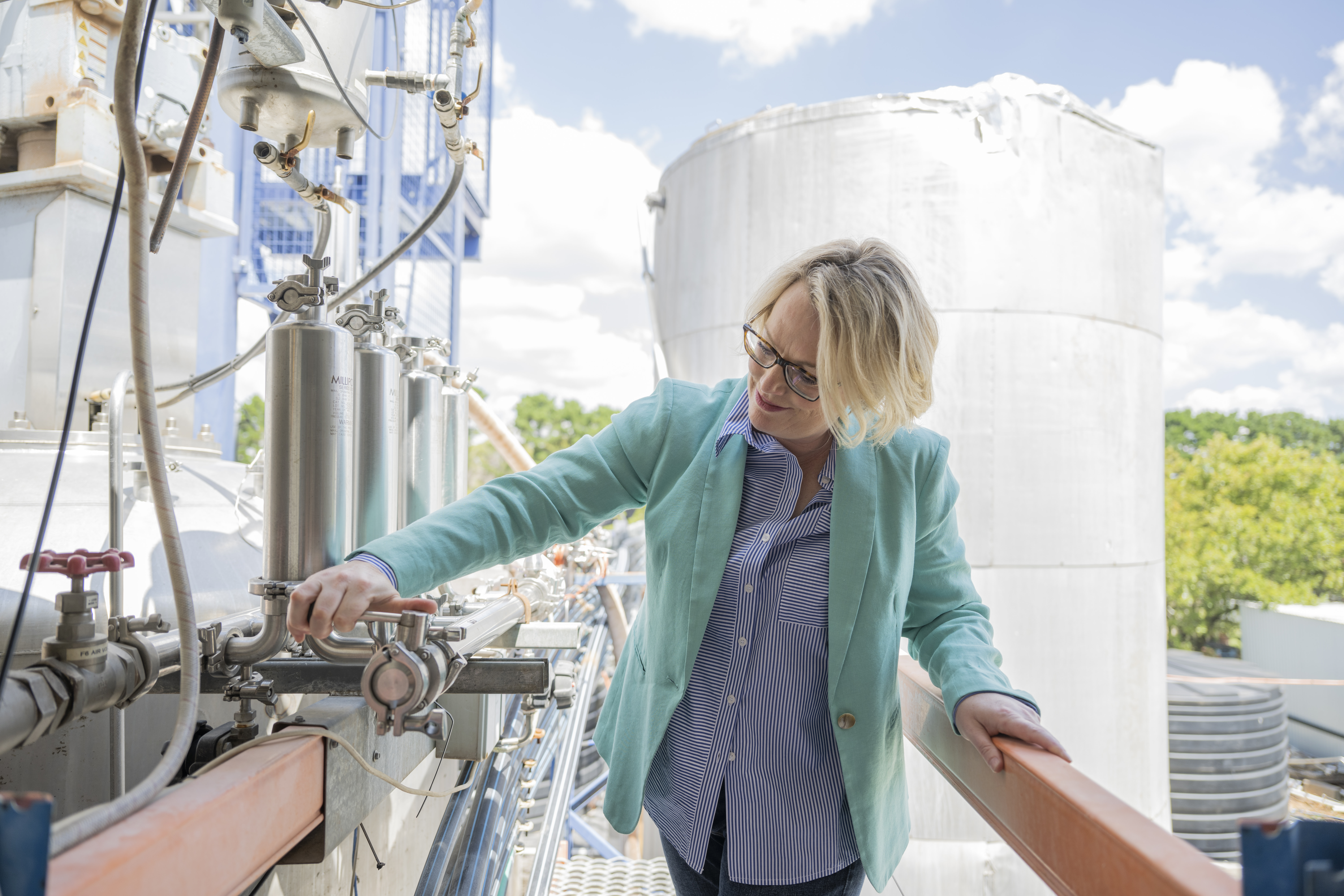
Precision fermentation uses microorganisms to make particular molecules. The organism is supplied with inputs, such as sugar, and grown under controlled conditions. Cauldron works with customers’ microbial processes to help move production towards industrial scale. Its service offering spans food ingredients, materials, chemicals and fuels. Behind the range of possible products lies the same awkward commercial requirement: the process must make enough useful output to justify its inputs.
Cauldron calls its approach hyper-fermentation. The central idea is continuous operation: keeping microbes in a productive state for extended periods. Batch production has a rhythm of starting, growing, harvesting and preparing again. A continuous process seeks to keep the production line going. Imagine how much the economics of any factory depend on the hours its equipment spends making something useful.
Living factories introduce complications. Unwanted microorganisms can enter a ferment. The population’s genetic makeup can change over time, affecting production. Cauldron identifies contamination and genetic drift as the two difficulties its technology is designed to address. It combines organism-specific nutrient media with proprietary operating protocols intended to support stability. The appealing simplicity of continuous production therefore rests on quite exacting biology.
Longer productive runs depend on contamination control and genetic stability. Diagram is conceptual, not an engineering specification.
Stansfield’s argument about scale is consequently an argument about utilisation. In a 2023 interview in Singapore, she discussed how continuous production could change the amount produced by a given line and the capital required to build a facility. The proposition was that smaller equipment, used more productively, could compete with much larger batch systems. Those were technology and cost claims, with a commercial programme still to execute.
Her emphasis has remained consistent. A company developing an ingredient already has difficult work to do. Building a large factory adds another expensive undertaking. Cauldron offers a way for customers to use specialist manufacturing expertise. It occupies the less photogenic middle of innovation, where the excitement of invention meets the cost of steel, utilities and repeated production. That middle has a habit of deciding what reaches the market.
A powder in a sack is progress
The physical end of this process can be wonderfully untheatrical. Stansfield has described a customer’s engineered yeast making a particular molecule, with the finished ingredient commonly emerging as a pale dry powder packed in 20-kilogram sacks. The customer then makes a product from it. An industrial future, apparently, can arrive looking as though it belongs in the storeroom.
That description also clarifies the company’s place in the chain. Cauldron is providing industrialisation and manufacturing services. Its first customer was Nourish Ingredients in 2023. In the same Qantas interview, Stansfield explained that acquiring Agritechnology’s intellectual property and Orange infrastructure had changed the focus towards manufacturing capability in smaller facilities. She came from a farming family, and the regional setting was part of the point.
She pictured metal tanks beside large flour or sugar mills. The image connects an unfamiliar production technique to a familiar agricultural landscape. A mill already belongs to a chain of inputs, transport and customers. Her aspiration puts biomanufacturing into that landscape, giving agricultural businesses another way to participate in making ingredients and materials. There is more to the idea than finding somewhere picturesque to put the equipment.
In May 2025, Stansfield said the research and development centre would remain in Orange, while factories would be located where the economics made sense. She also wanted stronger connections with university students in the region. The local ambition and the international one fit together: retain the place where the technology is developed, and take manufacturing to the places where it can work.
Proof, partners and the next cheque
The early funding gave that ambition room to move. Cauldron announced A$10.5 million in seed funding in March 2023, backed by Main Sequence and Horizons Ventures. The stated purpose included expanding the Orange pilot facility and testing the feasibility of other Australian hubs. David Kestenbaum co-founded the business with Stansfield, bringing the finance side alongside her fermentation experience.
A partnership with Boston Bioprocess followed, connecting process development capabilities with Cauldron’s manufacturing work. In 2024, Stansfield joined CSIRO’s Robert Speight on the main stage at SynBioBeta in California to discuss Australia’s potential and the importance of collaboration. Her network was taking shape around the same problem that had brought people into the room in 2022.
International expansion also acquired a planning budget. In December 2024, Cauldron announced a US$1.76 million Department of Defense award to plan a US commercial-scale facility. It belonged to a programme intended to move bioindustrial manufacturing from laboratories into production infrastructure. Planning support gives a project a route forward; the work of establishing an operating facility remains a further undertaking.
Announced rounds. Currencies are shown explicitly; these figures are not a valuation or personal wealth estimate.
Recognition widened the audience. The World Economic Forum selected Cauldron as a 2025 Technology Pioneer. In March 2026, the company announced a US$13.25 million Series A2 round led by Main Sequence, with Horizons Ventures, SOSV and NGS Super participating, alongside inclusion on Fast Company’s annual innovation list. Its stated direction included evaluating retrofits at corporate partners’ existing facilities.
There was a specific production milestone behind the announcement: continuous fermentation for synthetic biology strains demonstrated at 10,000-litre scale. Cauldron’s facilities page describes Orange’s laboratory, fermentation lines and downstream equipment for separating and drying products, with a larger commercial facility presented as future work. Keeping the demonstrated process and the next facility distinct makes the achievement more useful to understand.
The founder has to change, too
Stansfield’s career has required another kind of scale-up: moving from knowing the work to leading a company that can carry it. At the July 2026 UNSW Female Founders Showcase, she described learning to give her team room and to recognise the difference between doing everything and directing the organisation. Her account made leadership sound less like perpetual motion and more like a deliberate choice about where she belonged.
“I stood back. I set the vision. I let them go.”
Michele Stansfield · July 2026
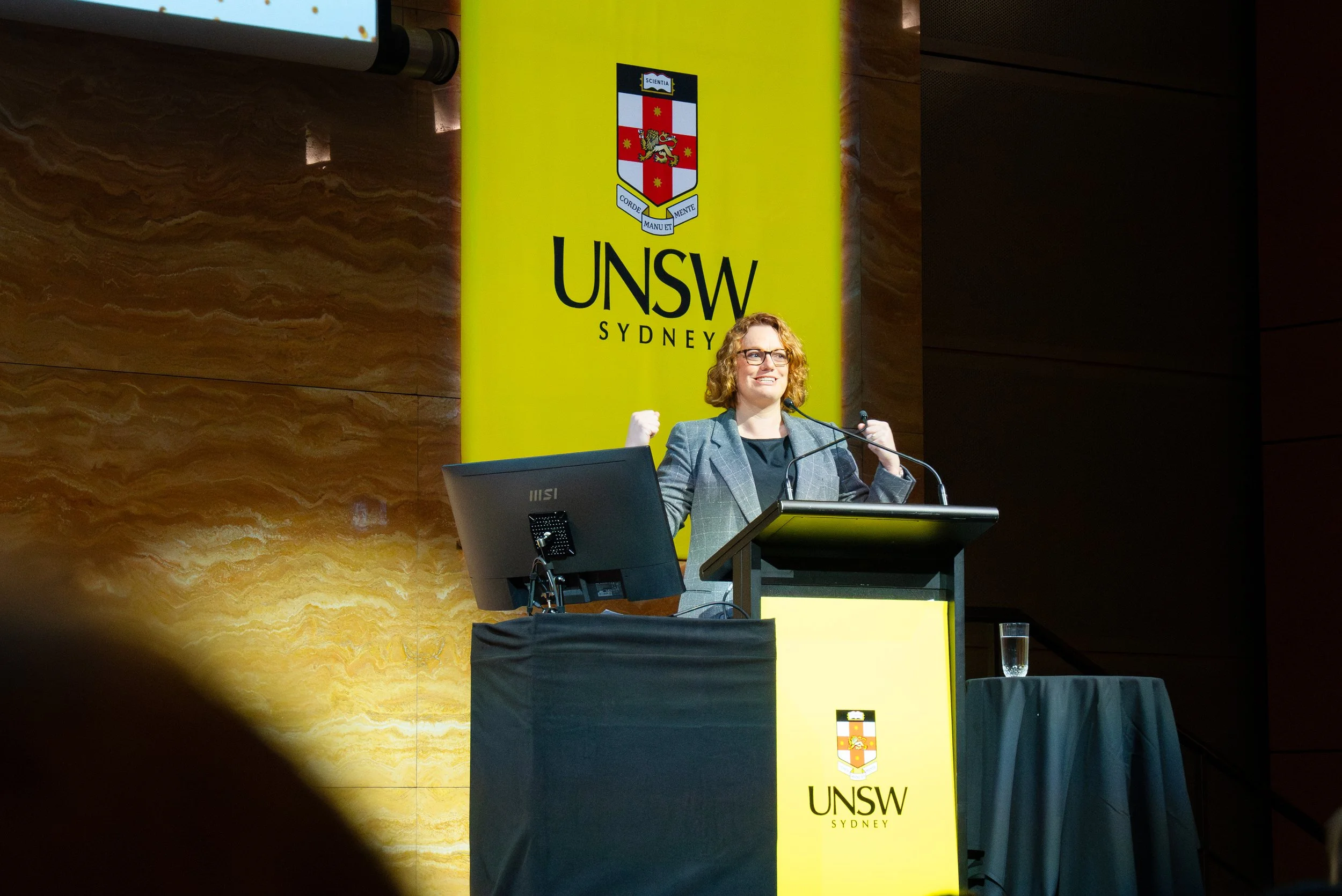
The advice to build around complementary strengths comes from someone who had already spent years inside the underlying science. Familiarity can make it tempting to keep every task close. Her keynote described a different arrangement: set the direction and allow capable colleagues to contribute their own strengths. A company needs to be able to do more than its founder can do personally.
Outside the company, she has an escape with considerably fewer committees: dirt-bike riding. It is an agreeable detail in a career full of controlled systems. Her professional ambition remains very concrete. Make the process work. Make the economics credible. Put the capability where it can be used. Somewhere between an Australian research business and an ingredient packed for a customer, Stansfield has found the company she wants to build.