The glamorous version of industrial biotechnology ends at the petri dish. A scientist edits a microbe, feeds it sugar and watches it produce something useful: a polymer precursor, a protein, a lubricant, perhaps rubber from a dandelion. The less cinematic version begins when somebody asks whether the organism can repeat the trick by the ton, at a price a customer will pay, without contaminating a tank or clogging the equipment that separates product from broth.
BioMADE lives in that second version. Its full name is the Bioindustrial Manufacturing and Design Ecosystem, and it is a nonprofit Manufacturing Innovation Institute sponsored by the U.S. Department of Defense. It does not sell a miracle molecule. It tries to make an entire domestic industry less likely to trip between discovery and production.
The institute funds cost-shared R&D, convenes more than 300 companies and institutions, builds training programs, develops safety and security practices, and is assembling a network of shared pilot plants. Its customers are the people with promising biology and inadequate scale: startups, established manufacturers, universities, community colleges and government teams. Farmers and defense contractors sit at the same table because one supplies feedstock and the other may buy the finished material.
The flask lies by omission
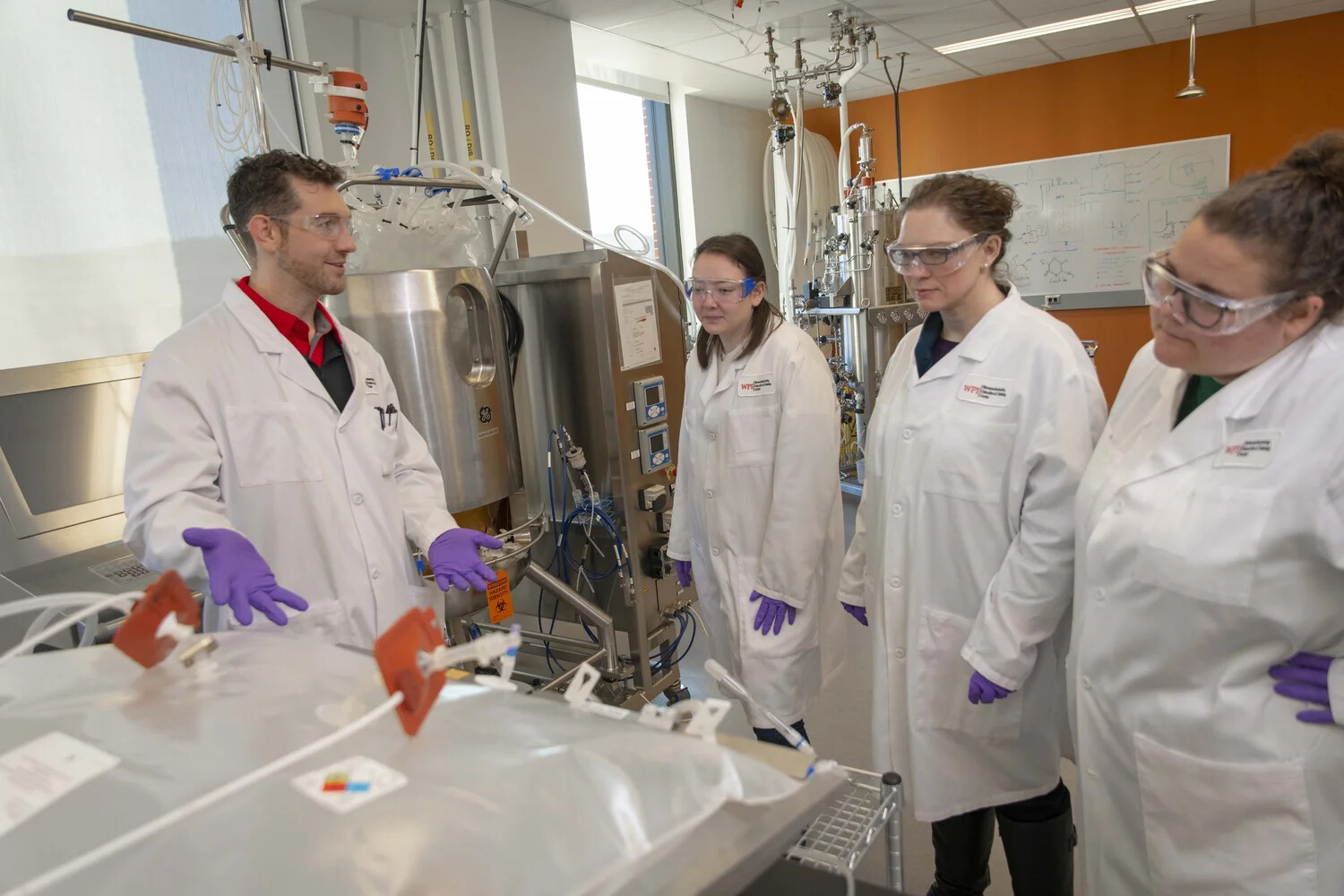
A benchtop result is real, but incomplete. In a larger fermenter, heat moves differently. Oxygen becomes harder to distribute. Mixing takes longer. Foam, viscosity and contamination become more expensive. Then comes downstream processing: centrifugation, filtration, purification, crystallization and drying. A process can produce the desired molecule and still fail because recovery costs too much.
This is the “valley of death” BioMADE keeps pointing at. The United States has excellent research and plenty of fermentation knowledge, but specialized pilot capacity is scarce. BioMADE manufacturing chief Jack Starr has described projects at Cargill that stalled or died because the right equipment could not be found domestically. The bottleneck was not imagination. It was stainless steel, operating time and people who knew what happened next.
“One of the things we hear constantly from our members is that there’s a lack of scale-up infrastructure in the United States.”Douglas Friedman, founder and CEO
What BioMADE actually built
The first layer is a project machine. Members answer project calls, form teams and propose work aimed at manufacturing readiness levels four through seven - the awkward territory between laboratory validation and production handoff. BioMADE sorts the technology portfolio into four unusually blunt verbs: Manipulate, Accumulate, De-Risk and Execute. The projects range from engineered enzymes and smarter fermenter sensors to cell-cultured chocolate, lithium biomining and textile fibers made from spent yeast.
Design the organism, tool or model
Make enough material, reliably
Test recovery, economics and demand
Run at pilot scale and hand off
The second layer is human. BioMADE supports curricula, certificates, workshops and apprenticeships with high schools, colleges and employers. That is not a side quest. A fermenter expected to run around the clock needs operators, maintenance technicians, process engineers and quality staff. As Friedman puts it, if the workforce is not ready at the right time, there is no industry.
The third layer is shared infrastructure. Facilities announced in Minnesota, Iowa and California are designed for different regional strengths. Minnesota’s 122,000-square-foot flagship in Maple Grove is planned around chemicals and materials, including 5,000- and 25,000-liter fermenters and equipment for volatile liquids. Iowa’s smaller facility is oriented toward agricultural bioproducts, chemicals and food ingredients. California adds 4,000-liter fermentation, spray drying and food-grade capability. BioMADE says the first network site is due in 2027; its Minnesota site page currently points to 2028 for Maple Grove.
The price of sharing
BioMADE’s original 2020 award was $87.5 million over seven years, paired with more than $187 million in committed non-federal cost share. In 2023, the Defense Department raised the institute’s federal budget ceiling above $500 million. A ceiling is permission to fund work, not cash in a venture account, and BioMADE is not a venture-backed startup. In 2025 it finalized a $132 million public investment in the Minnesota demonstration plant.
Members also pay. BioMADE’s published industry schedule runs from $1,000 in annual cash dues for a qualifying pre-revenue affiliate to $1 million for platinum membership, with in-kind obligations alongside the cash. Institute projects generally require at least a one-to-one cost share across the project. The structure gives small firms leverage without pretending the government should absorb every risk. It also asks members to prove conviction with labor, equipment, money or other resources.
What failed first?
In one BioMADE-backed Amyris project, the biology was not the first thing to fail. The company’s willingness to fund the next experiment did. A proposed in-situ product-removal system had too little data and too much risk, so Amyris put it on hold. BioMADE funding changed the decision. The revived 20-liter pilot worked, generated scale-up parameters and led to a follow-on effort aimed at 300 liters. The lesson is plain: sometimes the missing technology is a financing structure small enough to buy one more honest experiment.
Different by design, constrained by reality
A private contract manufacturer can run a process. A university pilot plant can support research. A trade group can convene members. A grant program can write checks. BioMADE’s distinction is the bundle: money, equipment, technical roadmaps, workforce, data, security and buyers in one member-governed system. Its nearest U.S. Manufacturing USA cousins, NIIMBL and BioFabUSA, lean toward pharmaceuticals and regenerative medicine. BioMADE focuses on the non-health industrial economy: chemicals, materials, food ingredients, textiles and defense goods.
The model is useful precisely because it admits that scale-up is not one problem. A startup may need a larger tank, but also a customer specification, a life-cycle analysis, an operator, a secure data room and a plan for the waste stream. BioMADE’s 2026 Digital Backbone beta tries to standardize bioprocess data so members can create a more useful record across strain design, fermentation and production. The ambition is sensible; persuading competitors to share context without exposing trade secrets will be the test.
The customer mix is equally deliberate. A young company can bring a process; a university can bring an assay or model; a large manufacturer can bring scale discipline; and a defense or commercial buyer can specify what the material must survive. BioMADE is not competing to invent every product in that chain. It is selling coordination, access and reduced uncertainty to the organizations that do. The eventual pilot-plant service is the most tangible offer, but the member network is the machinery that helps decide what belongs in those plants.
“There’s enough noise in biology itself, so we need to be able to control the noise across processes and equipment.”Robert Leachman, UC Berkeley benchmarking project
The part you can steal
BioMADE’s most copyable idea is not “get half a billion dollars from Washington.” It is to treat scarce, expensive infrastructure as a commons with rules. First, ask members to name the bottleneck. Second, publish a technical roadmap. Third, fund bounded experiments with measurable readiness targets. Fourth, require cost share so applicants have skin in the game. Fifth, share equipment and anonymized lessons. Finally, train the workers before the facility opens.
When the model will not work
Shared plants are not magic. The model weakens when projects require equipment too bespoke to reuse, when intellectual-property rules prevent meaningful collaboration, or when members want subsidy without cost share. It also fails if a product has no credible customer at a commercially realistic price. A better fermenter cannot rescue imaginary demand.
Timing matters too. Public facilities take years to site, permit, retrofit and commission. A startup with six months of runway cannot wait for a 2028 opening. Companies still need interim contract capacity, disciplined techno-economic analysis and enough capital to survive failed batches. Regional politics can also produce attractive buildings in the wrong place, far from feedstock, talent or offtake.
And there is a governance hazard hiding inside the coalition’s strength. A pre-revenue startup, a university, a global manufacturer and the Pentagon do not move at the same speed or define success the same way. BioMADE’s work is partly translation: turning national-security urgency and research curiosity into boring, repeatable production. If it succeeds, the evidence will not be a lab demo. It will be companies that graduate from shared tanks, win customers and build factories of their own nearby.
That is BioMADE’s wager. America does not merely need organisms capable of making things. It needs a place where those organisms can disappoint cheaply, improve methodically and eventually earn the right to manufacture at scale.