A molecule can perform beautifully in a laboratory and still make a dreadful business proposition. Alex Berlin built a company around the space between those two outcomes. The interesting part of his career happens there, where a scientific result acquires an equipment list, a production schedule and a bill.
He founded Solarbiotech in 2019, bringing an enzyme scientist’s background to the work of industrial fermentation. Other companies were developing biological products. Berlin wanted to help them manufacture those products at commercial scale. His territory was the awkward middle of the story, after the discovery and before the customer could reliably get what had been promised.
Over the following six years, that undertaking brought partnerships, investment, an acquisition in Canada, Chapter 11 proceedings and a sale of assets to a new owner. Berlin stayed through the transition, then left in September 2025. By 2026, his public writing was looking toward difficult enzyme engineering problems again. A career spent moving between molecules and machinery had returned to the molecule, carrying considerably more experience of the machinery.
A scientist before the startup
Berlin’s scientific training includes a doctorate in chemistry, biotechnology and catalysis from Lomonosov Moscow State University. The University of British Columbia’s Forest Products Biotechnology group lists him among its former researchers. His subsequent work at Novozymes placed him inside the industrial enzyme business, where biological activity had to prove useful beyond an experiment.
In December 2013, he published a commentary in Science titled “No barriers to cellulose breakdown,” with an affiliation at Novozymes in Davis, California. Its subject was research into a bacterial enzyme’s ability to digest plant material. Plant biomass, enzymes and the difficulty of turning them into useful industrial processes recur through his publication record. Long before Solarbiotech, he was working in the scientific neighborhood it would occupy.
That work also involved teaching. A UC Davis biotechnology seminar schedule for February 2014 lists Berlin, then a senior research manager, presenting on enzymology and the application chemistry of engineered enzymes. The series was called “From Discovery to Product.” It would have served equally well as a description of the career that followed.
A smaller detail survives in a former colleague’s doctoral thesis acknowledgments. Writing in 2021 about her time as an intern and research assistant at Novozymes, she thanked Berlin for personally training her in liquid chromatography/mass spectrometry methods despite his responsibilities as department director. It is a useful glimpse of the scientist beneath the management title: someone who still made time to teach a colleague how to use the analytical tools.
The factory gets a seat at the table
Berlin later became chief technology officer at Arbiom. In May 2019, he publicly marked his final working day there. Solarbiotech followed that year. The move put his experience behind a particular commercial proposition: companies developing products through biology also needed help with the processes required to manufacture them.
By May 2021, Solarbiotech had attracted attention for a $2 million debt-financing round. Its proposed approach used customized plant architectures it called BioNodes. The intention was to give customers a route to production without requiring each startup to assemble its own complete technology platform. For a young company, the production facility could otherwise become an additional business to build before the first business had properly begun.
The distinction mattered in fermentation. Making a desired ingredient inside a microbial host and recovering that ingredient as a usable product were connected tasks, each demanding its own expertise. Solarbiotech’s offering brought process and equipment engineering into that journey. Berlin’s company was selling experience with the stages that followed the laboratory result, as well as the capacity to carry them out.
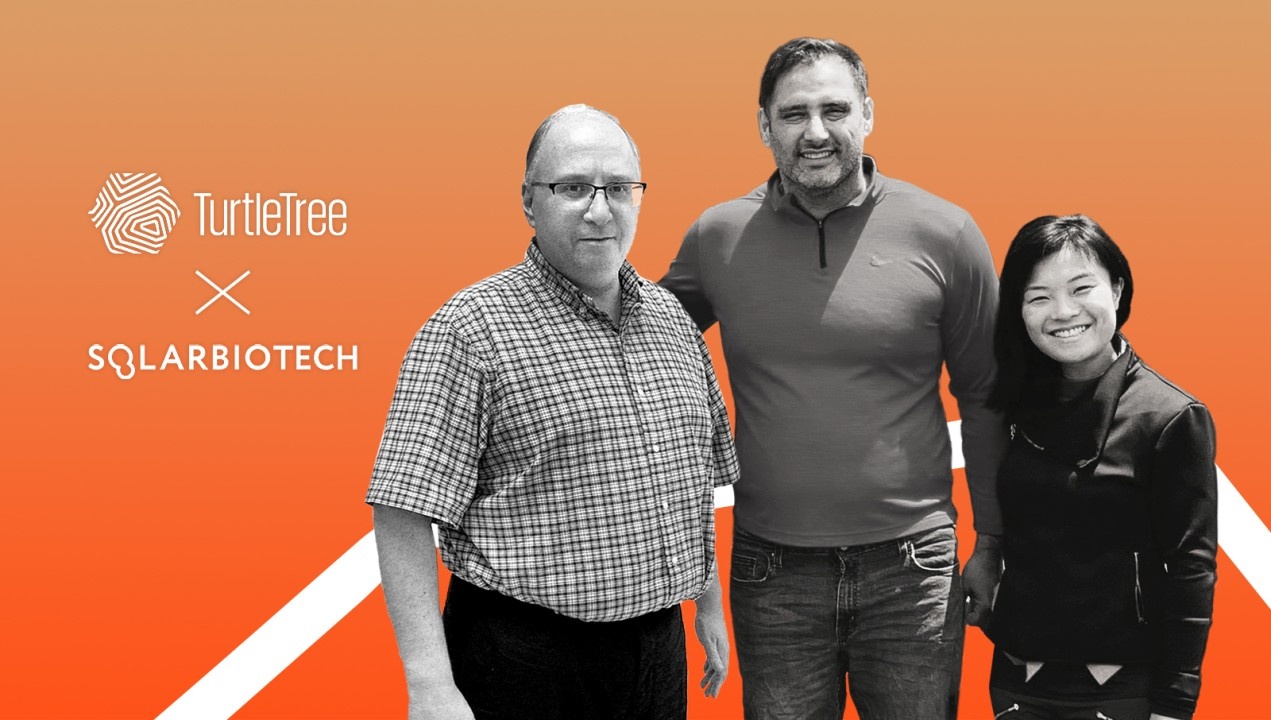
TurtleTree provided a concrete example. In August 2021, it announced a strategic partnership with Solarbiotech and described an investment in Berlin’s company. TurtleTree’s team could concentrate on laboratory development and bringing its ingredients to market while Solarbiotech worked on the bioprocessing technologies for production. The arrangement gave the manufacturing work an explicit place in the plan.
Berlin’s ambitions also included the way production consumed resources. In discussing that partnership, he emphasized solar energy and a circular economy approach. Sustainability, in his account, belonged inside the manufacturing process. In June 2022, an investment announcement from Ingredion linked further development of Solarbiotech’s platform with expansion at its Norton, Virginia, facility and additional employment in Southwest Virginia.
A process map, rather than a promise of equal time or difficulty at each stage.
North to Peterborough
In July 2023, Solarbiotech acquired Noblegen, the biotechnology company based in Peterborough, Ontario. Berlin became chairman of the operation renamed Solar Biotech Canada. The acquisition brought together different expertise in microbiology and manufacturing, with the Canadian operation intended to serve as a food-grade production and research hub.
The infrastructure behind it was substantial. The acquisition announcement described US$40 million invested in Noblegen’s infrastructure and technology development over the preceding nine years. That figure described the accumulated investment behind the operation. It was not an announced purchase price.
The plans in Peterborough extended beyond the existing facility. The company confirmed its commitment to a proposed second-generation research and development facility at Cleantech Commons, the research park associated with Trent University and the city. Existing fermentation capacity exceeded 160,000 litres; the proposed next facility envisaged more than two million litres. Those were different stages of development, with the larger number still a plan.
The expansion makes Berlin’s ambition tangible. His company was collecting the capabilities needed to help other businesses commercialize biological products: facilities, process knowledge and people who could move between them. It was also accepting the financing demands of that ambition. An industrial growth plan eventually has to make its peace with a balance sheet.
The year the balance sheet intervened
Solar Biotech and Noblegen entered Chapter 11 proceedings in June 2024. Berlin, as chief executive and chief technology officer, submitted a declaration supporting the companies’ petitions and first-day motions. The founder’s responsibilities now included a court-supervised process alongside the work of running the business.
In September, Pictor Biotech, created by former Novozymes executive Peter Rosholm, acquired assets through the bankruptcy auction process. Berlin continued as CEO and CTO. He and Rosholm had worked together on projects at Novozymes, bringing a professional connection from an earlier career chapter into this one.
At the time of the sale, Berlin said the US staff had been retained, some customer work had continued during restructuring, and operations would be concentrated in Virginia. Canadian assets were to move there. He described the new financial backing as an opportunity to resume operations and grow. The immediate achievement was continuity: keeping a working organization available to customers after the ownership changed.
- 2019Berlin founds Solarbiotech
- 2023Noblegen acquisition expands the footprint
- 2024Chapter 11 and sale of assets to Pictor
- 2025Integration, then Berlin’s departure
A production chain across three countries
Early in 2025, the business took another organizational turn. Solarbiotech, the French equipment company GPC Bio and Hungary’s Eleszto Genetika came together under consolidated ownership. Berlin described a division of work that connected strain engineering, production development and plant equipment within one organization.
Hungary would handle strain engineering and early process development. Solarbiotech would take processes through pilot and demonstration stages toward commercial production. GPC Bio, based in La Rochelle, would contribute plant engineering, automation and equipment. The structure gave geographical form to the same question Berlin had been pursuing since founding the company: how to connect the successive jobs involved in making a biological product.
He offered practical examples of the collaboration. A Virginia team had been working with colleagues in Budapest on customer projects before the Hungarian acquisition was complete. Personnel from Virginia trained in France on automation and equipment upgrades. Remote troubleshooting helped support the Virginia plant. The details are more revealing than the organizational chart: people learning each other’s systems while customer work was already under way.
Back to the stubborn molecule
Berlin announced that his employment as CEO and CTO of Pictor Biotech, doing business as Solarbiotech, would end on September 20, 2025. His farewell looked back over six years, including the restructuring and the transition after the acquisition. He emphasized the teams he had worked with. Solarbiotech subsequently announced Eric Abbate as its new chief executive.
Berlin’s next publicly stated direction reaches back into enzymology. In a post outlining his interests for 2026, he described exploring computational methods, AI and molecular engineering while keeping industrial production in view. He wanted to connect with researchers and companies working on difficult enzyme problems. The attraction was to questions that resisted familiar approaches.
“I have never been great at standing still.”
Alex Berlin, on his interest in enzyme engineering
There is continuity in that turn. His earlier research asked how biological systems could make plant material useful. His company asked how biological products could be manufactured beyond the bench. His stated interests now bring new design tools to enzyme problems while retaining the production constraint. The working scale changes; the demand for a useful result remains.
A scientist who has spent years responsible for a manufacturing business has plenty of reasons to ask what happens after the experiment works. Berlin has carried that question through teaching, technology leadership, entrepreneurship and restructuring. As he considers the next set of enzymes, the factory is still part of the question.