Maria Cho used to sell knives. Years later, she said she could still give the demonstration. It is an unusually domestic opening for a career in biotechnology: before the miniature reactors and industrial partnerships, there was a product to explain, a person to persuade and a sale that had to make sense.
The demonstration is a useful way into Cho’s story. A claim becomes more interesting when somebody can see what it does. Her subsequent work would involve more complicated products and longer commercial conversations, but that distance between promise and usefulness remained central. A laboratory result needs somewhere to go.
A sale has to survive the demonstration
Cho studied chemistry and music performance at the University of Florida, then earned a master’s in biomedical chemistry at Thomas Jefferson University. Her career moved through research and commercial roles, including WuXi AppTec and Fujifilm Diosynth Biotechnologies. She later co-founded Phi Therapeutics. In 2022, she became CEO of Triplebar.
By the time she appeared on the Sacramento Life Sciences Conference speaker list in 2023, her biography credited her with more than $1 billion in lifetime sales. That figure belongs to a career in business development. It helps explain why her account of science so often includes the people and processes required to turn research into a product.
There is a particular difficulty in selling something technically intricate. The explanation must remain faithful to what the product can do while becoming clear enough for another person to make a decision. Buyers have their own constraints. A process that looks elegant inside one organization may create awkward work inside another.
Cho’s route put her on both sides of that conversation. Research supplied familiarity with experiments; commercial work supplied a different test of usefulness. An idea could be scientifically interesting and still require considerable work before it fitted a customer’s operation. Her later food-tech partnerships would make that distinction concrete.
A test tube that fits in your hand
Triplebar’s work starts at a scale that makes the familiar test tube look rather extravagant. Cho described shrinking an experiment into a microreactor smaller than a human hair. A chip that fits in a hand can hold enormous numbers of these tiny tests. The company’s system then examines them rapidly.
In 2023, Triplebar and Singapore’s Umami Meats announced plans to collaborate on cell lines for cultivated seafood, beginning with Japanese eel. The practical challenge was to find cells with properties suited to growing in a bioreactor. The project connected a biological search to a specific production problem.
That choice gives the miniature experiment a destination. The question is whether a cell can do what a production process needs. A promising candidate has to endure the move from a tiny test to a larger working system. Anyone who has tried scaling a recipe will recognize the broad inconvenience, though the biology requires rather more equipment.
Cho’s explanation makes the equipment legible without pretending the whole business is simple. A smaller experiment allows more candidates to be examined. The commercial value depends on what that examination helps a partner build. Counting tests is easier than counting useful products, and the latter is where her business-development experience becomes relevant.
The factory belongs in the conversation
FrieslandCampina Ingredients offered another route into the production question. Its announced partnership with Triplebar covered multiple products, countries and years. The companies planned to develop and scale cell-based proteins through precision fermentation. An established ingredients business and a biotechnology startup were bringing different capabilities to the same project.
In March 2024, the collaboration’s work on lactoferrin became public. Cho discussed the importance of developing cell lines with the properties needed for scale. FrieslandCampina’s existing ability to manufacture and distribute was part of the commercial reasoning. A protein produced successfully in an experiment still needs a practical way to reach its market.
The pairing illustrates an approach Cho would also describe in her business writing: let partners specialize. The ambitions of a technology platform can be broad, but an agreement must address a particular product and a particular process. Production and distribution deserve a place in the discussion early enough to influence what gets developed.
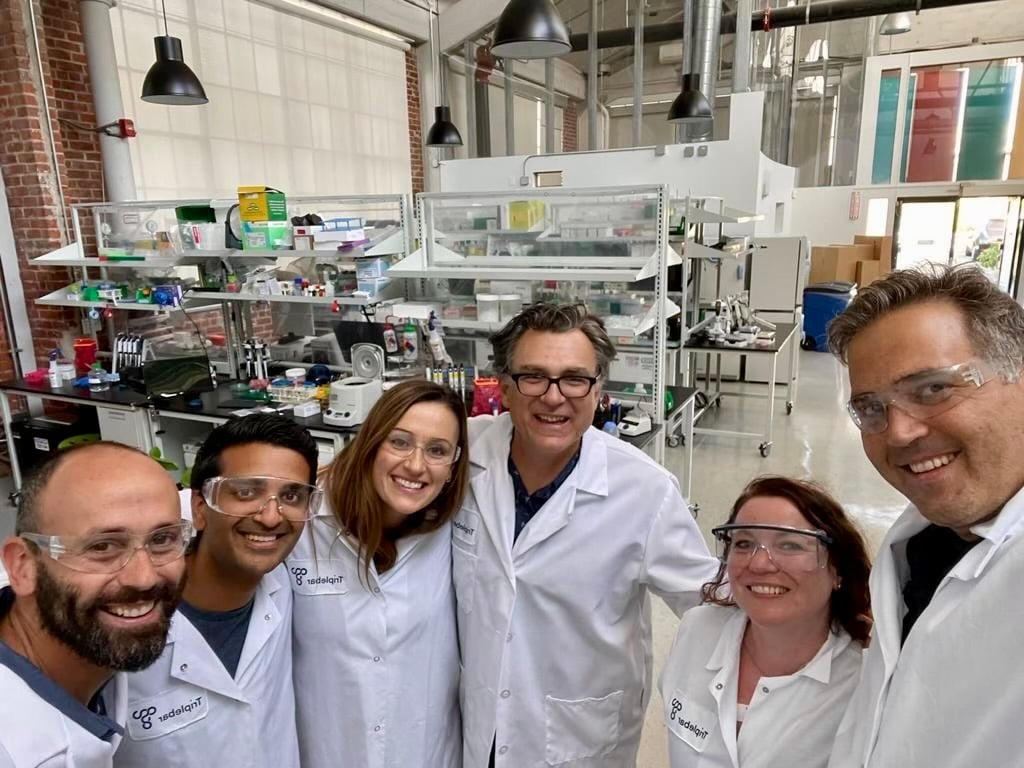
Money supported that work. Triplebar announced a $20 million financing round in 2023; the company later credited Cho with completing the round at $21 million in 2024. Synthesis Capital led the financing. Those are company-financing figures, attached to the work of developing a platform and its product portfolio.
Funding round completed in 2024, as recorded in Triplebar’s leadership-transition announcement.
Food, closer to home
Cho’s thinking also reaches beyond the factory door. In a 2024 conversation with Elysabeth Alfano, she discussed the possibility of locating food production closer to the people consuming it. Fermentation and cultivated food could, in her view, change where production happens and reduce dependence on long supply routes.
That is an aspiration about geography as much as biology. A new method of making an ingredient may allow a different arrangement of factories, customers and transport. The interview explored what such changes might mean for protein supply and when production could scale. Cho was describing possibilities for the food system.
The local-production idea gives her commercial ambitions a human scale. Food ultimately has to arrive somewhere, at a price somebody can pay. Technical progress becomes more tangible when the conversation includes that destination. A supply chain is also a sequence of ordinary purchases, meals and deliveries.
Cho took these subjects into public conversations, including a CES 2024 food-tech panel appearance. The setting matters: food production belongs among discussions of technology, manufacturing and infrastructure. Explaining the work to audiences beyond biotechnology is part of bringing those connections into view.
Go and look at the problem
Her most revealing leadership anecdote takes place in a lab where work had stalled. In a 2025 essay, Cho described repeated contamination at one of her startups. She asked the lab manager to walk her through the process. A newly introduced cleaning solution had not been given enough time to work, and staff had not been trained in its use.
The manager proposed training. Cho used the incident to explain the value of being present and looking at the work directly. The anecdote is pleasingly unglamorous. A company can have a serious scientific purpose and still lose time because an everyday procedure has not been explained properly.
Her leadership writing asks managers to consider a person’s readiness for a particular task. The amount of support should fit the work and the person doing it. That gives an executive something specific to investigate when progress falters: what instruction, knowledge or room to act would help?
It also puts an obligation on the leader. Attention takes time. Looking at a process requires listening to the people who know its difficulties. The lab walk is a modest episode, but it makes her approach visible in a way that an abstract statement about company culture rarely can.
The discipline of leaving things out
Cho’s writing on growth adds another requirement: choose what the business will pursue. In September 2024, she described a preference for partners specializing along a value chain, alongside a focus on customer demand and operating discipline. She also warned against trying to serve every possible opportunity.
For a company working with biology, the list of possibilities can be long. Every potential application offers a new conversation, experiment and claim on the team’s attention. Concentration therefore becomes a practical decision about resources. A business has to decide which of those conversations can become work it can actually deliver.
Her December 2024 essay on expansion returned to funding, spending, pitching and written execution plans. She emphasized practicing a pitch and choosing investors whose expectations fit the business. These are the administrative details behind an ambitious announcement: the capital, the explanation and the plan for putting both to work.
The emphasis on rehearsal fits her early sales experience. A clear explanation usually has work behind it. The listener should be able to understand the product’s value without inheriting every complication involved in creating it. Refining the pitch forces a business to decide what it wants another person to remember.
The next decision
In September 2024, Triplebar announced a shift toward generative AI genomic language models. Cho described reorganizing the business around the biological datasets it generated. The announced direction connected experimental measurements with models intended to help predict useful changes in cells. It was a new strategic focus during her tenure.
Her Triplebar chapter ended in March 2025. Shawn Manchester, previously the company’s COO, became CEO on March 20. Founder and CTO Jeremy Agresti thanked Cho for her contributions over the preceding three years. Her current public biography describes her as a strategic board advisor to biotech startups, working on operations, commercial strategy and execution.
In an August 2025 essay, Cho described dividing decisions by their consequences and weighing evidence alongside experience. Her stated personal balance was roughly sixty percent data and forty percent intuition. She presented intuition as accumulated recognition of patterns, shaped by earlier decisions.
“My ratio? About 60% data, 40% intuition.”
Maria Cho, on making decisions
That is a useful place to leave her story: with another decision to make. The early demonstration, the miniature experiment, the industrial partner and the board discussion all ask somebody to judge what comes next. Cho’s career has repeatedly placed her at that point, where a promising idea needs an explanation, a commitment and a workable route into the world.