There is a pleasing mischief in the fact that David Kestenbaum left the beer business for a company built around fermentation. Careers are expected to progress in straight lines, preferably with dignified arrows between boxes. His looks more like a loop drawn by a chemist. First there were bottles, retailers and the machinery of a global brewer. Now there are engineered microbes, stainless-steel tanks and the far less visible machinery of industrial biotechnology. The medium changed. The operational question did not: how do you make a physical thing, repeatedly, at a price the world will pay?
Kestenbaum is the San Antonio-based co-founder and chief financial officer of Cauldron Ferm, a company whose laboratory and demonstration operations sit in regional New South Wales. His colleague Michele Stansfield brings years of fermentation practice. Kestenbaum brings finance, corporate innovation, e-commerce and venture capital. Their business lives at the intersection, where elegant science encounters the invoice for a factory.
Precision fermentation can program microbes to produce useful molecules: proteins, fats, chemicals and materials. The laboratory feat is impressive. The industrial sequel is impolite. Tanks are costly. Contamination is unwelcome. Organisms can change over time. A process that works for a short batch may sulk when asked to run at volume. Conventional facilities can require extraordinary amounts of capital before the first commercial shipment leaves the gate.
Cauldron's proposition is to keep the biological workforce productive for longer. Its continuous process, called hyper-fermentation, feeds a culture while removing product, reducing the idle ritual of emptying, cleaning and restarting. The company says it has run the method for eight months and 24 days at a scale of 10,000 liters. For a CFO, the romance is easy to translate: more useful output from the same vessel, fewer pauses, and a better chance that a bio-based ingredient can approach the cost of its conventional rival.
The brewer's education
Kestenbaum studied finance at the University of Texas at Austin, then earned an MBA from Washington University in St. Louis. He joined Anheuser-Busch InBev in 2011 and spent the next decade moving through the hidden architecture of consumer business: commercial spending, trade promotion, key accounts, e-retail and global e-commerce strategy. These are not cocktail-party nouns. They are the disciplines that determine whether a product moves through a system or merely poses attractively inside it.
At ZX Ventures, AB InBev's venture and innovation arm, he became a founding member and later a general partner. He helped develop its venture-studio model, participated in the group that built an e-commerce business exceeding $1 billion, and managed a venture portfolio of roughly $350 million. He also served on boards across beer, food and emerging technology. The experience put him on both sides of a familiar table: the operator asking for resources and the investor asking what those resources might become.
It also trained the habit that now defines his work. An innovation is not a business because it is clever. It becomes a business when the product, capital, people and route to market can be assembled into a repeatable machine. Beer is ancient biotechnology dressed in excellent branding. Precision fermentation is biotechnology with a more ambitious ingredient list. Kestenbaum did not need to abandon one world to understand the other.
The spreadsheet meets the fermenter
Cauldron began in 2022, built around fermentation knowledge developed over decades in Orange, New South Wales. Stansfield had spent more than ten years at Agritechnology, the contract research company that held the process and infrastructure. Cauldron acquired that intellectual property and equipment, then recast the work around manufacturing for customers developing bio-based food ingredients, chemicals and nutraceuticals.
The partnership has a useful division of gravity. Stansfield's public account begins with microbes and regional manufacturing. Kestenbaum's begins with the systems that finance growth. He is based almost 8,500 miles away in San Antonio, an arrangement that sounds awkward until one considers the customers, investors and partners scattered across several continents. Cauldron is Australian in its industrial roots and global in its commercial argument.
That argument has become sharper. In 2024, the company raised $6.5 million in a Series A round and won public support for expanding its Orange facility. In 2025, the World Economic Forum selected it as a Technology Pioneer. In March 2026, Cauldron announced another $13.25 million, led by Main Sequence Ventures with participation from Horizons Ventures, SOSV and NGS Super. The company put total funding at $26 million.
The money is intended to extend the technical lead, expand demonstration work and evaluate retrofits at partner sites. The last point matters. A modular fermenter beside a flour or sugar mill is less cinematic than a gleaming greenfield megafactory, but it may be financially shrewder. Feedstock, utilities and industrial labor already exist. Infrastructure prefers neighbors.
Kestenbaum's title makes him keeper of the arithmetic, but Cauldron's mathematics are unusually physical. A percentage point of productivity becomes kilograms of output. Downtime becomes an idle tank. Capital efficiency becomes a smaller building in a regional town. The balance sheet and the bioreactor are not separate stories. Each is the other's translation.
Patience, with receipts
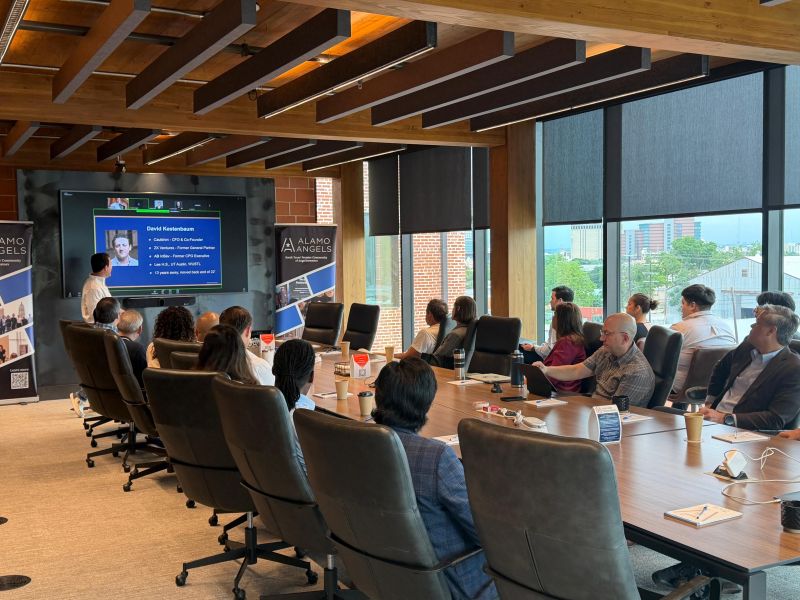
Back in San Antonio, Kestenbaum has become part of another kind of infrastructure. He served on the board of Alamo Angels and is listed as a founding partner of VentureSTX, which helps the network structure and manage special-purpose investment vehicles. In April 2026 he taught a public masterclass on building an angel portfolio. The subject was close enough to biography to be useful: three years of personal investing, discussed with returns, mistakes and write-offs included.
His advice was bracingly free of victory-lap etiquette. Early-stage returns follow a power law, so an investor needs enough positions to encounter the rare outsized result. Losses belong in the model. Follow-on capital should be reserved for companies already proving themselves. Patience is structural because signals emerge years before distributions. Fondness for a founder can blur commercial judgment, while an initially improbable idea can conceal an unusually strong insight.
The goal isn't 10 for 10. It's 2 great ones out of 20.David Kestenbaum, on angel portfolios
It is tempting to turn that line into a tidy philosophy for everything. Biology, however, resists tidy philosophies. Cauldron cannot tolerate a fermenter failing eight times out of ten. The connection lies elsewhere: in the willingness to measure, to accept that uncertainty has a cost, and to concentrate resources when the evidence improves. Venture portfolios and industrial processes both require a theory of what to do next, not merely a theory of why the original decision was brilliant.
A fellow investor later credited Kestenbaum with changing how he thought about defending pro rata ownership in successful companies. It is a small but revealing influence. Kestenbaum's public style favors frameworks over slogans: portfolio size, reserve strategy, time horizon, unit cost. Even his anecdotes arrive with denominators.
That temperament suits a sector recovering from exuberance. Precision fermentation has spent years proving that microbes can make astonishing things. The next chapter asks whether those things can be manufactured consistently, approved by regulators, delivered through supply chains and sold at tolerable prices. It is less glamorous work, which is often how one recognizes work that is becoming real.
Keeping the useful things running
Kestenbaum's career makes sense when viewed as a series of operating systems. At AB InBev, the system connected brands to retailers and drinkers. At ZX Ventures, it connected capital to experiments, then asked which experiments deserved a larger machine. At Cauldron, the system is literal plumbing wrapped around living cells. In San Antonio's investment community, it is a network that connects founders with informed capital.
His aspiration at Cauldron is not to make fermentation novel. Humans settled that question thousands of years ago. It is to make a demanding modern version of it economically ordinary: predictable enough for industry, compact enough to place near useful inputs, efficient enough to compete with established manufacturing. The company imagines regional sites where metal tanks stand beside sugar or flour mills. It is a vision of the future with the good manners to reuse the loading dock.
There will be no single spreadsheet cell marked “future of food.” There will be capital costs, contamination controls, customer trials, feedstock contracts and a thousand operational decisions too dull for a conference stage. Kestenbaum's career suggests he is comfortable there, among the uncelebrated joints that hold an enterprise together.
The bet is large, but its logic is modest. Keep the microbes productive. Keep the tanks smaller. Keep the costs moving down. Follow what works. Give it time. A factory, like a portfolio, is finally an argument made durable by repetition.