The oversized check is the easy part to photograph. In April 2026, StartUpNV reported that 68 local investors had committed $400,000 through its AngelNV program. Nevada’s matching investment brought the total to $800,000 across three startups. Behind that announcement was a less photogenic exercise: people learning how to examine young businesses before putting money into them.
That exercise explains StartUpNV better than the familiar word “accelerator.” The Nevada nonprofit works on both sides of a stubborn local problem. Entrepreneurs need people willing to finance an unproven business. People with investable money need a way to judge one. Put them in separate rooms indefinitely, and each group can conclude that the other is the problem.
StartUpNV supplies the rooms, the introductions and the homework. It offers founder education, mentorship, workspace and routes to affiliated investment funds. Its community reaches from Las Vegas to Reno and into rural Nevada. The ambition is economic diversification, but the work is granular: improve a pitch, test a business assumption, prepare a founder for the next difficult question.
A launch measured in hours, survival in dollars
The organization’s early history makes its enthusiasm for support systems understandable. In an August 2023 reflection, co-founder Jeff Saling recalled StartUpNV’s public debut at the Nevada Governor’s Conference on Business on August 18, 2017. Five member companies pitched. Talage’s Adam Keifer won a $2,500 check. The new organization had something to celebrate.
The following day, co-founder Eric Madison was killed by a wrong-way drunk driver in Reno. Saling’s account describes an organization suddenly trying to continue while grieving. For more than two years, he wrote, it operated on $2,600 in private donations and a Las Vegas coworking desk donated by Switch.
This was an institution trying to help startups while living with a startup’s thin margin for survival. The first crisis was brutally personal; money remained a constraint. An early planning document also names Zach Miles and Bob Susskind among the people who drove the founding.
A three-year, $300,000 federal grant announced in 2019 gave the effort a firmer base. Its purpose matters: develop angel investment activity in Southern Nevada, alongside entrepreneurial training. The organization was beginning to build the supply of capital as deliberately as it built the supply of companies.
The investors get homework
AngelNV makes that approach concrete. Its investor program brings participants through company screening, pitches and due diligence before a final selection. The 2026 schedule stretched from January into April. Investors moved through successive rounds, investigated finalists and prepared reports before the finale. Writing a check came with a reading assignment.
The founder side has its own preparation. Due-diligence sessions help entrepreneurs understand the information investors expect and get their businesses ready for review. These are complementary tasks. A more polished presentation is useful; a founder who can answer questions about the business underneath it is more useful still.
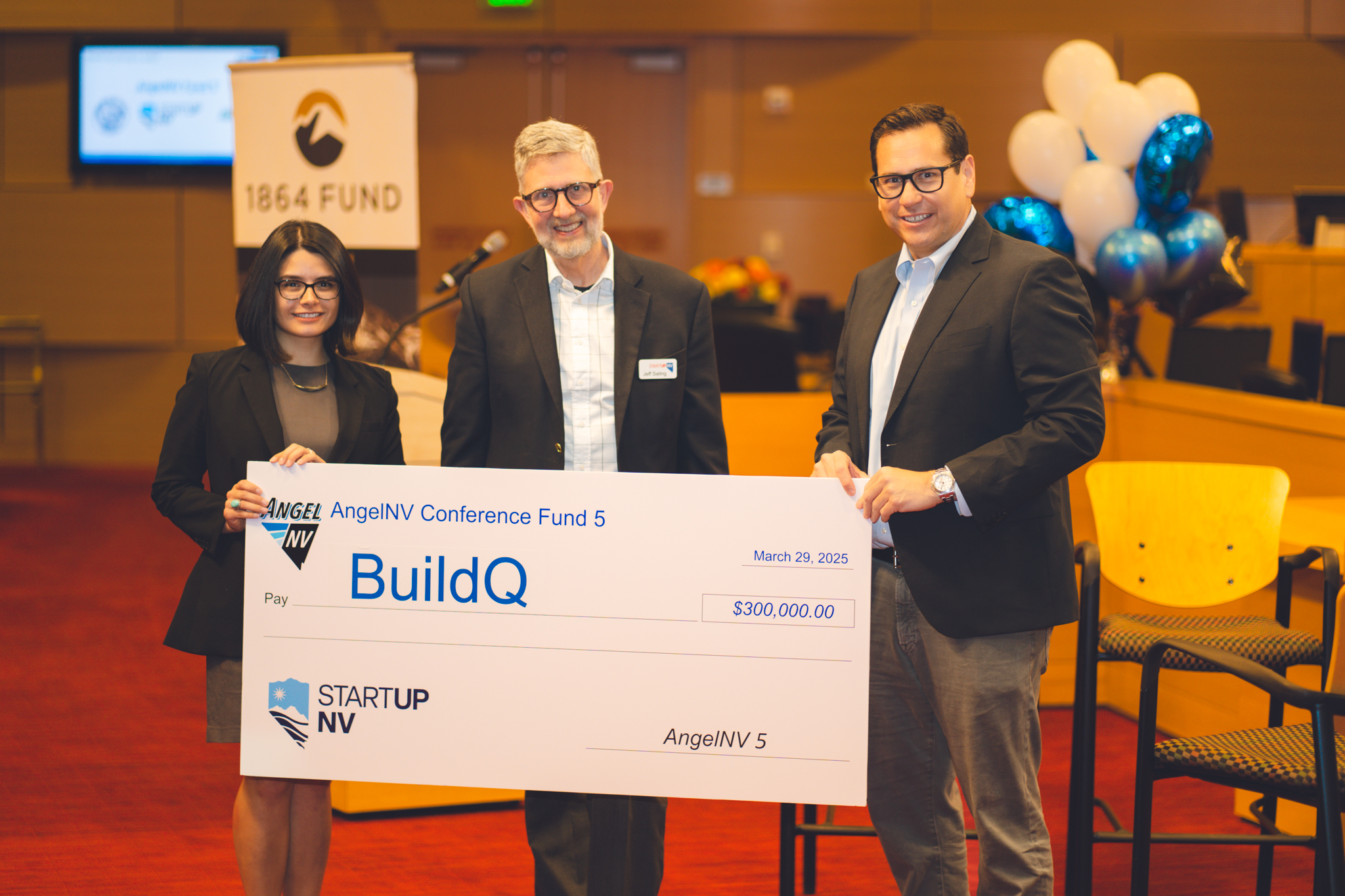
BuildQ, which develops software for managing large infrastructure projects, received AngelNV 5’s $300,000 first-place investment in 2025, with an SSBCI match. In 2026, the selected companies were Regara, RevReply and Amplibotics: businesses working on medical regulatory execution, sales automation and robot movement data, respectively. Their products differ; each had to pass through the same investment-selection process.
The 2026 announcement describes commitments, a distinction worth retaining when looking at the headline total. It demonstrates investors agreeing to back companies. It does not yet tell us what those companies will return. For a regional startup organization, building a repeatable occasion for those decisions is itself meaningful work.
Choose the door before polishing the pitch
StartUpNV’s homepage advertises seven founder growth programs and four affiliated funds. A newcomer does not need to navigate all of them at once. The useful starting question is what the business needs now. Someone testing an idea has a different problem from a founder already selling software and preparing an investment round.
IncubateNV is the self-paced online entry point. FounderNV offers workshops and speakers for people dealing with the everyday work of building a business. A ten-session Tribal Entrepreneur Development program adds another route. Workspaces in Las Vegas and Reno advertise coworking arrangements starting at $150 a month.
Explore the idea
IncubateNV
Self-paced learning
Prepare the evidence
AngelNV
Due-diligence education
Build toward a round
AccelerateNV
Selective coaching + investment
InnovateNV serves a more specialized need: helping small technology businesses prepare SBIR/STTR funding applications. The partnership includes UNLV, StartUpNV, GOED and UNR’s SAGE program. Its work covers agency selection, technical proposals, commercialization plans and budgets, with eligible proposal-preparation microgrants of up to $5,000. For a research-heavy business, that can be a more appropriate task than immediately rehearsing a venture pitch.
Clark County’s IncubateVegas and Seed Vegas relationship extends the model to first-time entrepreneurs and disadvantaged businesses. The county’s initial 2022 award was $600,000. An amendment added roughly $1.68 million and enabled additional bootcamps and seed grants. In March 2026, commissioners approved provisions for further grants tied to business performance, using remaining redeployed funding.
Those separate routes are a practical strength. They allow StartUpNV to serve entrepreneurs who need help without pretending every business belongs in the same financing process. A grant application, a first customer and a venture round require different kinds of preparation.
A nonprofit can still have a cap-table conversation
AccelerateNV is the selective route. Its current description specifies six months of work with coaches and mentors, using measurable objectives to tackle business challenges. It says roughly one in ten pitching companies receives an invitation, typically within three to six weeks. Admission connects a company to FundNV investment.
The advertised package combines $100,000 from FundNV with $100,000 in Nevada SSBCI matching investment. This is capital invested in a company, with deal terms attached. The current startup-program page also requires a 1% equity pledge to the nonprofit. Founders should distinguish that pledge from the affiliated fund’s investment.
$200K combined investment
Separate from the nonprofit’s 1% equity pledge. Actual investment terms govern.
StartUpNV’s own explanation is candid about the organizational split: the nonprofit supports entrepreneurs, while its affiliated venture funds seek financial returns. Grants, donations and some fees support the service operation. The longer-term hope is that successful companies’ pledged equity will help pay for future founders after exits.
For investors, FundNV 2’s published materials describe a $2 million pre-seed fund target, a $10,000 minimum and management and performance fees of 2% and 20%. A target is a fundraising objective, not proof that the money has all been raised. Nor is a fund’s size StartUpNV’s revenue. Keeping those accounts conceptually separate is essential to understanding the business model.
The practical cost question therefore has several answers. Some education is free; workspace has a monthly price; investment participation has its own fees; funded founders negotiate ownership terms. Calling the whole operation “free startup help” would hide the decisions that matter most.
The right business can still be the wrong investment
FundNV’s published preference is for B2B and enterprise businesses with early revenue. Direct-to-consumer businesses fall outside its stated thesis. AccelerateNV similarly describes companies capable of substantial exits within seven to ten years. That is a specific financial destination, and plenty of worthwhile businesses have no reason to choose it.
A founder building a consumer brand, a business outside Nevada or a company intended to stay small should consider other routes. StartUpNV points non-Nevada applicants toward the affiliated 1864 Fund or Sierra Angels. Its broader education programs should also be distinguished from its narrower venture selection.
Within Nevada, StartUp Vegas, Tech Alley and Startup Reno offer overlapping community connections and entrepreneurial activity. They can complement StartUpNV. The distinction in this profile is the combination of statewide founder support, investor education and affiliated funds. The best fit depends on whether someone needs peers, business guidance or a specific kind of capital.

Take the homework home
There is a useful method here for founders who never join. StartUpNV posts pitches on YouTube and sends founders their verbal feedback privately. Watching those sessions offers a way to study how a presentation turns into questions. Its mentor model also distinguishes specialist advisers from sponsors who coordinate coaching and accountability. Expertise is more useful when someone helps turn it into a next step.
The public culture has a lighter side. One blog post is titled “Sith Happens. Keep Pitching.” Beneath the Star Wars references, its advice is practical: collect investor feedback, show customer evidence and approach investors whose interests fit the company. Persistence without adjustment is a lot of meetings.
“By Founders, For Founders.”StartUpNV’s stated philosophy
For other regions, the transferable idea is to teach both parties and give them repeated opportunities to work together. That requires experienced mentors, operating support and investors willing to commit time as well as money. Nevada’s matching capital is a local advantage; it cannot simply be copied by changing the name on a presentation.
StartUpNV’s model asks founders to prepare evidence and investors to learn how to examine it. Anyone hoping a pitch event will substitute for customers will be disappointed. But for people willing to do the preparation, the organization offers something concrete: a place to make the next business decision with better questions on the table.
Meet the people. Watch the pitches.
Explore StartUpNV ↗ Find a program ↗ Events ↗ Founder reading ↗
YouTube pitch archive ↗ Watch: AngelNV 6 finale ↗ Watch: Las Vegas Startup Week 2025 ↗