The most persuasive number at 757 Collab is not $100 million, though its affiliated angel network says it has invested more than that. It is zero. A founder accepted into Startup Studios pays no rent for six months. A company selected for 757 Accelerate gives up no equity and, under the program's current published offer, receives $10,000 in non-dilutive capital. In a business famous for extracting a slice of the company before the company has much to slice, zero is a crisp proposition.
The nonprofit occupies Assembly, the handsome former department store at 400 Granby Street in downtown Norfolk. Around the tables are first-time founders, experienced operators, service providers, military-connected technologists and investors. They are not gathered for coworking theater. The point is to make the distance between a rough idea and the next useful conversation unusually short.
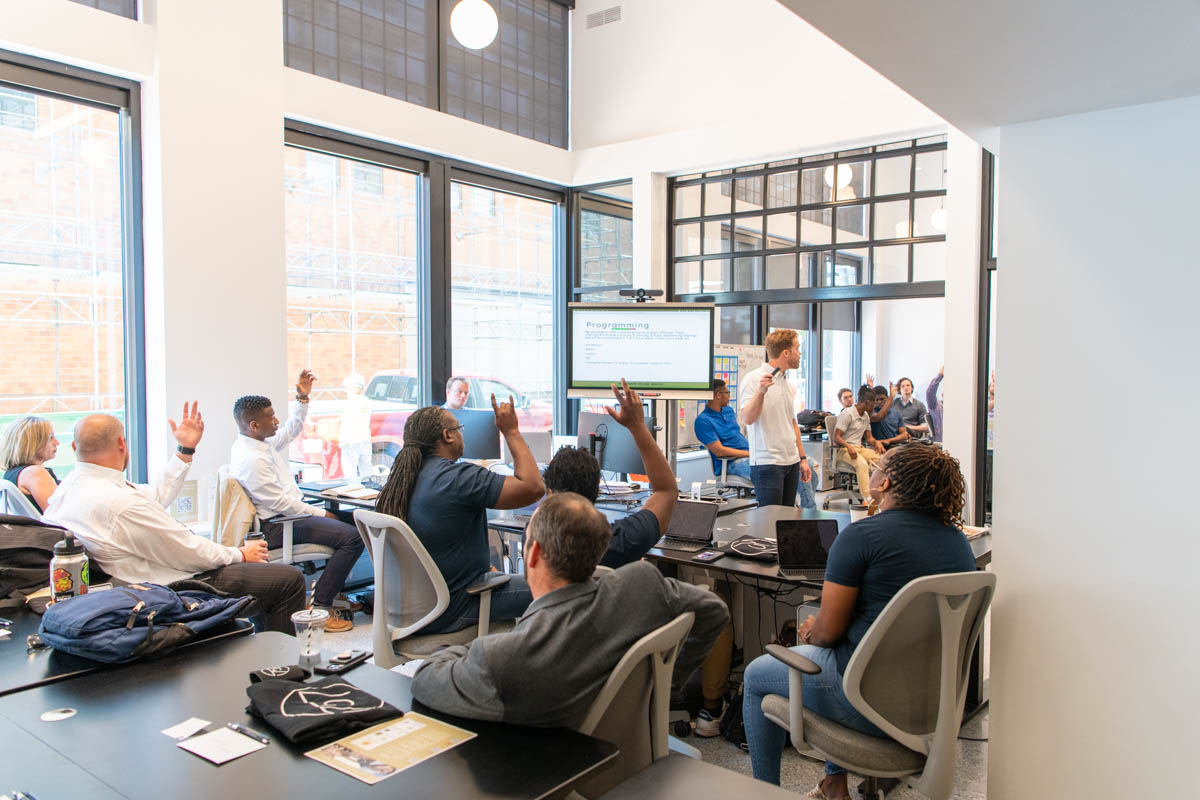
One building, four difficult handoffs
757 Collab is not a conventional company and it is not one program. It is the coordinating shell around a sequence. Startup Studios helps people test an idea. Accelerate works on customers, financials and fundraising. 757 Defend tackles the peculiar obstacle course of selling dual-use technology to government. 757 Angels introduces vetted Virginia companies to accredited investors. The customer changes at the final station: founders seek checks, while angels seek risk-adjusted returns.
That sequence is the distinction. A founder can find a free desk in many cities. An accelerator can teach cap tables. An angel group can host pitch nights. 757 Collab's argument is that each tool gets stronger when the next one is visible, reachable and, often, sitting in the same room. The organization calls this a continuum. Relay race is more accurate: each stage matters, but dropped batons are where regional startup systems lose people.
757 Collab connected us as founders, introduced us to mentors, provided structured programming that helped us refine our thoughts and focus our efforts.Katy Schuck, co-founder of Reelist
The thing that failed first was the map
Hampton Roads already had universities, military talent, economic-development offices and entrepreneur groups. Its weakness was navigation. The region is a collection of independent cities, and useful support could look like scattered islands. Paul Nolde, now president and CEO, described the need as tighter connections between the nodes and better founder density. His blunt premise was that no single organization could do everything.
That changed the design. Instead of inventing a grand new accelerator and asking everyone to orbit it, 757 Collab unified existing brands and built referral relationships with Innovate Hampton Roads, Black BRAND, the Hampton Roads Small Business Development Center and REaKTOR. In 2021, a $2.42 million GO Virginia award helped bring the accelerator, angel network, collaborative space and outreach work into one platform. In 2023, the U.S. Economic Development Administration added a $1.17 million federal award with an almost equal local match to scale the model with regional partners.
What changed minds was evidence that a front door needs several exits. The program menu has kept moving. Accelerate is now advertised as nine weeks with $10,000, rather than the older 12-week, $20,000 offer still visible in some institutional descriptions. A Capital Readiness Program appeared in 2024 for founders not yet ready to raise. The defense accelerator followed, taking advantage of the Navy, shipyards and technical workforce already thick on the ground. The organization did not abandon its generalist roots; it added sharper lanes where the region has an unfair advantage.
Who picks up the bill for zero?
Free to founders does not mean free to produce. 757 Accelerate Inc., the legal nonprofit behind the Collab name, reported $1.24 million in 2024 revenue and $1.66 million in expenses. Contributions supplied about 72 percent of revenue. Program services contributed about 27 percent, a notable change from 2023, when the filing recorded nearly all revenue as contributions. Grants, donations, sponsorships, locality support and paid work for partners subsidize the front end. An optional Founder Circle membership sells continued workspace and privileges. Angel investments are separate transactions, not disguised tuition.
The cost structure explains both the charm and the constraint. Public and philanthropic money can absorb risks that a commercial accelerator would price into equity. It also means the organization must keep proving regional benefit: companies helped, capital raised, jobs created, founders reached. In its 2024 filing, 757 Collab said it directly engaged more than 2,500 entrepreneurs, facilitated 90 internships and helped create 350 jobs. Those are self-reported outcomes, but they are the correct kind of receipts for an economic-development nonprofit.
A powdered drink tests the plumbing
Crunchy Hydration, founded by Megan Riggs, became the first company to complete the whole original route in 2024: Startup Studios, Accelerate and then 757 Angels. The product is a flavored hydration powder, not a shipboard robot or laboratory moonshot. That makes the example useful. The Collab says it focuses on the founder over the solution and accepts non-tech businesses; the pathway is not reserved for founders who arrive speaking fluent venture capital.
Other alumni show the range. Reelist uses short video to connect employers and job seekers and later joined Techstars. Luminoah developed a portable feeding system and raised a $6 million Series A. CXperks built an entertainment product used in more than 1,000 locations. In 2024, four Startup Studios companies won Commonwealth Commercialization Fund grants and nine companies completed Accelerate's seventh cohort. One Florida company, LuftCar, relocated to Virginia after the experience. A relocation is catnip to economic developers because it turns programming into taxable activity.
The Navy is not just a logo on the partner wall
757 Defend is the most region-specific part of the portfolio. Its 11-week program works with the NavalX Mid-Atlantic Tech Bridge to help dual-use startups understand government stakeholders, readiness requirements and the long path into Department of Defense applications. Participants receive a $10,000 travel stipend. This is less glamorous than a demo day and possibly more valuable. Federal procurement has its own dialect, calendars and trust networks. A warm introduction cannot erase them, but it can stop a young company from knocking on the wrong steel door for a year.
The focus becomes sharper in 2026. 757 Collab has said it will emphasize water, energy, defense, coastal resilience and adjacent infrastructure technologies. That is a strategic narrowing around the problems Hampton Roads sees up close. It also gives the hub a clearer place in the market. Lighthouse Labs and other Virginia accelerators can offer excellent general support. Few sit amid the country's largest concentration of naval activity with a formal Navy innovation partner down the hall.
What another city can copy
The copyable part is not the nautical branding or an expensive room full of ergonomic chairs. It is the architecture of the handoff. Start with a legible front door. Define the proof required for the next program. Keep advisors close enough to become relationships rather than calendar appointments. Separate education money from investment money. Let specialist lanes grow from real local customers and institutions, not from whichever sector is fashionable at a conference.
The conditions matter. This model leans on grant makers willing to fund shared infrastructure, a dense bench of mentors, credible follow-on investors and anchor customers such as the Navy. A region without those ingredients should not photocopy the org chart. Free desks alone can become a pleasant waiting room. An angel network without viable deal flow becomes a supper club. Government access without procurement fluency produces tours, not contracts.
757 Collab's own work is not finished. The annual deficit in 2024 shows the pressure of running broad programs while grant cycles shift. Outcomes must be tracked beyond capital raised, especially survival, durable revenue and local jobs. And the relay only works if founders who are not selected still receive a useful referral. Yet the operating idea remains sound and refreshingly concrete: reduce the cost of the first attempt, increase the quality of feedback, and never make a founder guess where to go next.
For founders: Startup Studios is the broad entry point; Accelerate suits ventures with a full-time founder and scalable product; Defend is for dual-use companies prepared for federal-market work; Angels is for Virginia seed-stage companies ready for investor scrutiny. Programs are selective, and published terms can change by cohort.