Jessica Preston knew fertility care. Business was another matter. After nearly two decades as a physician assistant, she was building Denovo Fertility and needed help turning clinical experience into a company. Ann Arbor SPARK’s Entrepreneur Boot Camp gave her an assignment with remarkably little glamour: talk to people. She conducted nearly 100 interviews with providers and prospective customers. Before polishing the answer, she had to understand the question.
- Startup coaching, workspace and funding connections, under one regional roof.
- Boot Camp charges tuition but takes no equity for participation.
- Different doors for technology startups, established employers and everyday small businesses.
That is a useful introduction to SPARK, a nonprofit whose work often happens between the milestones that make the news. A discovery needs a customer. A founder needs legal advice. An employer needs a building and people to fill it. SPARK helps arrange those encounters, giving Ann Arbor’s research economy a practical place to bring its unfinished business.
A town full of parts
SPARK began in 2005 with university, government and business backing. Rick Snyder and University of Michigan president Mary Sue Coleman helped create it; Michael Finney became its first chief executive. The original proposition was coordination: bring resources together so a company could find its next step without decoding the whole region first.
In a later SPARK interview, Snyder described writing the business plan and raising the money. He also supplied a pleasing twist. Years after serving as founding chair, he returned through his cybersecurity startup, SensCy, as a client. The person who helped assemble the machinery found a use for it himself.
A commercial accelerator can concentrate on a cohort. A landlord can rent a desk. A university commercialization office can help move research toward the market. SPARK combines several connecting roles with a regional mandate. Its constituency includes the founder and the community hoping that founder eventually hires locally.
The customer gets a vote
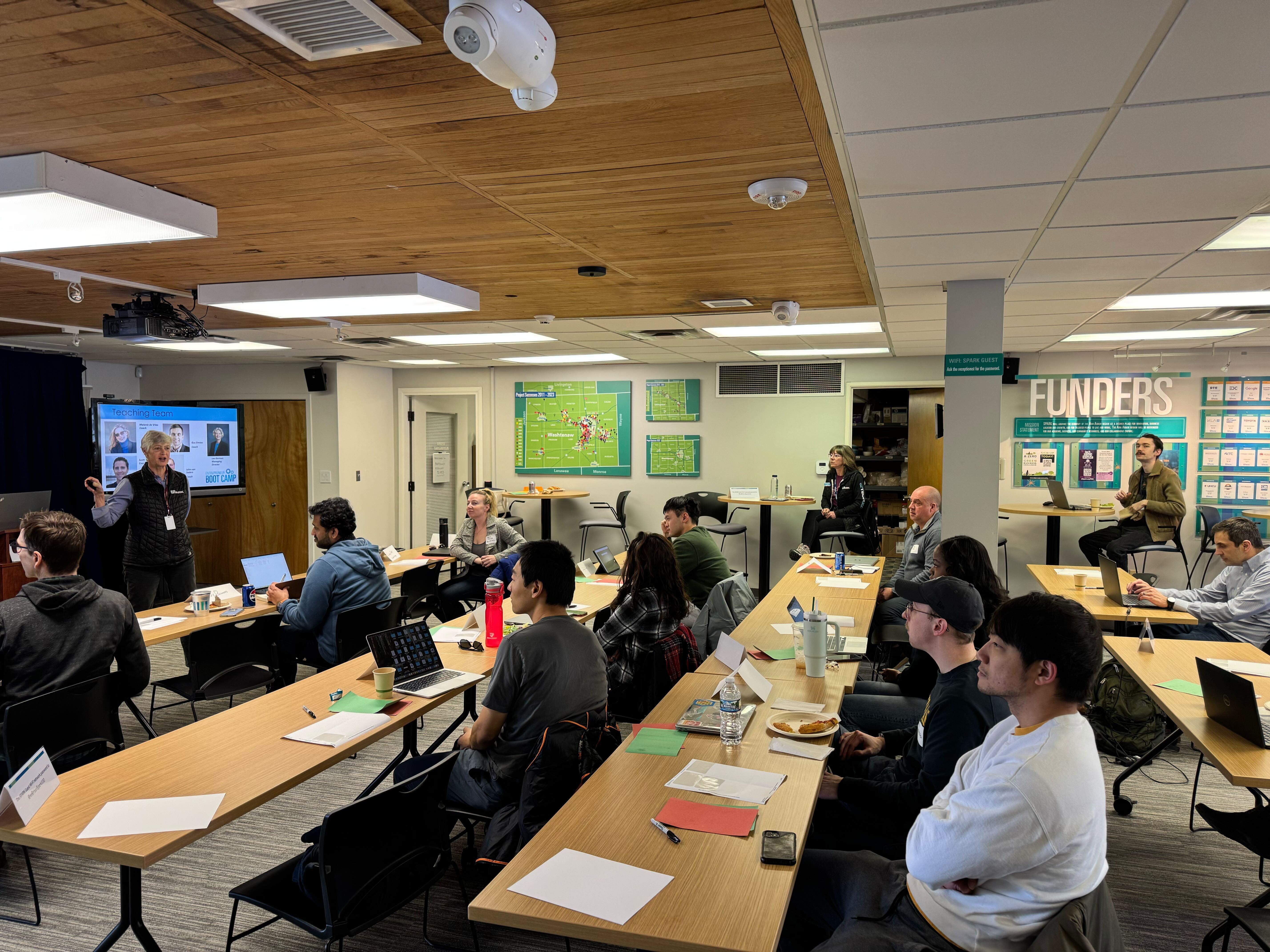
The current Boot Camp runs across eight weeks, with fewer than 40 hours in cohort sessions and substantial discovery work outside them. Teams meet coaches twice weekly. There is tuition, partial scholarships are available, and SPARK takes no equity for attending. The price includes a demand on time: participants must show up and investigate whether their business opportunity holds together.
“I wanted a solid foundation because I didn’t know anything about business or how this was going to work.”Jessica Preston, Denovo Fertility
Preston’s interviews helped her refine her offering. She won SPARK’s pitch competition in October 2022. The transferable lesson is modest and demanding: put prospective buyers into the process while changing direction is still affordable. Another founder can copy that sequence without moving to Michigan or waiting for an accelerator invitation.
Workspace is easier to price. SPARK lists shared coworking passes at $115 a month, with designated desks at $250 in Central and $200 in East. The appeal is proximity to advice and other entrepreneurs as well as a place to put the laptop.
- 01 Question
- 02 Interview
- 03 Refine
- 04 Finance
Keep the dollars in their lanes
SPARK Capital has a different job. It backs eligible, Michigan-based technology businesses alongside private investors, using instruments including convertible notes, SAFEs and preferred equity. Its FAQ lists typical investments of $100,000 to $200,000 per round, with a $250,000 maximum total per company. Applicants need a defensible product and evidence of a market; a good introduction cannot substitute for either.
At its 2026 annual meeting, SPARK reported that this capital program invested $3.85 million in 30 companies during 2025. The Michigan Angel Fund invested another $422,000 in three companies. Those are separate pools. Follow-on funding attracted by businesses measures something else again. Keeping the categories straight makes the results more useful to founders and taxpayers alike.
SPARK Capital investment across 30 companies.
Teal: SPARK Capital. Gray: Michigan Angel Fund ($422,000 in three companies). Separate programs; one reporting year.SPARK’s operating model also matters. Public funding, academic partners, private contributions and sponsorships support its work, alongside fees for selected services. An entrepreneur buying advice is therefore using infrastructure that several institutions help pay for. Its continuity depends on those institutions continuing to see value.
And what about the coffee shop?
The original focus left a practical gap. In a 2025 WEMU interview, senior vice president Bill Mayer described the missing ability to support businesses such as coffee shops and lawn services. A technology-startup system could be useful and still miss much of the neighborhood.
The Small Business Support Hub, launched in 2024 with a $3.4 million, three-year MEDC grant, broadened access across Washtenaw, Livingston and Monroe counties. That is a concrete adjustment to the model: build a route for businesses whose ambitions do not fit a venture-capital pitch. The grant pays for a program, rather than representing a startup funding round for SPARK itself.
Established employers enter through another door. SPARK’s business-development team coordinates site searches, permitting, incentives and workforce resources. An expanding company may need someone who knows which office handles an approval and which partner can help train staff. Here, economic development looks like a well-informed project manager.
The room has an address
Access has boundaries. SmartZone startup services generally require physical operations in Ann Arbor or Ypsilanti, a product-focused technology business, and annual revenue and private capital raised each below $5 million. SPARK Capital has statewide eligibility and its own investment criteria. Founders should choose the program that fits their business before treating the organization as a funding source.
The introductions keep moving outside the office. In October 2026, SPARK reported $200,000 in Invest360 awards across Constrat, Crank Bio and RoboWorkX. It also announced a four-company mobility showcase for Vehicle Tech Week later that month. For another city, the repeatable part is the discipline of connecting people around specific needs. The harder ingredients are patient institutions, relevant expertise and money that remains available after the event ends.