T-REX began with a small real-estate mistake. The group behind the new technology incubator needed about 8,000 square feet in downtown St. Louis. The Railway Exchange Building would lease no less than 12,000. Rather than swallow 4,000 empty feet, the organizers offered the surplus to startups. Interest was so brisk that the lease doubled to 24,000 square feet before the doors opened. The unwanted space had found the actual business.
That origin still explains T-REX better than the usual vocabulary of innovation centers. It is a nonprofit, not a venture fund. It does not promise founders a secret formula and says it takes no equity. Its practical work is to assemble affordable rooms, specialist neighbors and a full calendar, then reduce the friction between them. A founder with a half-built product can sit near Arch Grants, Cultivation Capital, university programs, mentors, public agencies and other founders who have already met the same ugly spreadsheet.
The spare 4,000 square feet that refused to stay spare
The first assumption to fail was modest: there would be extra room. Demand corrected it immediately. Within two years T-REX occupied about 80,000 square feet. In 2013 it moved into the Lammert Building at 911 Washington Avenue, an eight-story, 160,000-square-foot former furniture store built in 1898. New Markets Tax Credit financing helped make the move possible, including $1.7 million in equity from U.S. Bancorp Community Development Corporation. Early renovations were reported at roughly $1 million.
The building matters because it changed the incubator's ceiling. T-REX could stop behaving like a temporary tenant and start curating a vertical neighborhood. Startups received short commitments and low rents. Larger anchor tenants signed longer leases and helped carry the institution. Event rooms produced another reason for outsiders to enter. The polished concrete, exposed ducts and century-old timber looked pleasantly startup-ish, but the floor plan did the serious work: it made repeated encounters ordinary.
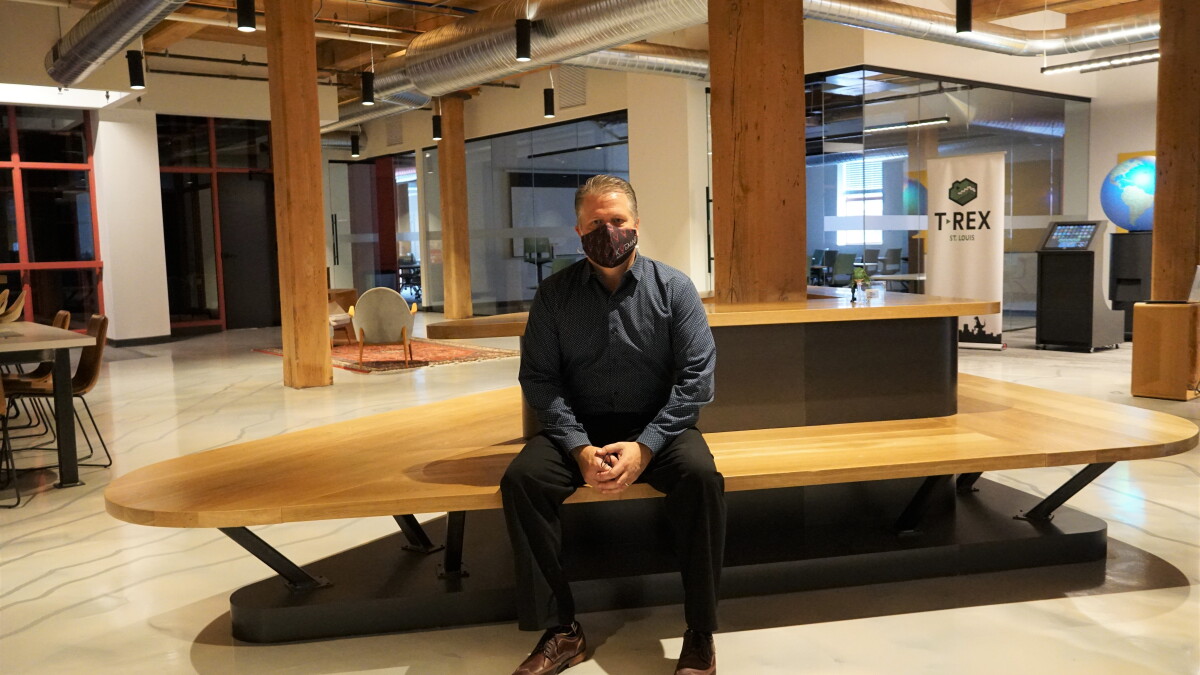
A $50 key to a room full of more expensive answers
T-REX's public price sheet is almost disarmingly plain. A membership costs $50 a month and includes coworking, conference rooms, gigabit Wi-Fi, private phone booths, coffee, tea and programming. Private incubator offices for technology startups are listed at $200 to $600 a month, plus membership, with furniture and 24-hour access. Members give 30 days' notice rather than signing a conventional lease. For a company still testing whether anyone wants its product, flexibility is a form of runway.
Those dues do not pay for the whole machine. T-REX mixes memberships and office fees with conference rentals, longer anchor leases, donations, sponsorships, grants and public support. Its 2024 Form 990 reported $6.30 million in revenue, $2.19 million in expenses and $11.20 million in net assets. Contributions accounted for $1.72 million. This is civic finance, not software economics: lumpy grants and building costs sit beside recurring rent, and a cheap founder desk can exist because several other constituencies value the room.
The customer is therefore plural. There is the founder buying time and credibility. There is the established company renting a stable office or sponsoring a program. There is the university seeking a bridge from classroom to employer. There is the agency that needs outside ideas without dragging every collaborator through a secure gate. And there is St. Louis itself, buying a better chance that a promising company begins and stays downtown.
03 · Maps move inThe floor where geography became strategy
T-REX's sharpest specialization arrived when the National Geospatial-Intelligence Agency chose north St. Louis for a new campus. The incubator could have treated the decision as neighborhood good news. Instead, it reorganized a floor around it. Bayer contributed $500,000 toward what was first called Geosaurus, a nearly 15,000-square-foot geospatial innovation space. By 2020, the roughly 16,000-square-foot Geospatial Innovation Center was operating as common ground for startups, established contractors, educators and researchers.
Then the federal customer came inside. In 2021, NGA opened Moonshot Labs at T-REX, its first unclassified collaborative innovation center. The approximately 12,000-square-foot workspace let agency staff work with industry and academic partners on software and geospatial problems without placing the conversation behind classified walls. Harris-Stowe State University opened GeoHornet Lab the same year, connecting students and faculty to NGA professionals, Maxar projects and geospatial career paths. The University of Missouri-St. Louis also based national-security and community-policy work in the center.
“Partnerships are in our DNA.”Jesse Winters, president and CEO
This is where T-REX differs from a generic coworking floor. Cortex and CIC St. Louis offer formidable innovation communities, and conventional offices can beat any incubator on privacy. T-REX's bet is narrower: co-locate enough of one city's support system that a founder's next introduction becomes a hallway encounter. In geospatial technology, the presence of NGA, corporate funders and university labs gives that bet an unusually credible anchor.
After a sudden loss, the calendar came first
The institution endured a hard interruption in May 2024, when longtime president Patricia Hagen died unexpectedly. Jesse Winters was named president and CEO late that year and began in January 2025. He has described his early work in sturdy, unromantic terms: stabilize the organization, return it to its central mission and restore programming. The choice says something about what management believes the product really is. A building creates potential energy; the calendar makes people use it.
Winters set out to “own Wednesdays.” The first Wednesday brings Morning Hatch, aimed at founders moving an idea toward a viable product. The next two feature geospatial programming, including Geosaurus Unleashed and a user group. The fourth is Strictly Social, complete with guest bartenders. By 2026, T-REX was also pointing to youth entrepreneurship, geospatial workforce development and hands-on founder support as new priorities. A Leidos and GeoSTL maritime hackathon offered university students a real problem, cash prizes and consideration for internships.
The plainest description of T-REX came from Winters after 13 months in the role: it is not a coworking space or a real-estate company, but a nonprofit economic-development organization. That framing is useful, though the real estate is hardly incidental. T-REX works because the subsidy has an address, the partnerships have meeting rooms and the mission can be seen in who shares the elevator.
05 · The part worth stealingCopy the mechanism, not the dinosaur
A city trying to reproduce T-REX should begin with the sequence, not the branding. First, find real founder demand and offer a low-commitment place to gather. Second, recruit support organizations and larger tenants that solve different problems and can shoulder different prices. Third, use programming to create a habit of return. Finally, specialize around an authentic local advantage. For St. Louis, the NGA investment made geospatial technology more than a theme pasted on a conference room.
- Demand must predate the décor. T-REX expanded because founders had already filled the spare space, not because exposed ductwork looked entrepreneurial.
- Subsidy needs patient backers. $50 memberships make sense only alongside grants, donors, anchor tenants and public partners willing to fund broader economic value.
- Density must be curated. A crowded building is not an ecosystem unless its occupants can actually help one another.
- The local anchor must be real. A geospatial floor works near a major NGA investment; copying the label without customers, talent or institutions would produce themed vacancy.
There are limits. The model is tied to St. Louis, its public-private relationships and a large building acquired with favorable financing. It will be less useful to a company that needs a specialized wet lab, complete secrecy or a dense customer market outside the region. And impact figures attributed to resident and graduate companies should not be mistaken for revenue earned by T-REX itself. The organization is connective tissue. Measuring precisely which connection caused which job will always be slippery.
Still, the original lesson has aged well. T-REX changed its mind when the empty desks disappeared. It stopped treating surplus space as a burden and recognized it as evidence: people wanted an affordable place where building a company felt less solitary. Fifteen years later, the best thing it sells remains difficult to put on an invoice. It is the chance that the person with the missing answer is already downstairs.
Keep the connection open
Explore current programs, office availability, events and videos directly through T-REX.