The first thing Rapid City’s startup incubator ran short of was space. Entrepreneurs were waiting for a place in Ascent Innovation, the business center on the South Dakota Mines campus. The response eventually became a downtown building with room for companies, advisers and economic development agencies. Ambition, in this version of the American business story, needed more square footage.
That is a useful place to begin with Elevate Rapid City. The nonprofit combines the familiar work of a chamber of commerce with business recruitment, startup support and workforce development. Its territory is Rapid City and the surrounding Black Hills. Its practical proposition: a business owner should be able to find help with several connected problems without assembling a civic organization chart first.
Three organizations, one front door
Elevate took shape in 2019 through the merger of the Rapid City Chamber of Commerce, the Economic Development Partnership and the Economic Development Foundation, which operated Ascent Innovation. The combination brought established business relationships and entrepreneurial support into the same organization. Its stated mission is to improve the Rapid City economy for everyone; the work ranges from business introductions to the infrastructure that makes expansion possible.
That breadth is its distinguishing feature. A private office landlord mainly supplies space. A consultant might supply research. A chamber offers relationships and representation. Elevate combines those functions with a regional development mandate. Businesses can still use each service separately elsewhere. The case for putting them together is that hiring, premises, financing and local rules rarely arrive as separate problems.
A crowded incubator gets a downtown sequel
The earlier incubator opened in 2006. By the time a second location was being discussed, demand had pushed against its capacity. “We’ve been maxed out over there for several years,” Mitch Nachtigall, then Elevate’s ecosystem development director, recalled in the organization’s 2021 account. The bottleneck was physical: companies wanted in, and the available space could not accommodate them.
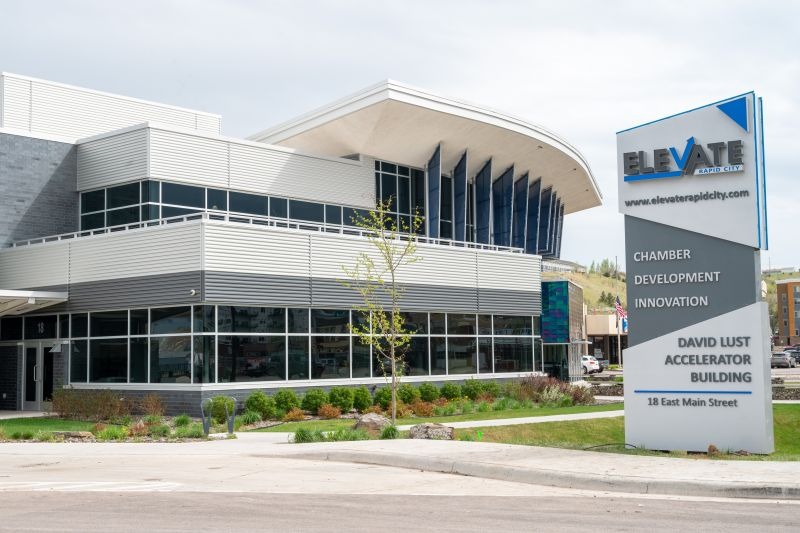
Elevate moved into the new David Lust Accelerator Building in March 2021. Its formal grand opening followed in October. Named for the attorney and former lawmaker who helped develop Elevate, the facility placed a 40,000-square-foot business address near downtown and South Dakota Mines. Keeping those connections close was part of the location decision.
The opening-day account put the campus package at $15 million: $8.5 million from Elevate, $3.2 million from the federal Economic Development Administration, $1.7 million from South Dakota and city-donated land valued at $1.6 million. An earlier legislative report had described a $10 million building. Those figures refer to different scopes; they do not establish a construction overrun.
- Elevate
- $8.5m
- Federal EDA
- $3.2m
- South Dakota
- $1.7m
- City land
- $1.6m
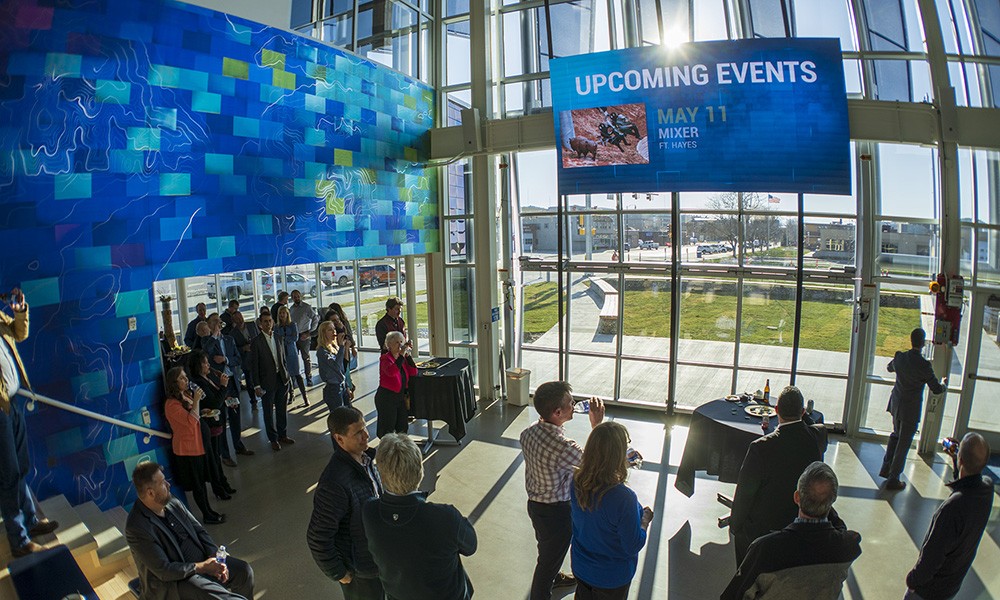
The building has a little local geology in its personality: agate-inspired wallpaper and acoustic panels echoing the surrounding hills. More consequential is the mix of occupants. Alongside businesses sit Elevate, the Governor’s Office of Economic Development’s West River office and the South Dakota Ellsworth Development Authority. An introduction can be a short walk.
What happens after you get the keys?
Office space is only one entry point. DLAB offers management assistance, meeting facilities and access to volunteer business and technical expertise. Its tenant directory includes Wildfire Labs, Daktronics and the Sanford Underground Research Foundation, among others. The mix extends beyond newly formed companies. That matters for a founder looking for experienced neighbors as well as fellow beginners.
For technology entrepreneurs, Elevate’s TechForge mentorship program connects existing regional resources into a sequence. I-Corps, led regionally by North Dakota State University with South Dakota Mines as a partner, helps teams investigate customers and commercial potential. Teams with a viable invention can then move toward FAST Launch for business planning and the next stage of commercialization.
The sequence contains an easily copied idea: ask about customers before treating an invention as a business. A promising technical result still needs someone willing to buy it. Mentorship is more useful when attached to that decision than when it becomes a standing appointment with no clear next step. That is a reading of the program’s design, rather than a claim that every participant succeeds.
Federal support has helped pay for this surrounding work. In 2023, the EDA awarded $100,494 to Elevate’s STEMpreneurship program, with an equal local match. The proposal targeted early technology companies, Mines alumni and graduates of Wildfire Labs. Its recruitment and startup-creation figures were goals, so they should be read as a plan rather than a tally of completed businesses.
The business help that never gets a ribbon
For an established employer, a custom report may be more useful than an accelerator desk. Elevate’s Market Research Center offers workforce comparisons, market information and location analysis. Its menu includes local wages and job postings, graduate pools, spending patterns and population around a prospective site. A retailer considering another location and a manufacturer competing for staff can ask quite different questions of the same service.
The value depends on asking something specific. “Help us grow” is a difficult research brief. “What are nearby employers paying for this role?” gives an analyst a problem to investigate. “How many potential customers live near this property?” gives a business owner a way to test an assumption before committing money. These are practical uses of the published report categories, not promises of a particular commercial result.
Manufacturers have another route in. The Black Hills Manufacturing Alliance, founded in 2023 and supported by Elevate, meets quarterly and brings together businesses across fields including defense, chemicals, construction materials and precision products. Facility tours sit alongside conversations about business challenges and regulatory changes. Sometimes the useful insight is seeing how the factory down the road handles a familiar problem.
The chamber side adds marketing opportunities, networking, education and advocacy. Member-investors receive different benefits according to their level of support. For a business choosing whether to participate, the useful question is which relationships or services it will actually use. An event calendar can open a door; someone still has to walk through it.
A job offer needs somewhere to live
Successful recruitment creates another question: where will the workers live? Elevate’s 2021 annual report described housing demand and workforce shortages as problems requiring a response. It outlined a housing coordinator partnership with the Black Hills Area Community Foundation and work toward a housing trust fund. That is the documented change in emphasis: growth exposed constraints that business recruitment alone could not settle.
The organization now maintains a housing dashboard and a regional study refreshed in 2025. The study combines market data with expert input and residents’ experiences to examine supply and demand. For an employer, housing information belongs beside wage information. For a developer, it helps frame where demand and available homes are failing to line up.
Childcare makes the connection even plainer. Elevate’s 2024 report describes a loan for infrastructure upgrades at a childcare facility that retained 165 places. The same report records 16 supported local business expansions associated with 109 jobs, and 137 market research requests. These are specific, self-reported activities. Regional employment totals answer a different question and cannot fairly be credited to one organization.
Growing a business also means making room for the people who work there.One lesson from Elevate’s housing and workforce work
Military transitions are another part of that labor supply. Elevate has served as a SkillBridge provider since 2020, helping connect service members with civilian internships and helping employers develop arrangements through its umbrella. Its guidance recommends starting well ahead of separation. For both sides, the service turns an unfamiliar administrative process into a sequence of conversations and a training plan.
Career LIFT addresses a different starting point. Its free online courses cover introductory workplace and industry skills. Completing the soft-skills course and another industry course offers a route to a local employer interview. An interview is the promised opportunity, not a job offer. That distinction makes the program easier to understand and easier for a job seeker to judge.
Who pays for all this?
Elevate’s economics resemble a civic business institution rather than a startup selling subscriptions. Its 2024 tax-return data records about $7.21 million in revenue and $5.13 million in expenses. Contributions accounted for roughly 78 percent of revenue; program services contributed about 13 percent, with investment income and other receipts making up the rest. These are annual organization figures, separate from the accelerator campus construction package.
The model depends on businesses and public partners supporting work whose benefits may spread beyond any single contributor. That can make shared research, workforce coordination and infrastructure planning possible. It also creates a continuing obligation to show what the money accomplished. A busy room and a persuasive annual report are useful beginnings; the enduring test is whether businesses and residents benefit.
The next address is 128 acres
In August 2026, Elevate described Northline Business Park, a planned 128-acre development near Haines Avenue and Mall Drive. The target mix includes advanced manufacturing, light industry and offices. Planning, engineering and site preparation are expected to take several years. This is a future business location, not a completed park with a demonstrated jobs tally.
The proposal exposes the same constraint at a larger scale. Vacant land still needs access, utilities, grading and drainage before an employer can build. Elevate is working with city, state and other partners on that preparation, with private businesses expected to make their own investments afterward. A company shopping for an expansion site may not wait for a community to start that work.
Other cities can copy the habit of connecting services around an employer’s actual decisions. Copying the real estate requires more: sustained funding, capable partners and enough business demand to justify the space. Without those conditions, proximity alone achieves little. Rapid City’s experiment is worth watching because its ambitions keep returning to a concrete question: what is stopping the next business, or its next employee, from staying?
Find your way in
Choose a program, bring a specific question, and start a conversation.