On a Tuesday in 1909, two dozen businessmen walked into the dining room of Renton’s Melrose Hotel. They had no member portal, no email newsletter, no “personal brand.” They had a city full of factories and one old problem: useful people were scattered. The organization they began would eventually call itself the Renton Chamber of Commerce. Its first great marketing line described Renton as the “Town of Payrolls.” Its newest idea is almost the reverse. Instead of counting how many people a business employs, the Chamber now asks what that business wants.
That change sounds administrative. It is actually a compact theory of community. The Chamber’s old dues formula was based on full-time employees. Yet a five-person firm might attend everything, volunteer on a committee and post a job every month, while a company with 500 employees might want only a directory listing and a voice in policy. Headcount was neat. It was not particularly revealing.
The useful room
Today the Greater Renton Chamber is best understood as a civic switchboard. Its customers range from solo professionals and restaurants to manufacturers, nonprofits, schools, healthcare organizations and local government. They arrive with different questions: Who is hiring? Which regulation is moving? Where can I meet customers? Who understands this permit? How do I get people through my new front door?
The Chamber answers with a bundle rather than a single product. There is a searchable directory, job postings, member news, discounts, sponsorships, business breakfasts, after-hours mixers, ribbon cuttings, workshops and legislative advocacy. Members can publish events and offers through an online information center. Exporters can have Certificates of Origin stamped. Employers can meet training providers and job seekers. A new member can attend a recurring online session devoted entirely to learning where the useful levers are.
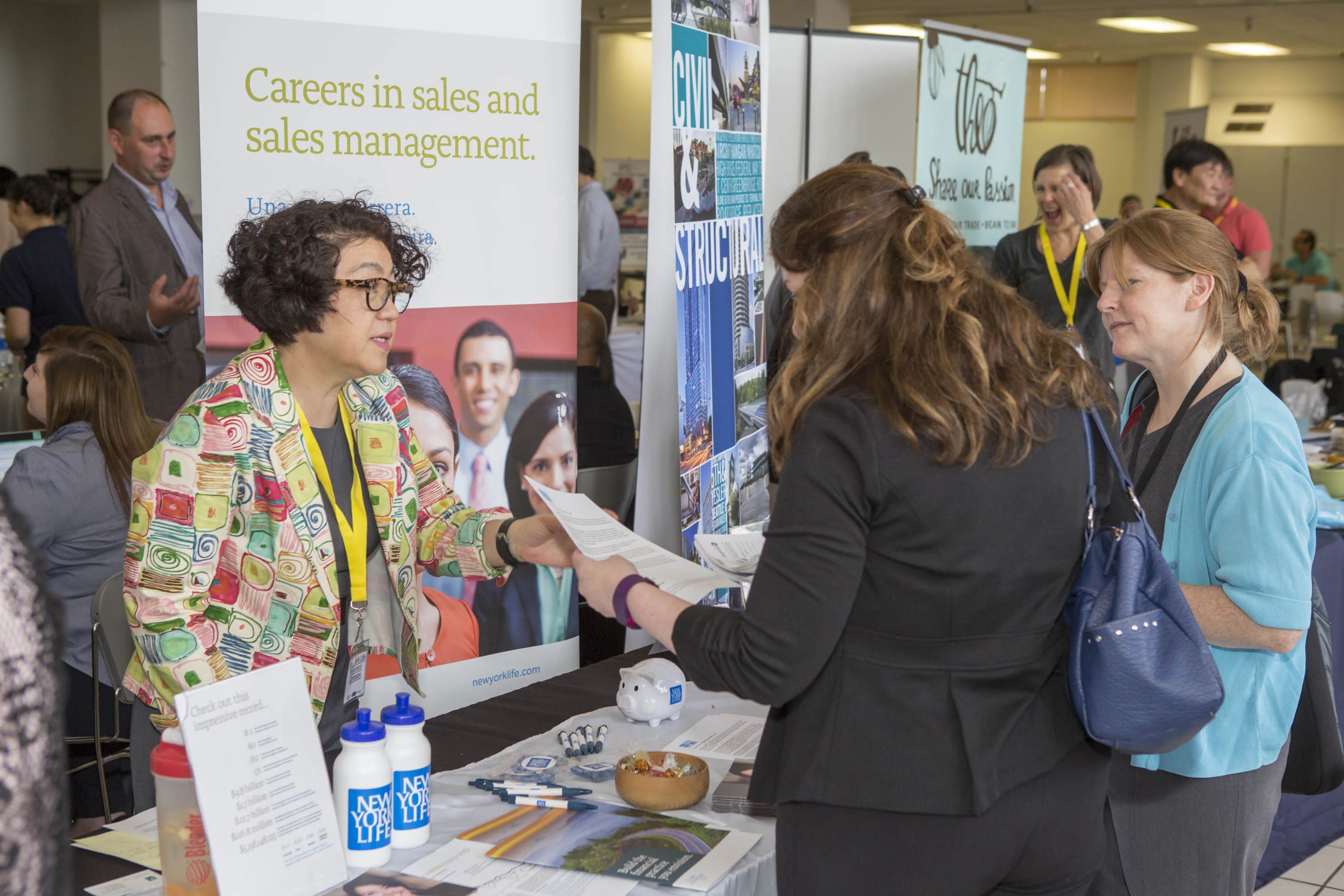
The career fair photograph is instructive. Nobody is watching a keynote. People are leaning across folding tables, passing paper, reading faces. The Chamber’s expertise is in arranging these moments at sufficient frequency that luck begins to look organized. More than 90 events a year means the network is not saved for a single annual gala. It is rehearsed monthly, sometimes weekly.
The local trust loop
When the proxy stopped behaving
The first thing to fail was not membership. It was the proxy used to price it. Employee count once served as a rough stand-in for ability to pay and likely use. The Chamber now says that model did not reflect how organizations actually engage. Its answer is three tiers - Basic, Classic and Premium - organized around goals and benefits. A member can buy foundational credibility, more promotion or the deepest level of access and influence.
The model changed its question
What changed the calculation was a simple behavioral observation: a small team can be intensely active, and a large organization can be selective. The new structure also includes admission credits for eligible Chamber programs. That matters because annual dues are psychologically foggy; a credit is something a member can spend. It converts belonging into a visible next action.
What the money buys
The Chamber is a nonprofit business league, not a venture-backed startup. Its business model combines membership dues with event admissions, sponsorship and service fees. Public tax reporting for fiscal 2024 shows about $458,000 in revenue and $527,000 in expenses. At street level, the pricing is easier to grasp. A September 2026 after-hours event cost $10 for members, nothing for Premium members and $25 for non-members. An August business breakfast was $10, free and $30, respectively. Certificate-of-Origin stamping costs $10 for members and $30 for non-members.
The price is only half the bargain
The explicit fee buys entry. The implied obligation is repetition: attend, volunteer, post, introduce and follow up.
Member / non-member price at a typical 2026 After Hours event. Premium members attended free.
That last part explains where the model has limits. A business seeking national scale, specialized technical counsel or purely digital customer acquisition may get more from an industry association, a consultant or an advertising platform. A passive member may also discover that a directory entry is merely a directory entry. Renton’s own onboarding language compares membership to a gym: use determines results. Local density is the advantage, and participation is the fuel.
The coalition behind the counter
The Chamber differs from networking clubs because it can move between commercial and civic rooms. It works with the City of Renton, Renton School District, Renton Technical College and Valley Medical Center. Its legislative committee monitors regulation, develops positions with regional coalitions and carries business concerns to Olympia. It has hosted candidate forums and issue debates. In workforce development, it helps connect employers to colleges, schools and job seekers; the Chamber and City have also described plans for paid teen internships.
One partnership has had a particularly long afterlife. In 1999, a $257,000 grant from the Greater Renton Chamber of Commerce Foundation helped five local institutions establish what became the Renton Regional Community Foundation. The foundation now serves communities across South King County. This is what a switchboard can do at its best: route not only calls, but capital and institutional trust.
The physical headquarters makes the metaphor almost too tidy. The Chamber operates from a 3,400-square-foot former train depot built in 1952 and renovated in 1999. A building designed to move people between places now moves introductions between institutions. Outside, Renton has grown beyond the old factory town. Inside, the job remains recognizably similar.
The part worth copying
The Chamber’s most portable lesson is not “hold more events.” It is to design a loop in which every encounter makes the next one easier. The directory gives a name context. The breakfast gives the name a face. A committee gives the face a track record. A referral then carries less risk. Renton reinforces that loop with recurring formats rather than relying only on spectacles.
- Price participation around the result people want, not a convenient proxy such as company size.
- Give new members a monthly, repeatable onboarding session instead of one welcome email.
- Turn annual value into spendable credits and clear next actions.
- Mix commerce with workforce, education and civic questions; local problems rarely respect organizational lanes.
- Measure useful collisions - introductions, postings, referrals and repeat attendance - not merely names on a roster.
This only works under particular conditions. The geography must be tight enough for people to meet repeatedly. Members must be willing to help produce the network, not simply consume it. Staff must remain credible across political and commercial lines. And the calendar must create real reasons to return. Without those, the switchboard becomes a mailing list.
In 1909, two dozen men needed one dining room. In 2026, 598 listed organizations need many rooms, plus a directory, a login and occasionally an enormous pair of scissors. The technology changed. The need underneath it did not: business moves faster when the next useful person feels one introduction away.