Doug Erickson knew hundreds of technology people in Silicon Valley. Back home in Santa Cruz, he knew surprisingly few. In 2007, he tried an uncomplicated remedy: invite people to meet, and offer free pizza. Twenty came. Before there was a program, a membership ladder or a pitch competition, there was a roomful of neighbors discovering that they had professional reasons to know one another.
- Local introductions for founders, employers, students and job seekers.
- Annual memberships from $59 for students and $99 for individuals.
- Paid internship support of up to $10,000 per eligible placement.
- An equity-free accelerator whose seventh cohort is currently on hold.
That gathering became Santa Cruz New Tech. A separate organization, Santa Cruz Works, arrived in 2012, founded by Bob Cagle, Bud Colligan and Bonnie Lipscomb. Its ambitions extended beyond technology: help businesses start, grow and find the people and institutions they needed. In April 2019, the two merged under the Santa Cruz Works name. The social habit had acquired a wider job description.
A room with more than one exit
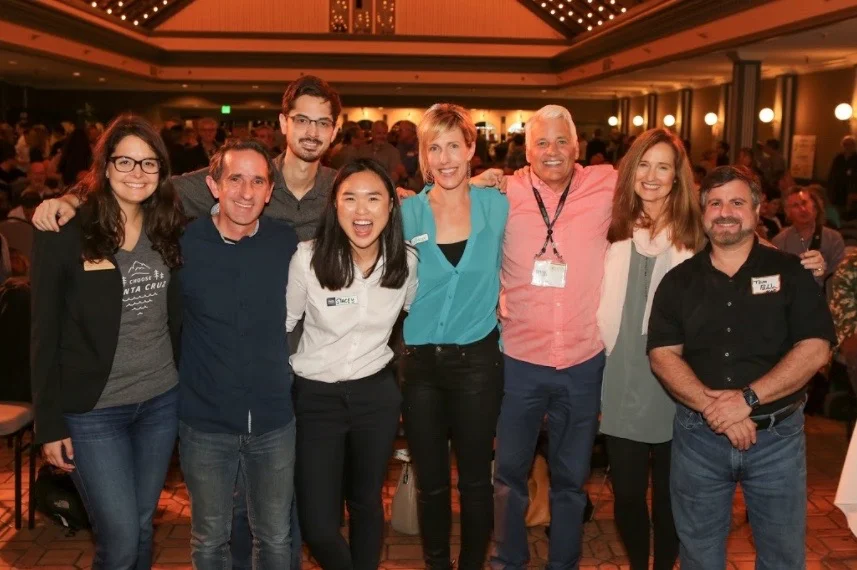
To see what the organization does, consider Launchpad. On May 13, 2026, the event occupied the Grove at the Santa Cruz Beach Boardwalk. Students pitched businesses; afterward, attendees met employers. UCSC reported 12 competing teams, seven prize recipients, $20,000 in cash awards and a job fair featuring 25 industry partners and organizations with more than 300 openings.
The juxtaposition matters. A student can arrive convinced that the next step is founding a company and leave with a useful employer connection. A hiring manager can see technical ability before it has been squeezed into a résumé. Cherry Wheels, which makes expressive wheelchair covers, won the social-impact award. Standby, developing voice agents to support incarcerated people, took first place in technology. The ideas were varied; the audience was shared.
“Launchpad brings together talent, ideas, and opportunity in one room.”
Doug Erickson, executive director
This is Santa Cruz Works’ market position in miniature. It connects activities that otherwise live in separate calendars: university entrepreneurship, company recruitment, civic development and the ordinary search for someone who can answer a question. Its expertise lies in convening and navigating those relationships. The product is often a better next conversation.
The founder has homework
Santa Cruz Accelerates adds structure to those introductions. Established in 2015, it describes an equity-free model, online coursework, mentor access and pitch preparation. Its current positioning emphasizes B2B software, AI-enabled products and developer tools. Founders keep their ownership; participation does not promise an investment cheque.
The revealing detail comes from its published 2024 flight plan: founders needed 25 customer-discovery interviews and completion of at least 80 percent of coursework to qualify for the pitch competition. There is a useful discipline here. Before polishing the story for investors, test whether prospective customers recognize the problem. A beautifully delivered pitch can still advertise something nobody wants.
Evidence first. Presentation follows.
In a February 2026 essay, program leader Michael Mash Ashley described the accelerator as preparation for larger programs. He pointed to Light Links, a Cohort 6 participant subsequently accepted into Berkeley SkyDeck, as an example. That is a sensible role for a regional organization: make founders better prepared to use the next network.
But timing matters. The program page’s June 2026 update says Cohort 7 is on hold while resources and timelines are reviewed. Anyone seeking an immediate cohort must check availability rather than plan around the earlier spring announcement. Mentorship may preserve equity, but organizing it still consumes time and resources.
Introductions become paid work
The workforce program tackles a different barrier. An employer might like to hire an intern yet lack the budget or recruiting connections. A young person might have skills but no obvious entrance into a local workplace. The Internship Opportunity Program joins those needs with public funding.
The City of Santa Cruz, Santa Cruz Works and Digital NEST announced the collaboration in June 2025. The current fall 2026 cohort involves Cabrillo College, which handles outreach to residents ages 18-24 in disadvantaged neighborhoods. Santa Cruz Works reviews employers and administers funding. Employers interview candidates and make the hiring decision.
Placements typically last about six months. Grants provide $5,000-$10,000 toward wages, reimbursed after invoices and time logs. The employer must pay on time, handle employment obligations and supply meaningful work and supervision. For a business without cash to carry payroll or someone to mentor a newcomer, the subsidy alone cannot make the arrangement work.

The network has a price list
Santa Cruz Works operates as a 501(c)(6) nonprofit mutual benefit corporation. Its published annual membership tiers run from $59 for students and $99 for individuals to $2,500 for solopreneurs, $5,000 for small and medium businesses, and $10,000 for enterprises. Company tiers bundle visibility, event presence and recruiting connections; individuals buy affordable access to the community.
Alongside New Tech events, the organization offers clinics, company breakfasts, a free newsletter and CEO Works peer discussions. Manufacturers can find connections to Roadmap 4 Innovation for operational and training support. The audience extends beyond startups. A mature employer seeking talent has a different problem from a founder seeking a first customer, but both benefit from local knowledge.
Membership also advertises more than $1 million in potential perks. That figure describes a collection of offers, credits and discounts, subject to eligibility. A founder should value the tools they will actually use. Unused discounts make handsome wallpaper.
Keep the habit; maintain the machinery
The infrastructure requires upkeep. In February 2026, Santa Cruz Works announced that OneValley’s PassportOS portal would shut down by April 30. It sought a replacement for accelerator content while retaining separate access to member perks. In August, it announced a rebuilt events calendar and updated jobs and membership pages. The work includes maintaining the paths between gatherings.
Other communities can copy the sequence: convene people repeatedly, involve employers and colleges, then give each introduction a practical next step. It depends on partners willing to show up and staff able to follow through. Santa Cruz Works’ original insight remains appealingly modest. Talent can be nearby and still difficult to find. Sometimes the first useful intervention is dinner.
Find your next conversation
Browse Santa Cruz Works, compare memberships, check accelerator updates, explore paid internships, or read the website update.
Follow LinkedIn, X, Instagram and Facebook. Watch talks and event recordings on YouTube or browse the recordings collection.