A former shopping mall in Southern Dallas now offers a different kind of retail therapy: somewhere to work on the business you keep talking about. At The DEC Network’s RedBird center, entrepreneurs can rent offices, record a podcast and find business training. The expanded facility opened in April 2024 with a reported price tag of $2.4 million. Its most consequential feature may be the address.
Putting help in South Oak Cliff makes a statement about who belongs in the entrepreneurship economy. A founder with a day job, a tutoring company or a first business idea needs practical support, too. The DEC Network has spent more than a decade building places and programs around that proposition. RedBird gives it walls, meeting rooms and a front door.
A business center where the customers already are
The Dallas nonprofit supplies a combination of workspace, education, mentoring and introductions. Its audience includes aspiring founders, established small businesses and nonprofits across Dallas-Fort Worth. Women and entrepreneurs of color are a particular focus. The services address ordinary, stubborn problems: working alone, finding someone qualified to advise you, meeting potential collaborators and understanding where to look for money.
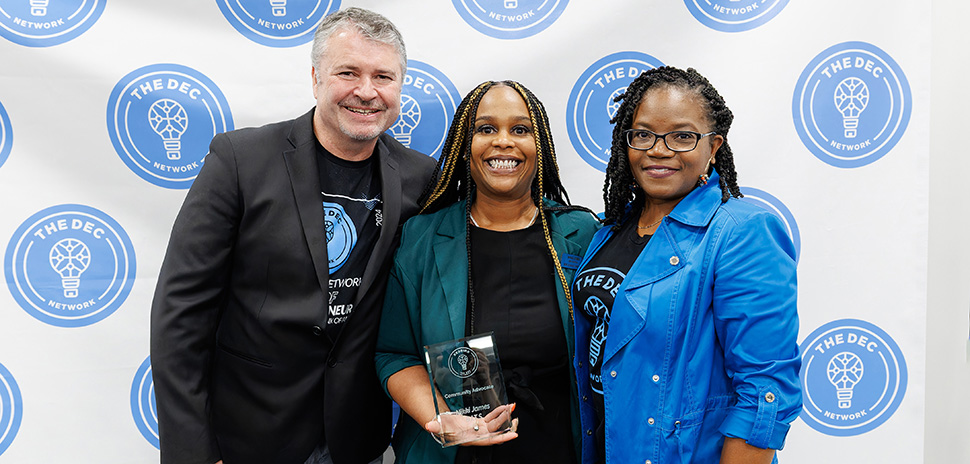
At the RedBird opening, the range of recognized businesses made that audience visible. Honorees included Nikki James of B.I.T.S., Yolanda Cotton of Abundant Healthcare Training Academy and Dominque Hamilton of the Black Girl Magic Museum. These are useful correctives to the idea that every startup conversation must end with an app.
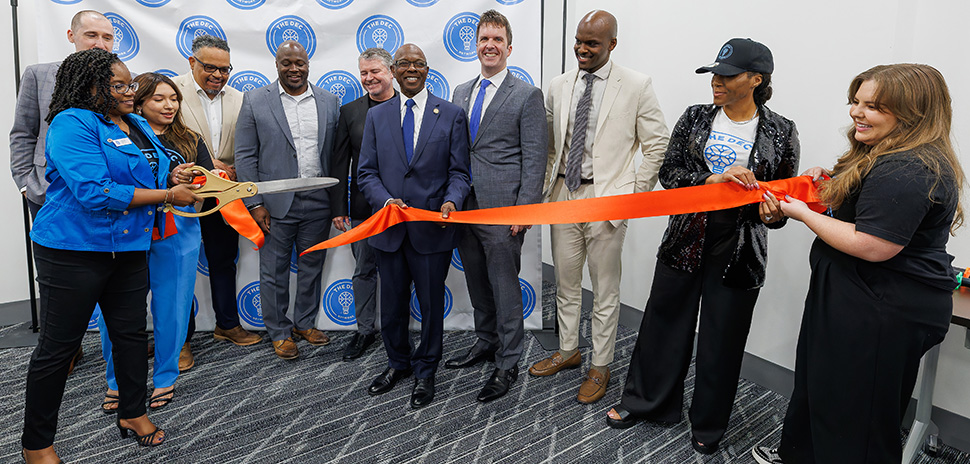
The facility includes more than 20,000 square feet, 120 coworking or hot desks, 48 dedicated desks, 19 dedicated offices and office suites. Two podcast rooms add somewhere to produce content. Page Southerland Page designed the center; K2 handled construction. Several supporters donated furnishings. The hardware of economic development can look surprisingly like a chair.
“Many of our entrepreneurs work a full-time job, but need a space to come to launch a business.”Tarsha Hearns · RedBird opening, April 2024
The downtown idea that outgrew downtown
The DEC began in 2013, with Trey Bowles, Jennifer Conley and Jeremy Vickers among its founders. Bowles had seen entrepreneurship centers in other cities and wanted a place that could connect North Texas founders with one another and with useful resources. Early demand was brisk: he later recalled filling the original 10,000-square-foot location in less than three months.
The next discovery concerned distance. Some entrepreneurs would not, or could not, travel downtown for help. In late 2014, DEC expanded through Addison TreeHouse, working with the town’s economic development department. By 2018, Bowles was describing a region with dozens of coworking options and a DEC increasingly focused on programs, mentorship and community. A partnership with Capital Factory accompanied a move to the Centrum.
This was a change in emphasis driven by a changed market. Office space had become easier to find. Access to the right people still required work. The history also contains a closed San Antonio franchise, which Bowles acknowledged in his 2018 account. Expansion produced a network with revisions along the way, rather than a tidy chain of permanent locations.
You can join before you rent a desk
For someone considering DEC today, the least complicated entry is its free community membership. The published benefits include connections with other entrepreneurs, news of programs and events, and selected early-access opportunities. Paid workspace and room reservations sit alongside that offering. A membership in the community does not mean every room or service is included.
The distinction matters because a founder may need advice long before needing office rent. DEC’s mentoring program draws on volunteers with business experience. Its recruitment materials seek entrepreneurs, subject specialists and business leaders, and describe matching help to a company’s industry and stage. That is a more useful starting point than asking a stranger to be generally inspiring.
The educational menu also has recognizable audiences. WEDallas offers women business owners workshops, coaching and community, with Capital One sponsorship. DFW Startup Week, which began in 2015, gathers entrepreneurs for a concentrated run of programming; Capital One also sponsored its 2026 edition. Smaller workshops and member gatherings keep the calendar moving between the headline events.
Join the community
Find events and meet other owners.
Bring a specific problem
Seek a relevant mentor or workshop.
Choose the next commitment
Consider a cohort, workspace or capital connection.
A reader can copy the sequence without treating it as a magic formula: enter cheaply, bring a defined question, then decide whether a deeper commitment is useful. A pricing problem calls for different experience than a hiring problem. The value of the network depends partly on how clearly a founder can explain what needs to happen next.
The tutoring company belongs in the picture
Nikki James provides a concrete example of the kind of founder DEC serves. In May 2023, the Fort Worth Report described how the RedBird center had helped her grow Building Intellect Tutorial Services. The business, started in 2020, then had about 270 employees and worked with the Dallas and DeSoto school districts, according to the report.
That is a dated snapshot of one company, not a promise to the next member. It does, however, show why local business support needs room for education services and public-sector customers. A growing tutoring operation faces business questions with consequences for employees and schools. Its needs belong alongside those of a software founder seeking an investor.
DEC’s own 2022 report offers another view of the work: 115 mentors, 169 mentees and more than 1,470 connections. It also lists 87 events, of which 71 were free. These counts describe activity. They should be read alongside individual business experiences, rather than converted into a claim that every conversation caused a sale or created a job.
When getting together became the problem
The pandemic struck at the organization’s basic method: bring people together and make help easier to find. A Brushfire customer case study says DEC moved into virtual events but struggled to reproduce the success of its in-person gatherings. It then wanted an event-management system flexible enough for virtual, physical and hybrid formats. The account comes from a vendor, but the operational problem is plain.
Mentoring demanded its own adjustment. In 2020, DEC launched free Fast Start Mentoring, pairing business owners with experienced advisers remotely. Mentors supplied scheduling links, and staff helped participants use video conferencing. The organization reported more than 100 mentor or mentee sign-ups in the first three days. The immediate need for advice made waiting for ideal conditions a poor option.
There is a modest, repeatable lesson here for any organization built around meetings. Make the appointment easy to arrange. Help people use the tools. Preserve the conversation when the room becomes unavailable. Remote mentoring cannot manufacture trust on command, but a scheduled call gives two people a chance to begin.
Free help has a balance sheet
DEC’s economics explain how it can serve people who are still figuring out their business. Its 2024 tax filing reports revenue of $3,179,879 and expenses of $3,177,792, leaving $2,087 in net income. Contributions supplied $2,370,867, roughly three-quarters of revenue. Program services supplied $806,722. The operation finished that year close to break-even.
Total annual revenue
74.6% Contributions
25.4% Program services
Rounded shares. Other revenue: $2,290. These are DEC’s operating finances, separate from money raised by participating businesses.
That mix makes the sponsor logos easier to understand. Donations, grants and corporate support help pay for activities that founders can access without a ticket or consulting bill. Workspace and other paid services contribute to the operation. Volunteer mentors add experience without turning every conversation into an invoice.
The $2.4 million RedBird project is a separate measure from annual operating revenue. So is money raised by entrepreneurs. Keeping those categories apart matters: a nonprofit’s budget, the cost of its building project and investment secured by businesses describe different things. Combining them would make an impressive number and a misleading story.
An introduction is only the beginning
DEC occupies the space between commercial coworking, business education and local economic development. A founder comparing options might also consider a Small Business Development Center, SCORE mentoring, university programs or a specialist accelerator. DEC’s particular combination is broad business support tied to local places, with partnerships extending the expertise available beyond its own staff.
Capital access illustrates both the opportunity and the limit. In fall 2022, DEC partnered with Economic Impact Catalyst on research into barriers facing Black and Latinx entrepreneurs in Dallas County, with JPMorgan Chase support. A June 2023 white paper set out findings and proposed remedies, including an Entrepreneur of Color Fund. A proposal is distinct from money already delivered.
DEC also works with the North Texas Angel Network. Such relationships can make an unfamiliar financing world easier to approach. They do not make every business suitable for angel investment, or oblige a lender to approve an application. Founders still need customers, usable financial records and a financing route suited to their business.
The next test has 60 seats
The geography question followed DEC west. Create FW opened in August 2023. Reporting ahead of its launch raised the concern that a Near Southside location might still miss people without transportation or a reason to visit that neighborhood. A central meeting place only serves people who can reach it; partnerships and programs outside the building remain important.
As of September 2026, DEC is advertising another step: the Community Entrepreneurship Collaborative, developed with SMU Cox School of Business. The announced 11-month cohort begins in January 2027, with 60 entrepreneurs selected and a November 1 application deadline. Its stated aim connects business education with documentation, mentoring and lender relationships.
The proposed sequence makes sense: help people prepare, then help them approach capital. Its results lie ahead. For now, RedBird makes the organization’s argument tangible. Put qualified help somewhere founders can use it. Keep an affordable way in. Give people reasons to return after the opening-day ribbon has been packed away.
Step inside the network
Explore The DEC Network, membership benefits, upcoming events and the DEC blog. Watch A Decade of Entrepreneurship on YouTube.
Follow on LinkedIn, X, Instagram and Facebook. Read the RedBird opening coverage and the Fort Worth expansion story.