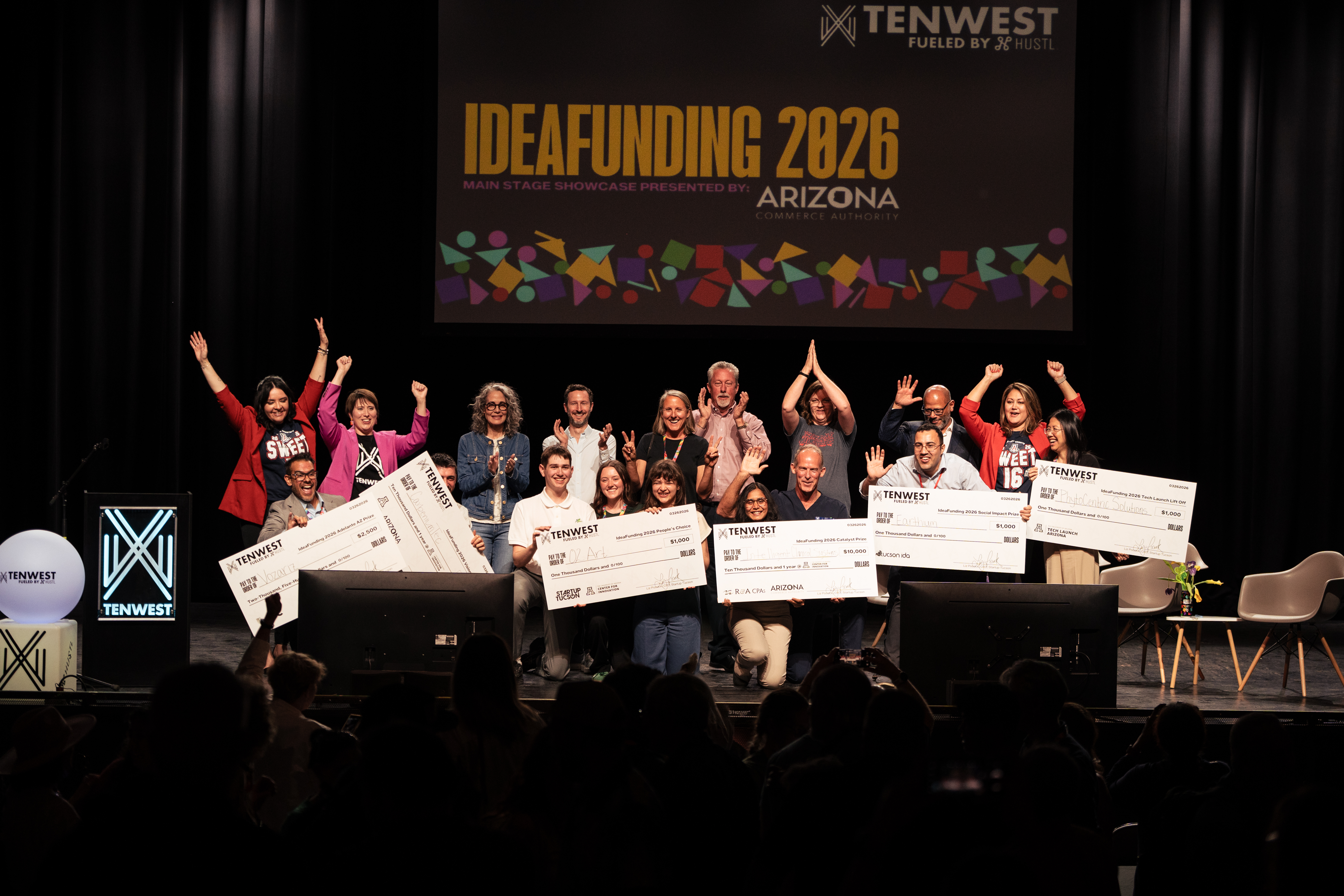
On March 26, 2026, the finalists at Tucson's Rialto Theatre included HUHU's House of Dumplings and Intelligent Clinical Systems. One made dumplings. The other described technology that helps clinical staff locate medical supplies. There were also ventures working on telecom infrastructure, pharmaceuticals, agricultural products and algae-powered decor. A pitch competition can tell you a great deal about a city's ambitions simply by revealing who gets the microphone.
This was IdeaFunding, co-led by Startup Tucson and the University of Arizona Center for Innovation. Nineteen companies had competed in daytime track finals; six reached the evening showcase. The event awarded more than $50,000 in prizes. Its two flagship $10,000 awards went to Intelligent Clinical Systems and Carbeniumtec. Yet the revealing detail was the company of dumplings. Here, entrepreneurship has room for someone whose invention arrives on a plate.
- Food, makers, services and tech all belong here.
- Start free; BUILD costs $99; GROW begins at $150.
- Meetups provide introductions; programs ask for action.
The invitation comes before the pitch
Startup Tucson is a nonprofit that helps Southern Arizona entrepreneurs evaluate ideas, improve businesses and meet people who can help. It occupies the space between having an ambition and knowing what to do on Monday morning. Its direct programs welcome innovative ventures with an intention to grow, including food businesses, makers, services and software. Innovation can mean serving a customer differently; a patent is optional.
The entry point can be wonderfully unceremonious. Startup SIPS is a monthly coffee meetup at local cafes, open to entrepreneurs, creatives, remote workers and curious neighbors. OneAZ Credit Union's sponsorship for 2026-2027 includes complimentary drip coffee. CEO Liz Pocock puts the problem plainly: “Entrepreneurship can be lonely, especially in the early stages.”
Consider the practical implication. A person who would hesitate to enter an accelerator application can turn up for coffee. Enrollment is unnecessary for community events. That lowers the social cost of asking a naive question, perhaps the most expensive question to leave unasked. The promise is a place to begin a conversation, with more structured help available when there is a business to discuss.
A business idea gets three different doors
The first door, Startup 101, is free. Its self-guided playbook introduces the Lean Startup framework and a first Lean Canvas. Participants examine the customer, the problem, competition, money and evidence. Someone can start without a registered business or a finished plan. The useful output is a clearer next step, which might be further exploration rather than buying another program.
BUILD costs $99 and offers eight lessons, worksheets and monthly virtual group check-ins. Most participants take three to six months; toolkit access lasts twelve. The work culminates in a one-page Business Snapshot. Customer conversations and experiments make the curriculum more demanding than its modest price suggests.
GROW addresses founders already taking action. The invitation-based annual membership costs $150 initially and $100 on renewal. It combines goal setting, quarterly check-ins, mentor connections, workshops and peer relationships. BUILD is not a prerequisite, and finishing it does not purchase admission. The distinction is useful: learning business fundamentals and getting help with an operating venture are different jobs. A founder seeking continuous individual consulting is directed toward other resources.
The city supplies the missing introductions
The organization began in 2012, after Tucson's first Startup Weekend, as a volunteer effort. The University of Arizona identified engineering alumnus Justin Williams as its founder in its reporting that year. Over time, the project acquired the machinery of a regional connector: education, mentors, events and relationships with public agencies and university organizations.
TENWEST, launched in 2015, gives those relationships a larger meeting place. In September 2026, Startup Tucson announced a three-year Vantage West title sponsorship through 2029. Its account of the 2026 festival reported more than 1,200 attendees, including over 900 conference participants. More than a quarter came from outside the region. The next festival is scheduled for March 30-April 2, 2027, with Taskrabbit founder Leah Solivan as keynote speaker.
A conventional accelerator tends to assemble a selected cohort around a defined growth path. Startup Tucson also maintains places where people meet before such selection. University incubation, investment networks and business advisers remain parts of the surrounding market. Its distinctive contribution is to connect those resources to a wider assortment of founders, and to give that assortment a public stage.

What the cheap ticket actually costs
A $99 program does not explain how the organization pays its bills. The nonprofit's 2025 tax filing reports $833,964 in revenue and $832,187 in expenses. Contributions supplied $717,336, or about 86% of revenue; program services supplied $110,163. Fees are one piece of a model supported heavily by outside contributions.
Public grants also reveal the work behind the events. In 2021, the Economic Development Administration awarded $316,346 to TechExcel, with a $105,000 local match. The proposed work combined e-commerce and productization training, a digital mentor network, and a physical media and product design lab. A separate D.R.I.V.E. Tucson award provided $297,990 federally, alongside a $298,299 local match, to develop the investor pipeline.
The pandemic exposed a practical obstacle: businesses needed ways to sell and present products in changing markets. TechExcel answered that obstacle with specific skills and equipment. The organization's history also records a move to virtual support. The lesson a reader can borrow is concrete: find the missing capability, then build assistance around it. A networking calendar alone would have left the digital selling problem untouched.
Count the businesses, then ask what the count means
Startup Tucson's 2025-2026 impact report lists $34 million in founder revenue, $9.9 million secured in funding and 110 new jobs, based on self-reported founder data. Those figures describe participating businesses. They do not establish how much activity the nonprofit caused. Keeping that distinction visible makes the numbers more useful, not less interesting.
The earlier 2024-2025 report shows how varied its constituency was: professional services accounted for 27%, software and technology 19%, food 17%, retail and e-commerce 16%, creative ventures 13% and nonprofits 8%. An entrepreneurial economy looks rather different when the entire room is counted.
For an aspiring founder, the sequence is easy to borrow: investigate a real customer's problem, test an offer, put the economics on one page, then seek advice on a specific obstacle. The conditions matter. Self-paced learning requires time and independent effort. Peer support requires participation. Pitch prizes require eligibility and performance; they are not a dependable operating budget. Startup Tucson's appeal is the chance to get those early decisions into the open, among people who might know something you do not. Even if what you are building is dinner.
“Entrepreneurship can be lonely, especially in the early stages.”Liz Pocock · CEO, Startup Tucson