A lobster sweater is a perfectly respectable place to start a business. In 2025, Erin student Elise Woodworth turned a homemade design for a Nova Scotia visit into FrancEl Studio, a venture reworking second-hand clothing. She was among the young owners getting practical help through Business Centre Guelph-Wellington. The leap from making something to selling it came with the less photogenic tasks: planning, marketing and keeping records.
That is the territory this Ontario nonprofit occupies. Its customers include people considering self-employment, students trying a first venture and established owners wrestling with their next decision. The centre supplies education, individual advice and connections. Its value proposition is refreshingly legible: you can bring an unfinished idea or an awkward business question and find someone equipped to discuss it.
Since 1999, the centre has worked in Guelph and Wellington County, where business support has to accommodate very different ambitions. A summer sideline and an employer preparing for expansion do not need the same intervention. The centre’s program menu reflects that difference, with separate routes for students, operating businesses, food producers and owners approaching an exit.
A small cheque, a substantial commitment
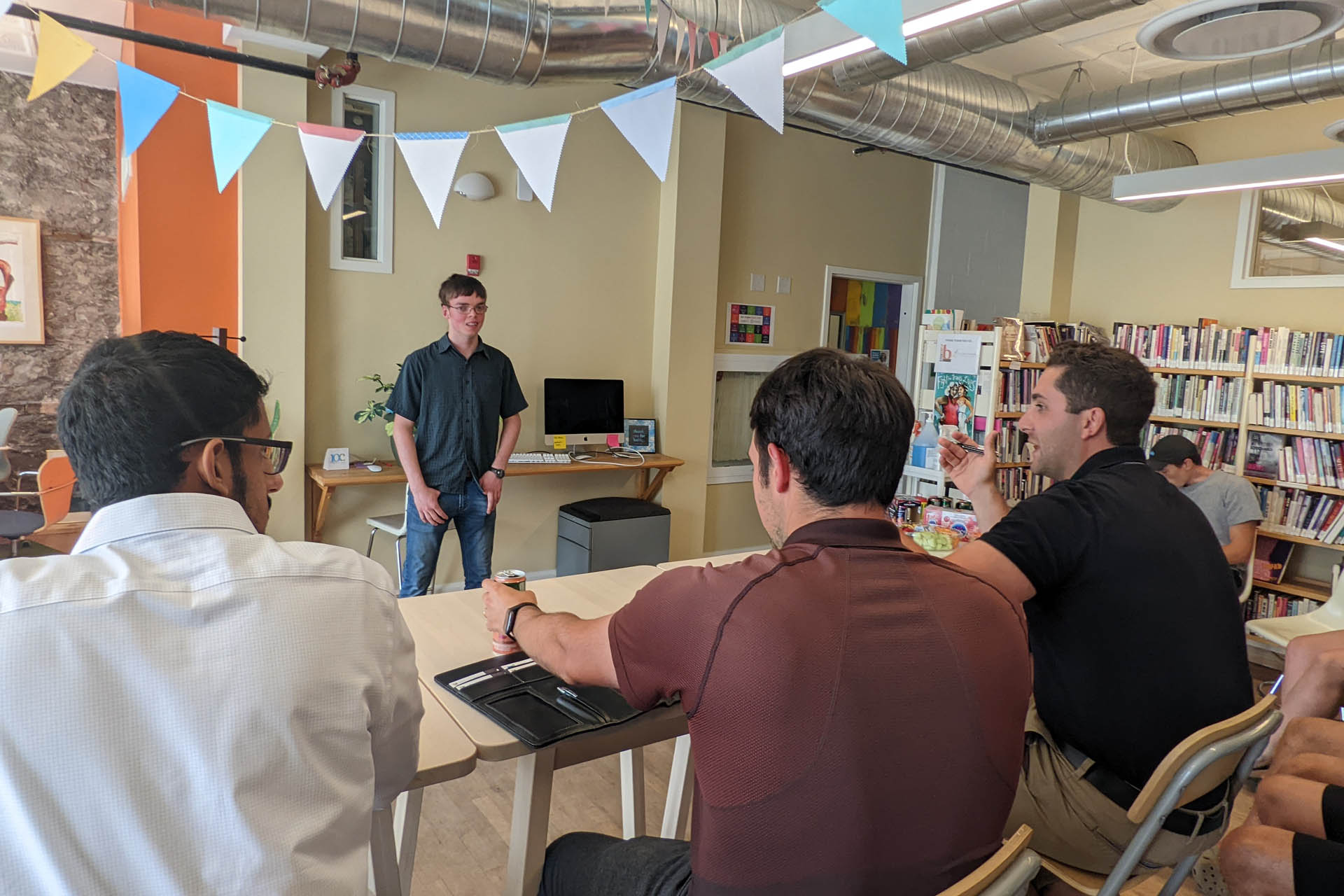
Summer Company gives eligible students aged 15 to 29 a supervised chance to run a business. Ontario’s award can reach C$3,000, split between startup assistance and a payment after successful completion. The hours matter: the published minimum is 280 for high-school students and 420 for postsecondary students. Applicants must be returning to school. This is a working summer with a learning component.
The 2025 cohort included a maker of wooden cutting boards and rings, alongside Woodworth’s apparel venture. A modest award has an intelligible use at that scale: tools, materials and the means to begin selling. It also makes the program’s educational argument visible. A participant gets to connect what they make with what someone will buy, then manage the responsibilities that follow.
Two stages. A business to run in between.
The pandemic changed the address
The centre’s own operating model changed under pressure. In September 2021, it announced a move into Guelph City Hall’s economic development offices, effective October 1. Its explanation connected two developments: a surge in demand during the pandemic and a shift to virtual services that had made it easier to reach entrepreneurs.
The announcement framed the move as a way to align business advice more closely with municipal economic development. That is a concrete answer to what changed the organization’s direction. The demands of delivering support during the pandemic prompted it to reconsider where and how it operated. Physical proximity to a partner became useful even as client services moved online.
The distinction still matters to anyone planning a visit. Today’s contact instructions specify virtual or telephone appointments and identify the City Hall address as mail only. Scheduled programs can include in-person sessions, but an owner seeking advice should start with the online intake. A street address, in this case, is not an invitation to turn up with a folder.
Existing businesses needed a turn
In 2022, a C$126,000 Ontario Trillium Foundation grant helped finance Momentum, a mentoring initiative for businesses and nonprofits responding to COVID-19. Executive director Kristel Manes described an effort to reach more of the existing business community. The initial application round attracted more than 75 applications.
“The uptake was immediate.”
Kristel Manes, on Momentum’s early response, 2022
Some applicants needed help handling growth. Others needed to work through an operational problem. The common ingredient was a structured conversation leading to a project plan. At the time, the grant was a one-year commitment and Manes was pursuing further funding. That detail explains a central tension in publicly supported advice: demand can arrive quickly, while the money that pays for capacity has a timetable.
Program partner Pollinate describes a multi-cohort effort using tailored mentor matching, trained volunteers and a shared platform for learning materials and planning tools. Its case study reports support for 126 organizations. That figure describes reach within the collaboration; it is not a tally of businesses proven to have survived because of mentoring. The useful design lesson is the combination of a match, a plan and somewhere to keep working between conversations.
The current Momentum offer is narrower and specific: up to three hours of free advisory services, with limited access. It targets eligible operating businesses and nonprofits in Guelph-Wellington. The owner has to supply time and effort to implement the agreed work. Free advice still has an opportunity cost, particularly for the person who is also doing the selling, scheduling and invoicing.

Follow the problem before the grant
Starter Company+ makes the exchange especially explicit. The local program combines group learning and individual advice with the possibility of a grant of up to C$5,000. Selection and funding are competitive. For the autumn 2026 intake, the published application deadline is September 25 at 4 p.m., with eight group classes scheduled from October 21 through December 9.
The appealing number is the grant. The more useful question is what it would change. An owner who can identify a particular constraint has something to work on with an advisor. An owner arriving only with a desire for funding still has to decide what the money should accomplish. The program’s emphasis on an implementation plan puts that decision ahead of the award.
A previous digital-adoption initiative shows how this can work in practice. In June 2023, the centre reported more than 200 Digital Transformation Grants, together worth over C$500,000. Its Digital Service Squad helped local shops assess their digital needs, develop plans and apply for C$2,500 awards. Support included work on Google Business Profiles and social media presence.
Those were grants for participating businesses, rather than investment capital raised by the centre. The distinction matters when judging its business model. Public funding and local partnerships support program delivery; the intended return is stronger local enterprise. The centre’s role is to help an owner use a resource, which can involve considerable work before an application is ready.
A food producer, a shopkeeper, an owner ready to leave
Some problems require a more specialized room. Foodpreneur Advantage connects the centre to a regional collaboration of Small Business Enterprise Centres, supported by Libro Credit Union and FedDev Ontario. Its offering spans introductory food-business workshops and more comprehensive programming for scalable packaged food and beverage ventures. A producer preparing a consumer product can be directed toward training suited to that job.
Downtown Guelph presents a different problem altogether. The centre and Invest in Guelph offer complimentary, confidential advice to eligible downtown businesses affected by infrastructure revitalization. The program names reduced customer traffic, disrupted operations and delivery complications as challenges. Its advisory subjects include cash flow, debt, marketing and vendor relationships. The specificity is welcome: construction outside a shop creates questions a general motivational workshop would struggle to answer.
Then there is the owner who wants to sell. The centre’s exit-planning support covers preparation, valuation resources, professional connections and the emotional difficulty of letting go. Its materials identify dependence on the owner, disorganized records and unrealistic valuation expectations as obstacles. Bringing those questions into earlier advisory conversations treats continuity as part of running the business, rather than a task to postpone until a buyer appears.
Make a product
Foodpreneur Advantage
Manage disruption
Downtown advisory support
Prepare to leave
Exit and succession support
Know which door to open
The centre’s place in the market becomes clearer beside its neighbours. Its own local resource directory points to Boundless Accelerator for innovative enterprises, the Guelph Chamber for advocacy and connections, and 10C for shared space, collaboration and social enterprise. Those roles overlap at the edges. Referring an owner elsewhere can be a useful result of an advisory meeting.
The expertise is equally concrete. The current roster includes youth and newcomer support, food and agriculture, sales development, digital strategy and operational improvement. That range gives an intake conversation a purpose: finding the person or program suited to the question. It also offers an owner a way to prepare. “I need help” can become a discussion about customers, capacity or a financial forecast.
For a beginner, the county’s 2026 listings show a free two-hour Business 101 introduction and a five-week evening Stepping Into Business series. The sequence provides room to move from an overview to a more developed business case. Someone uncertain about entrepreneurship can begin there before committing to a program intended for an operating company.
The approach is most useful when the owner has a decision to make and time to act on advice. Geography, eligibility and limited places constrain access; grant-dependent plans also have to survive the possibility of no award. The part a reader can copy is less complicated: choose one business question, collect the information needed to discuss it, and give the next meeting something concrete to review.
Put a question on the calendar
Book an advisory conversation ↗ · Explore the programs ↗ · Browse workshops ↗
Website · LinkedIn · Instagram · Facebook · Twitter/X · News archive