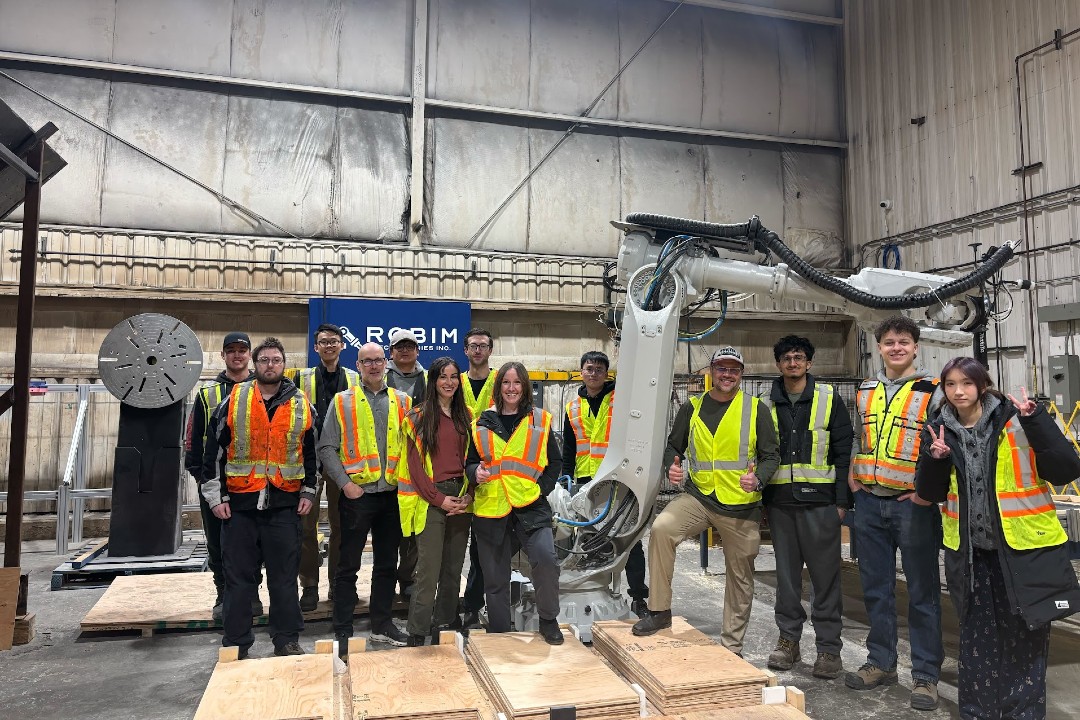
A robotic arm is an unusually persuasive answer to the question of what an innovation agency actually does. In Edmonton, RoBIM Technologies is working with modular-home builder Honomobo to make building components. Edmonton Unlimited helped put that pilot on the agenda. The prospect is pleasingly concrete: a young technology company gets a customer, and a homebuilder gets to test a different way of making things.
The project, reported by Taproot Edmonton in March 2026, belongs to the agency’s Built World venture pilots. RoBIM’s system combines a robotic arm with software and interchangeable tools. The Honomobo work gives it a chance to develop capabilities that could serve other buyers. A demonstration becomes more useful when somebody has a reason to order the output.
That is a revealing introduction to Edmonton Unlimited. The nonprofit municipal innovation agency offers workshops, specialist advice, introductions and gathering space. Its customers, in the everyday sense, are founders trying to turn an idea into a business. Its public backers want something broader: companies that grow, employ people and contribute to Edmonton’s economy. Keeping those two audiences satisfied is the job.
A customer before a victory lap
The pilot model tackles an awkward commercial gap. A startup needs proof that its technology works in a customer’s environment. A customer wants that proof before committing. Edmonton Unlimited’s December 2025 program outline puts funding and potential advisory support between those two positions, with an initial goal of launching 10 pilots during 2026.
The rules make the intended bargain clear. Technology must be ready for use in the customer environment in 2026. Either the startup or customer must be based in Northern Alberta, defined as Red Deer and points north. Matching contributions receive preference, although there is no fixed matching requirement. Founders must commit to converting pilots into sales and reporting progress.
The agency’s published pilot roster now ranges from industrial robotics to energy storage and materials. CityScan is testing infrastructure-assessment software with Tetra Tech. Other projects address flooring installation records and ultrasonic pipeline monitoring. These are opportunities to establish usefulness under working conditions. Their presence on a program page does not establish that the technology has already won a wider market.
problem
a customer
next sale
A pilot supplies evidence. The next order still has to be earned.
The free advice has a public bill
Edmonton Unlimited advertises its programs at no cost to participants. That removes a familiar obstacle for a founder who needs business help before there is much business to pay for it. The organization’s model draws on municipal support, government grants and partnerships. The payer and the person sitting in the workshop are often different people.
The municipal 2024 outcome reporting document records C$5.233 million in City funding to Edmonton Unlimited. An earlier annual report described C$5 million in 2022 core funding plus C$8.07 million raised for projects spanning 2022 through 2025. The latter is a multiyear funding package, so treating the combined figure as one year’s revenue would muddle the accounts.
City funding to Edmonton Unlimited
Annual municipal support. Separate from investment in participating startups.The distinction matters when reading the more exciting numbers. The agency’s homepage reports C$69 million invested by funders in 53 companies it has served since 2022. That is financing for those companies. It is neither Edmonton Unlimited’s own fundraising round nor proof that its programs caused every dollar to arrive. A useful assessment asks what support founders used and what happened afterward.
A front door, with several ways through
For someone with a first idea, the entry point is deliberately modest. Business Model 101 uses the Lean Canvas to map the idea. Discover & Validate turns attention toward prospective customers. These exercises ask a founder to expose assumptions before a long build makes them expensive to change. The deliverable can be a better question, rather than another feature.
A company with a working product has different needs. Experts on Demand organizes focused advisory work around a specific business problem. Its current description emphasizes ventures beyond the idea stage, with traction and a team able to act on advice. Projects have a defined scope and milestones, and the founder approves the scope before work begins.
“Experts Advise. Founders Execute.”
Edmonton Unlimited’s Experts on Demand program
That division of labour is worth taking seriously. A founder looking for someone else to run the company will be disappointed. The practical preparation is to arrive with a bottleneck: an unclear market position, an investment-readiness problem or a product decision. Specialist time becomes more valuable when the team can describe the decision it needs to make.
The broader growth offering includes finance and fundraising workshops, post-secondary business development support and accelerator connections. Platform Calgary helped develop Alberta Catalyzer; 500 Global and Plug and Play appear among the accelerator partners. University entrepreneurship centres, private advisers and other hubs provide overlapping help. The market is full of collaborations, making a simple competitor league table misleading.
There are tangible examples beyond construction. Team CarePal, a caregiving venture, completed startup programs in 2022 and used expert connections in 2023 while preparing for market. The agency’s account describes pilots with long-term-care facilities in Alberta and Saskatchewan at the start of 2024. Founder support here means filling business gaps around a product, rather than claiming ownership of the product’s success.
The room where the pitches happen
The address is part of the service. Edmonton Unlimited opened its Jasper Avenue home in May 2023, bringing operations, founders, programs and partners into a downtown space of more than 18,000 square feet. Its current facilities offering includes hot desks, meeting rooms, phone rooms, a community café and a retractable event space called the Pitch Deck. Someone enjoyed naming that one.
The room has a purpose beyond providing a desk with better company. A first-time founder can encounter a more experienced operator; a researcher can find someone who speaks customer; a pitch can attract a question that exposes a weakness. Those are possible benefits of proximity, not automatic consequences of an attractive fit-out. People still need a reason to return.

In its report published in 2026, the organization counted 2,636 program participants, including 1,173 first-time participants. Its public dashboard also tracks events, visitors and coffee. These measures describe use of the institution. They are useful for judging whether people show up, but company survival and repeat sales require a different set of questions.
Reported activity in the latest community reporting. Coffee is a conversation starter, not an economic return.
A reset after the startup phase
The institution has had its own revisions. City Council supported its creation in May 2020; incorporation followed in October. Catherine Warren became founding CEO that December. Startup Edmonton joined the new organization in 2021, and Innovate Edmonton took the Edmonton Unlimited name in September 2022. The often-repeated 2009 founding date belongs to the predecessor’s story.
In January 2024, the board parted ways with Warren. Chair Lindsay Dodd said it wanted different leadership skills for the next stage, while explicitly saying she had done nothing wrong. He credited her with assembling the organization and establishing its headquarters. This was a change in leadership; presenting it as evidence of misconduct would distort the public account.
Tom Viinikka took over in May 2024, bringing experience as an entrepreneur, investor and chief executive of the Edmonton Screen Industries Office. The 2024 community report identifies a clearer influence on the organization’s direction: calls from the community for a stronger entrepreneurial focus. Its response included leadership change, engagement and a new three-year strategy.
The next experiment starts with industry
That focus is visible in the latest work. In May 2026, Edmonton Unlimited and the Construction Innovation Centre announced a partnership to support technology adoption and pilot opportunities. The commercial question runs both ways: what can founders supply, and which problems are established businesses prepared to help solve?
The autumn Built World Challenge extends the approach to people who may not yet have companies. Its eight-week format draws problems from industry, brings participants into teams and leads toward a planned November Demo Day. Applications were scheduled to close at noon on September 9. Selected teams may progress toward pilot funding; participation itself is no promise of an award.
Borrow the sequence, then do the work
A founder can copy the order of operations without copying the institution: identify the customer problem, test the assumptions, ask for expertise on a specific obstacle, then build evidence with a willing buyer. Someone still exploring entrepreneurship should start with discovery. A venture ready to deploy technology can bring a much more concrete conversation to a pilot program.
The conditions are demanding. Advice needs a team with time to act. A pilot needs a customer willing to participate and technology ready for the setting. Public support also comes with eligibility rules and reporting. Edmonton Unlimited can help arrange those encounters. The founder’s remaining task is wonderfully unforgiving: make something useful enough that the customer wants more.
Step inside the conversation
Explore Edmonton Unlimited, its programs, news and founder stories, and event calendar.
▶